The cloaking engine behind every scam you've never seen. PhishDestroy scanned 50,000+ sites, discovered 1,565 Keitaro TDS admin panels, and found zero legitimate deployments. Every single panel was connected to crypto fraud, phishing, malware distribution, or worse. Clients include EvilCorp, LockBit ransomware, and VexTrio. Open-source detection toolkit, 7-point methodology, and full panel CSV now released.
1,565 Panels Found100% Malicious Rate7 Detection Methods4 Tools Released
0
Admin Panels Found
50,000+
Sites Scanned
0%
Legitimate Uses
7
Detection Methods
What Is Keitaro TDS?
Keitaro TDS is a commercial Traffic Distribution System sold by Apliteni OU, a company incorporated in Estonia. On the surface, it markets itself as a traffic management tool for affiliate marketers. In practice, it is the single most widely deployed cloaking engine in the global scam ecosystem.
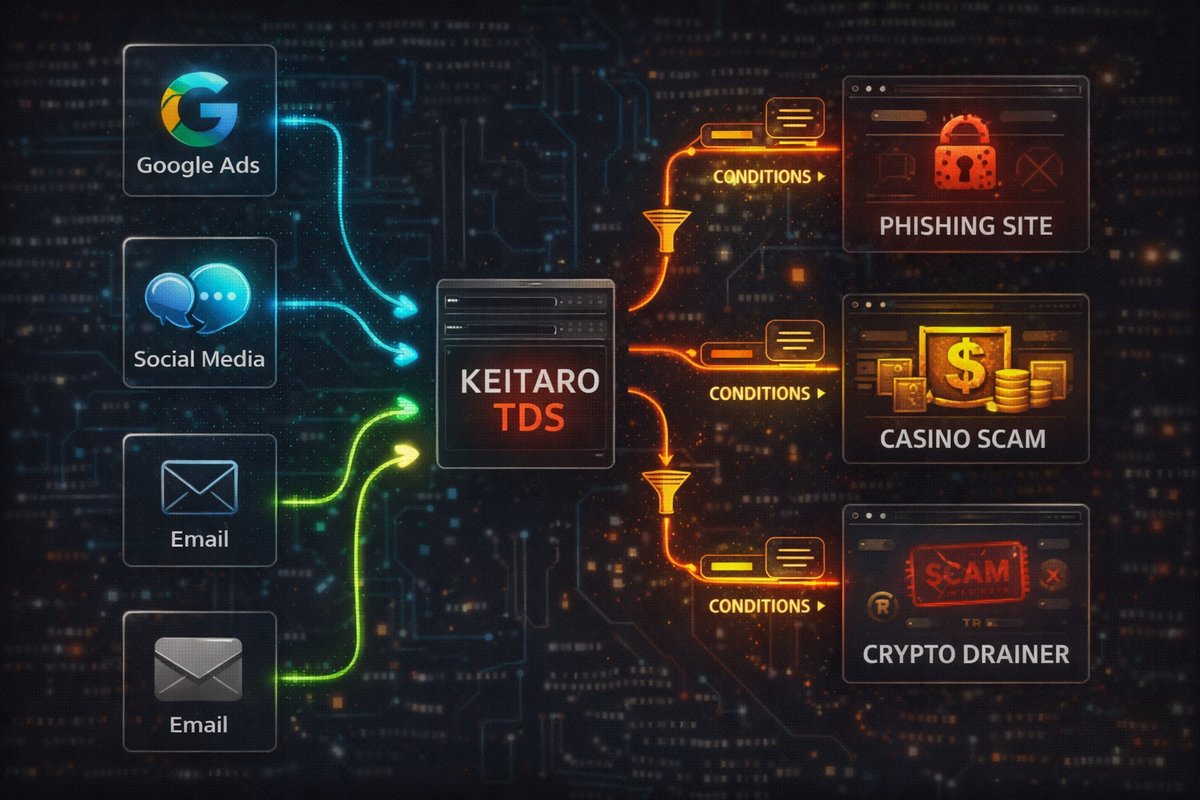
Cloaking is the art of showing different content to different visitors. When a security researcher, ad reviewer, or law enforcement officer visits a URL, Keitaro identifies them and serves a clean, innocent page. When a real victim visits the same URL, they get redirected to crypto scams, phishing pages, malware downloads, or fraudulent e-commerce sites. The victim never sees the clean version. The analyst never sees the scam.
Keitaro's pricing ranges from €40 to €400 per month, positioning it as enterprise-grade fraud infrastructure. It stores visitor data for up to 9.75 years, giving operators a massive dataset of victim fingerprints, geographic data, and behavioral profiles. All of this data is stored on AWS infrastructure, meaning Amazon is unknowingly hosting the backend for thousands of scam operations.
Corporate Shell
Apliteni OU operates from Estonia, leveraging the country's e-Residency program and favorable corporate privacy laws. The company maintains a veneer of legitimacy through professional marketing, documentation, and customer support — while every measurable deployment of their product is connected to criminal activity. They charge €40–400/month for what is effectively a scam-as-a-service platform with nearly a decade of data retention.
The Numbers: 1,565 Panels, Zero Legitimate
PhishDestroy's investigation began with a simple hypothesis: if Keitaro TDS has legitimate uses, we should find them at scale. We scanned 50,000+ sites using a combination of automated tools and manual verification, specifically looking for Keitaro TDS fingerprints. What we found was unambiguous.
1,565 active Keitaro admin panels were discovered. We analyzed every single one. The result: zero legitimate deployments. Not one panel was being used for lawful affiliate marketing, A/B testing, or any other benign purpose. Every panel — 100% — was connected to criminal activity.
1,565
Active Panels
100%
Malicious Rate
50K+
Sites Scanned
9.75yr
Max Data Retention
Abuse Categories Breakdown
The 1,565 panels were distributed across six primary abuse categories. Many panels served multiple categories simultaneously, using Keitaro's traffic routing to direct victims to different scam types based on geography, device, or time of day.
Every panel was verified through at least two independent detection methods before being classified. False positives were manually reviewed and excluded. The 1,565 count represents only confirmed, active Keitaro installations — the true number of deployments, including those behind additional layers of protection, is certainly higher.
Criminal Client Roll Call
Keitaro TDS isn't just used by small-time scammers. It is the cloaking infrastructure of choice for some of the most dangerous cybercriminal organizations on the planet. Here are the documented clients:
EvilCorp
The sanctioned Russian cybercrime syndicate uses Keitaro to bust through international sanctions. By cloaking their operations behind Keitaro's traffic distribution, EvilCorp evades the very security controls designed to shut them down. Every click routed through Keitaro is a sanctions violation enabled by Apliteni OU's software.
LockBit Ransomware
The LockBit ransomware group leveraged Keitaro for malware distribution, using its cloaking capabilities to ensure that only genuine targets received ransomware payloads while security sandboxes and researchers saw benign content. Keitaro was a force multiplier for one of the most destructive ransomware operations in history.
VexTrio
The largest known Keitaro client. VexTrio operates with 60+ affiliates and controls 86,832+ domains, all funneling traffic through Keitaro's distribution engine. This single operation represents a massive portion of the internet's malicious ad traffic, and Keitaro is the backbone that keeps it invisible.
ClearFake
ClearFake injects fake browser update prompts into compromised websites, delivering malware when victims click "Update." Keitaro's cloaking ensures that only real visitors see the malicious overlay — security scanners see the original, clean website. The result: malware delivery with near-zero detection rates.
FakeBat
FakeBat is a malware loader distributed through malicious advertising campaigns. Keitaro routes ad traffic through a decision engine: security tools get redirected to legitimate software download pages, while real users are served trojanized installers. Keitaro makes FakeBat's malvertising campaigns virtually invisible to ad platform safety teams.
Doppelganger
A Russian state-linked disinformation campaign that uses Keitaro to distribute propaganda across Western social media. Keitaro's geographic and device fingerprinting ensures that content moderators and fact-checkers see different content than targeted populations. Information warfare, powered by commercial Estonian software.
"We found Keitaro fingerprints in every major cybercrime operation we investigated in the past 18 months. It's not a coincidence — it's the industry standard for criminals."
— PhishDestroy Research Team
7-Point Detection Methodology
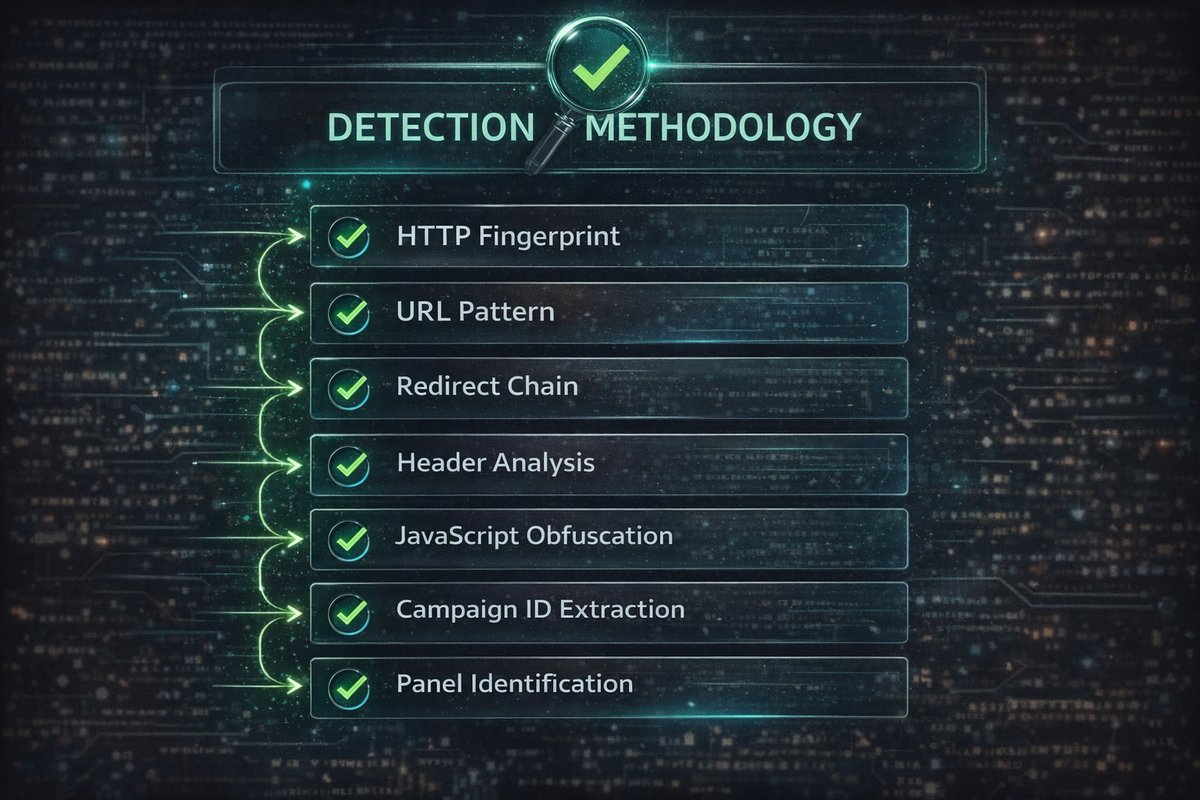
Over the course of this investigation, PhishDestroy developed seven independent methods for identifying Keitaro TDS deployments. Each method targets a different fingerprint that Keitaro leaves behind, and together they form a comprehensive detection framework that is now available as open-source tooling.
1. /click_api/v3 Endpoint
Keitaro's core API endpoint for processing click events. This path is hardcoded into the software and present on every installation. Probing for this endpoint is the single fastest way to confirm a Keitaro deployment. A 200 or 302 response at this path is a near-certain positive identification.
2. _lp / _token / _subid URL Parameters
Keitaro appends distinctive tracking parameters to URLs during redirect chains. The _lp parameter identifies the landing page, _token carries session authentication, and _subid tracks sub-affiliate sources. These parameters are unique to Keitaro and rarely appear in legitimate traffic management systems.
3. Keitaro-Specific Cookies
Keitaro sets distinctive cookies to track visitor sessions and maintain cloaking state. These cookies follow naming conventions that differ from standard analytics platforms, making them identifiable through browser inspection or automated cookie analysis.
4. Response Header Patterns
Keitaro's server responses contain distinctive HTTP header patterns, including specific cache-control directives, custom headers, and server identification strings that differ from standard web servers. These headers persist even when operators attempt to customize their installations.
5. JavaScript Redirect Chains
Keitaro implements multi-stage JavaScript redirects to evaluate visitor fingerprints before deciding whether to show the scam or the clean page. These redirect chains follow predictable patterns — specific variable names, timing sequences, and evaluation logic — that can be detected through static and dynamic JavaScript analysis.
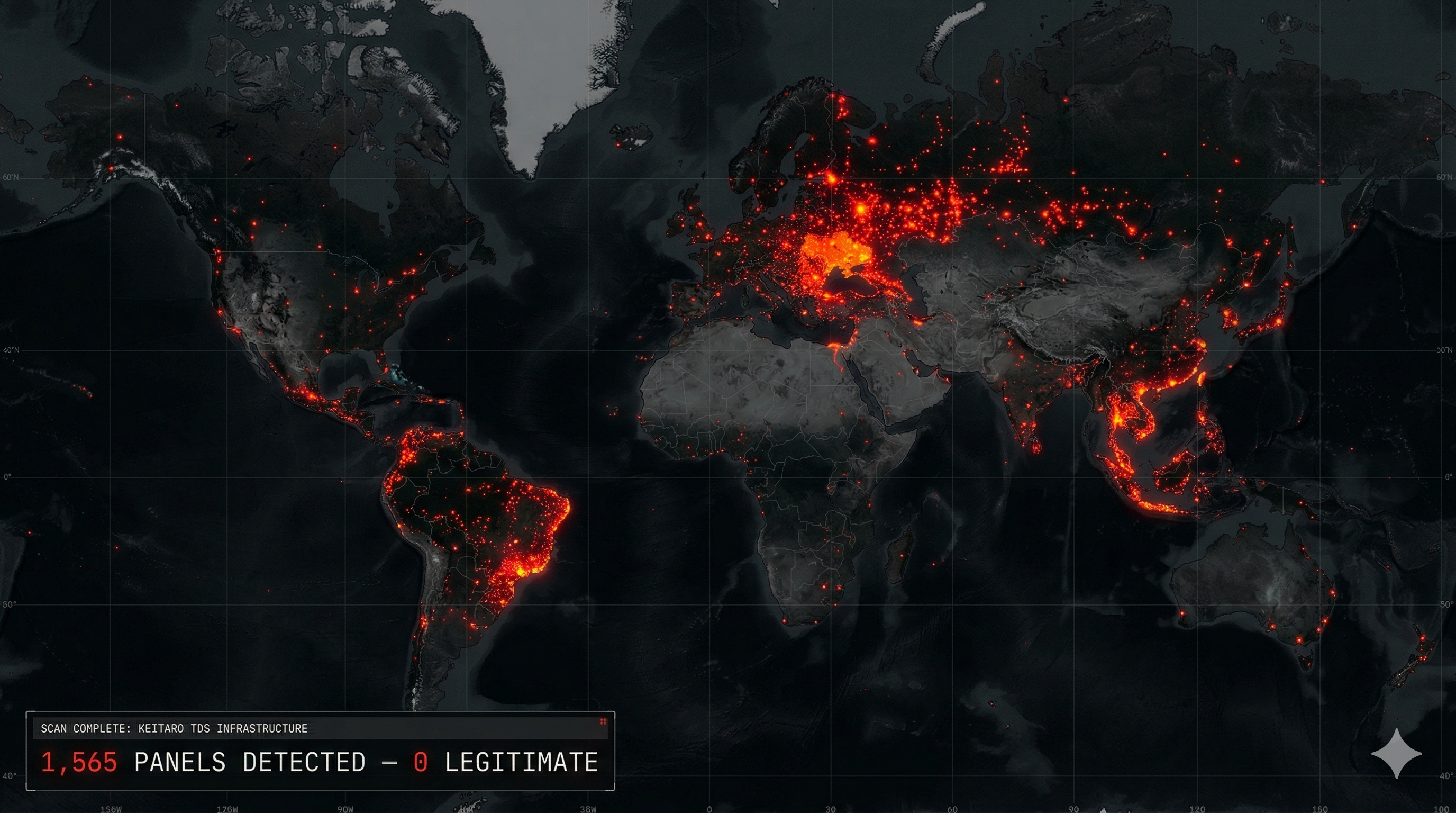
World heat map: 1,565 Keitaro TDS panels detected across the globe, 0 legitimate uses found
6. Domain Pattern Analysis
Keitaro operators tend to register domains following predictable naming conventions and registration patterns. Bulk domain analysis reveals clusters of domains with similar WHOIS data, registration dates, nameserver configurations, and hosting providers — all pointing back to coordinated Keitaro deployments.
7. Admin Panel Fingerprinting
Keitaro admin panels are accessible at known paths and return distinctive HTML structures, CSS class names, and JavaScript files. Even when operators change the default login URL, the panel's frontend framework leaves identifiable artifacts that can be detected through path enumeration and content fingerprinting.
Defense In Depth
No single detection method is foolproof. Sophisticated operators may disable or modify individual fingerprints. That's why the 7-point methodology works as a layered system — even if an operator eliminates three or four signatures, the remaining methods will still flag the deployment. In our testing, every Keitaro panel was detectable by at least four of the seven methods.
Global Infrastructure Map
The 1,565 Keitaro panels are distributed across a global hosting infrastructure that favors cheap VPS providers and jurisdictions with slow abuse response times. Here's where the panels live:
↔
Region
Hosting Providers
Notes
United States
DigitalOcean, Vultr
Largest concentration of panels. US-based hosting provides fast response times for North American victims.
Netherlands
Various VPS
Popular for European-targeted campaigns. Permissive hosting policies.
Germany
Hetzner, various
Major hub for EU-targeted phishing and e-commerce fraud operations.
Russia
Various bulletproof
Home base for many operators. Hosting providers with zero abuse enforcement.
United Kingdom
Various cloud
Used for targeting UK financial institutions and government services.
Hong Kong
Femo cluster
Distinct cluster of panels associated with Asian-targeted crypto scams. The "Femo cluster" operates as a coordinated group.
US Dominance
The United States hosts the largest concentration of Keitaro panels, primarily on DigitalOcean and Vultr. These are mainstream cloud providers that process abuse reports — but the volume of deployments and the speed at which operators spin up new instances means abuse teams are perpetually playing catch-up.
The Femo Cluster
A distinct cluster of Keitaro panels operating from Hong Kong infrastructure, targeting Asian markets with crypto scams and gambling fraud. The "Femo cluster" shows coordinated deployment patterns suggesting a single operator or organized group managing dozens of panels simultaneously.
AWS Backend
Regardless of where the frontend panels are hosted, Keitaro's core data storage runs on Amazon Web Services (AWS). This means visitor fingerprints, redirect logs, and targeting data for potentially millions of scam victims are sitting on Amazon infrastructure. With data retention of up to 9.75 years, AWS is hosting one of the largest scam victim databases in existence.
Open-Source Tools Released
Alongside this investigation, PhishDestroy is releasing a complete open-source detection toolkit. Every tool is free, requires no API keys, and can be deployed immediately. The full dataset of 1,565 panels is included.
All tools, data, and evidence are published at phishdestroy.github.io/ScamIntelLogs/keitaro/. The repository is public and will be updated as new panels are discovered. Community contributions and additional detection methods are welcome.
Detect, Report, Dismantle
How we detected Keitaro TDS panels — fingerprinting methodology Keitaro TDS traffic flow — how malicious panels redirect victims
Keitaro TDS is the invisible infrastructure that keeps scams alive. Every panel you report, every detection you make, and every dataset you share helps dismantle the ecosystem. Use the tools. Share the data. Report what you find.
Transparency notice. PhishDestroy is a non-commercial, independent project. Our research may reflect an inherent bias against scam infrastructure and the services that enable it. We encourage readers to evaluate all material critically and independently. Read our full transparency statement →