GitHub Arsenal: Open Source Tools for Fighting Cybercrime
In the ever-evolving landscape of cyber threats, open-source tools on GitHub provide a powerful defense.
The fight against cybercrime is a global effort, and the open-source community plays a crucial role. GitHub, as the world's leading platform for software development, hosts a vast array of tools designed to detect, analyze, and combat various cyber threats, including the pervasive menace of phishing.
The Power of Open Source in Cybersecurity
Open-source projects offer unparalleled transparency, allowing security researchers and developers worldwide to scrutinize code, identify vulnerabilities, and contribute to improvements. This collaborative model fosters rapid innovation and creates robust, community-vetted solutions against sophisticated cyberattacks.
Key Resources for Phishing Combat
Beyond general cybersecurity tools, several specialized resources are invaluable for directly combating phishing attempts. These tools range from real-time threat feeds to URL analysis services and community-driven blocklists:
- TweetFeed.live: Provides a live feed of cyber threat intelligence, often including early warnings about phishing campaigns shared on social media.
- Phish.Report: A platform for reporting phishing sites, contributing to a collective database that helps block malicious URLs.
- URLQuery.net: Offers a free service to analyze suspicious URLs, providing detailed reports on their behavior and potential threats.
- ThreatView.io Experimental IOC Tweets: A raw data feed of Indicators of Compromise (IOCs) extracted from tweets, useful for automated threat detection systems.
- Polkadot-JS Phishing Repository: A GitHub repository dedicated to tracking and detecting phishing attempts targeting the Polkadot ecosystem.
- URLAbuse.com Public Data: Provides a public list of reported abusive URLs, which can be used to update blocklists.
- MetaMask/eth-phishing-detect: An open-source project by MetaMask to detect and prevent Ethereum-related phishing attempts.
- Phishing.Army Blocklist: A regularly updated blocklist of known phishing URLs, maintained by the Phishing.Army community.
- VirusTotal URL Analysis: A widely used service that analyzes suspicious files and URLs, providing insights from multiple antivirus engines and blacklisting services.
- Phish Guard Blue: A web application designed to help users identify and avoid phishing links.
- Netcraft Phishing Report: Netcraft's platform for reporting phishing sites, contributing to their comprehensive anti-phishing efforts.
- Seal Phishing Bot (Telegram): A Telegram bot that helps users check links for phishing and report suspicious activity.
- URLScan.io: A free service that scans and analyzes websites, providing detailed reports on their content, technologies, and potential malicious activities.
"At PhishDestroy, we firmly believe in the power of collaboration and transparency in cybersecurity. Our own efforts are built on principles that align with the open-source ethos."
OSINT Investigators' Toolkit
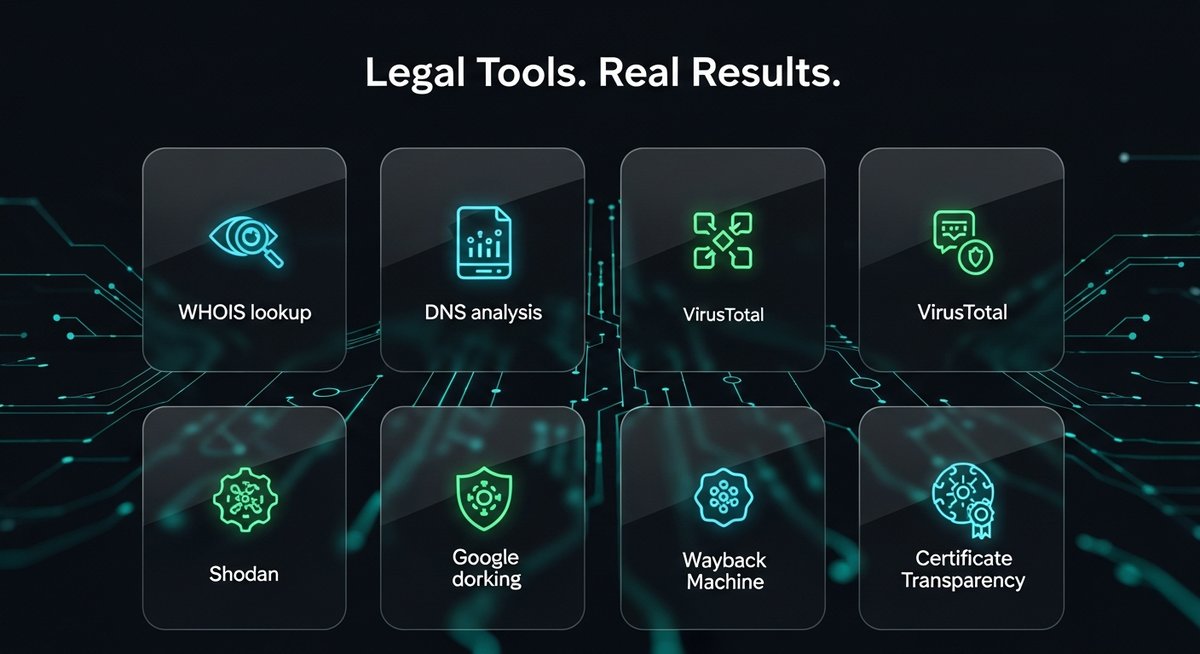
Beyond block-lists, real investigation requires deeper instrumentation. The following open-source tools form the backbone of any phishing-takedown workflow — each is free, scriptable, and battle-tested by the community:
- urlscan.io — sandboxed URL analysis: full DOM snapshot, screenshots, network calls, certificate details. Indispensable for evidence preservation before takedown.
- VirusTotal — multi-engine reputation lookup for URLs, files, IPs, and hashes. Submitting a phishing URL here propagates detection to dozens of AV/EDR vendors.
- Shodan — internet-of-things and exposed-service search engine. Used to map scammer infrastructure, identify hosting clusters, and discover panels.
- Censys — certificate-transparency & banner search; pivoting from one TLS cert to a hundred related domains is routine here.
- crt.sh — free Certificate Transparency log search, perfect for catching newly-issued look-alike certs against protected brands.
- Wayback Machine — preserves snapshots that survive even after the original site disappears.
- WHOIS & ViewDNS.info — registrant lookups, reverse-IP, and DNS pivoting.
- Maltego CE — graph-based link analysis; ideal for visualizing scammer networks across email, domain, IP, and social-media nodes.
- theHarvester — collects emails, subdomains, hosts, and employee names from public sources.
- Kali Linux — pre-loaded distro with hundreds of OSINT and security tools.
Browser-Side Defenses
Most phishing victims are caught on the click. Browser-layer defenses stop the attack before it ever reaches the wallet:
- MetaMask eth-phishing-detect — domain blocklist that ships with MetaMask and many Web3 wallets, blocking known phishing pages before they load.
- PhishDestroy destroylist — 130K+ curated active scam & phishing domains, multiple formats (DNS, hosts, JSON, CSV) ready for integration with Pi-hole, AdGuard, browser extensions, or corporate firewalls.
- PhishFort lists — community-maintained crypto-phishing blocklists.
- uBlock Origin + Privacy Badger — filter ads and trackers, dramatically reducing exposure to malvertising delivery channels.
- ScamSniffer — Web3 scam-database extension that surfaces drainer-contract risk on-page.
Threat-Intelligence Feeds
If you operate a SOC, CERT, or security stack, ingest these public feeds for active phishing infrastructure:
- destroylist — auto-updated, 130K+ threats, free API, multiple formats.
- OpenPhish — community phishing feed with clean text format.
- PhishTank — verified-phishing URLs (Cisco/OpenDNS).
- URLhaus (abuse.ch) — malware-distribution URLs.
- TweetFeed — IOCs scraped from infosec social media.
- ScamSniffer scam-database — Web3 blacklists.
YARA, Honeypots & Active Defense
- PhishingKit-Yara-Rules — detect known phishing-kit fingerprints in HTML/JS.
- Yara-Rules — community-maintained rule library.
- Honeypots & canary tokens — canarytokens.org, MazeRunner CE.
- Operation-Takedown — our own collection of scripts for active phishing-campaign disruption.
Workflow — From Tip to Takedown
A typical investigation chains these tools together:
- Receive a lead — a community report (Telegram bot), a paid-ad parser hit, or a CT-log alert.
- Confirm phishing — sandbox via urlscan.io; cross-check with VirusTotal, OpenPhish, PhishTank.
- Map infrastructure — pivot via Censys/Shodan to find related domains, IPs, certificates.
- Preserve evidence — Wayback snapshot, urlscan archive, full HTML/JS capture, screenshots.
- Notify partners — submit to 50+ AV vendors, file abuse with registrar/host, syndicate to MetaMask & ScamSniffer feeds.
- Monitor — confirm takedown; watch for resurfacing on neighboring IPs or freshly-registered look-alikes.
Read more:Anatomy of a Takedown · Registrars enabling scams · Crypto Security Guide
By leveraging these open-source tools, individuals, small businesses, and large enterprises can significantly enhance their cybersecurity posture. The collective intelligence and continuous development within the open-source community are invaluable assets in the ongoing battle against cybercrime. Stay vigilant, stay informed, and utilize the power of open source to protect yourself and your community.