Scammers Are Not Hackers: 4 Backends Dissected, All Trivially Compromised
Firebase · Supabase · Express.js · Drainer-as-a-Service · February 2026

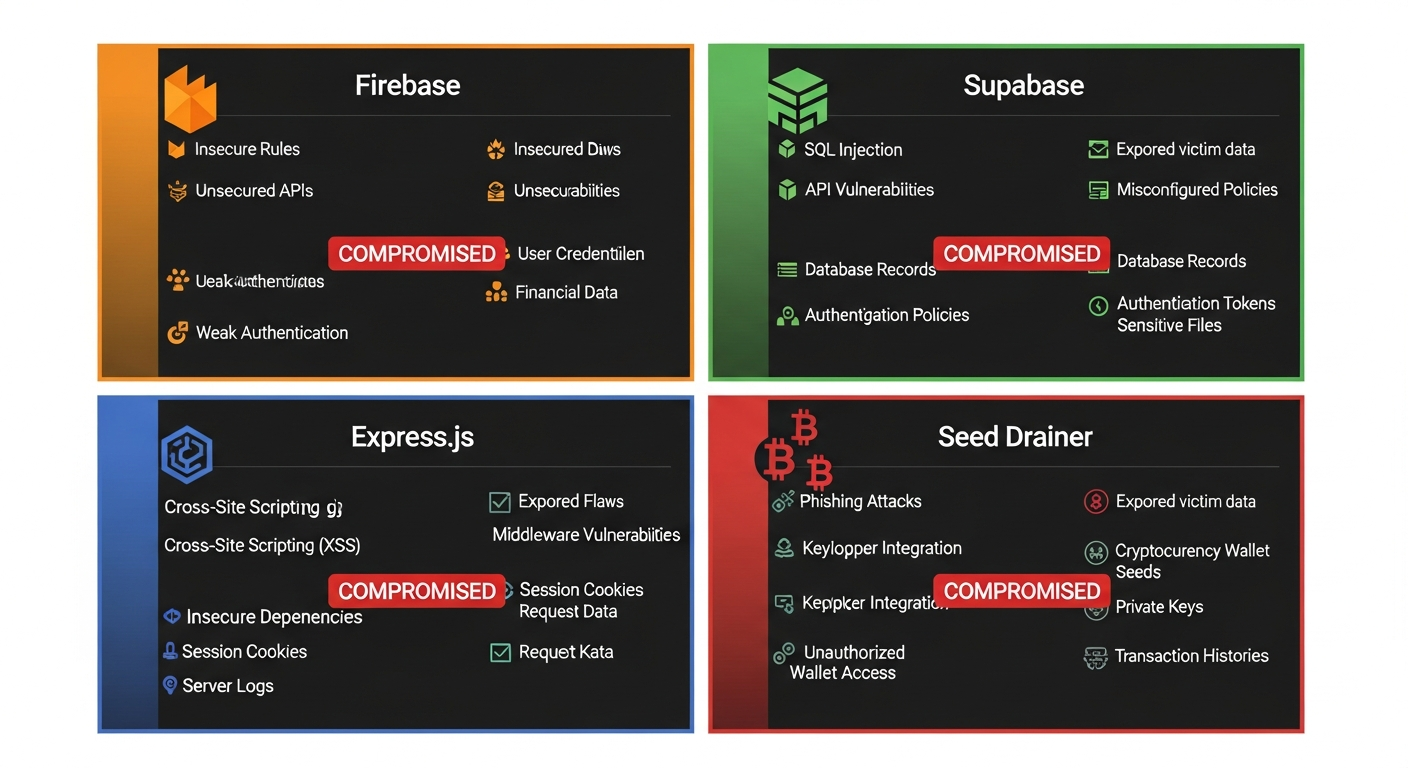
Disclaimer: Analysis, Not Attack
Everything presented in this article is the result of passive analysis and publicly accessible data. No systems were breached. No authentication was bypassed. In each case, the scammers' own misconfiguration exposed their infrastructure, victim data, and operational identities to anyone who simply looked. Every API key was found in public JavaScript bundles. Every database was wide open by the operators' own design. We document this not to attack — but to demonstrate that the people stealing your crypto cannot even secure their own tools.
The Core Thesis: Script Kiddies With Stolen Tools
There is a persistent myth in the public imagination that online scammers are "hackers" — technical masterminds who break into systems with skill and sophistication. This is wrong.
Modern crypto scammers are script kiddies using purchased toolkits. They buy "Drainer-as-a-Service" packages for $200–$500, deploy them on free or cheap hosting, and pray their victims don't notice. They do not write code. They do not understand networking. They certainly do not understand security.
We know this because in February 2026, PhishDestroy analyzed 4 independent scam operations — and in every single case, we could have:
- Read all stolen victim data (seed phrases, emails, IPs, wallet types)
- Modified or deleted the scammer's database
- Identified the operator through exposed API keys, email addresses, and infrastructure fingerprints
- Reproduced the attack against the scammer — using the same vulnerabilities they left open
No exploits needed. No zero-days. No "hacking." Just opening the front door they left unlocked.
Case 1: The Phantom API — server0002.mn19indexpre.xyz
Express.js on Apache, Zero Real Security
| Parameter | Value |
|---|---|
| Domain | server0002.mn19indexpre.xyz |
| IP Address | 108.181.185.225 |
| Server Stack | Apache/2.4.58 (Ubuntu) → Express.js (Node.js) |
| SSH Banner | SSH-2.0-OpenSSH_9.6p1 Ubuntu-3ubuntu13.11 |
| TLS Issuer | Let's Encrypt (E7), valid Jan–Apr 2026 |
| DNS Registrar | GoDaddy (ns39/ns40.domaincontrol.com) |
| Email (MX) | mn19indexpre-xyz.mail.protection.outlook.com |
| Microsoft Tenant | NETORGFT19090185.onmicrosoft.com |
| Open Ports | 22 (SSH), 80 (HTTP→301), 443 (HTTPS) |
"Authentication" — A Joke
The API ships with a hardcoded Bearer token: thisisakeyforsecureserver. But here's the punchline — the token is not actually verified:
Zero Input Validation
Every injection payload we tested was silently accepted:
Performance Fingerprint
Consistent ~7.5 second response time on POST regardless of payload size (10 bytes to 10 MB accepted), suggesting email forwarding or webhook relay on the backend. GET responds in 0.6s. 10 parallel requests complete in 9.1s — no rate limiting enforced.
Deanonymization Potential
Microsoft 365 tenant ID NETORGFT19090185 is a direct link to the organization account that registered this domain. Combined with GoDaddy registration records and a dedicated IP (not behind CDN), this operator is trivially identifiable through legal channels. The SPF record (include:secureserver.net) confirms GoDaddy email hosting — all email metadata is accessible via subpoena.
Case 2: Firebase Wide Open — web3ledgar.com
Firestore With Zero Security Rules
| Parameter | Value |
|---|---|
| Phishing Domain | web3ledgar.com (typosquat of "Ledger") |
| Alternate Domain | web3.ledgerscore.ltd |
| Firebase Project | web3ledger-210ab |
| API Key | AIzaSyCv8e-Gl7nK1RPpfNkJt-WjSZiaoe4AsL8 |
| App ID | 1:1054258933515:web:9fb193fcd0093023f7fc0e |
| JS Bundle | /static/js/main.7a5ec2fa.js |
| Firestore Rules | Wide open — unauthenticated read/write |
| Total Victims | 12 records in users collection |
| Collections Found | users, transactions |
Victim Data — Fully Accessible to Anyone
A single unauthenticated GET request to the Firestore REST API returned every stolen seed phrase:
Among the 12 records was a telling entry — someone had already tested the system with fbi@fbi.gov as the email. The scammer either tested their own system (useful for identification) or someone else had already probed it.
The Attack Flow
The phishing site mimics Ledger's wallet interface. Victim clicks "Connect Wallet" → enters seed phrase → React frontend writes directly to Firestore → scammer reads from the same open database. No backend server at all. The entire operation runs on Google's free tier.
Deanonymization Potential
Firebase Project ID web3ledger-210ab and App ID 1:1054258933515 are linked to a Google account. Google maintains billing records, IP logs, and account creation data for all Firebase projects. A single law enforcement request to Google reveals the operator's identity. Furthermore, the Firestore rules being wide-open means we could have written records into their database, notified victims in real-time, or wiped the entire collection.
Case 3: Supabase Full CRUD — web3safe-pal.com
Row-Level Security Disabled, GraphQL Wide Open
| Parameter | Value |
|---|---|
| Phishing Domain | web3safe-pal.com (typosquat of "SafePal") |
| Supabase Project | gzqsadraigchwdhblavp |
| Anon Key | Exposed in /assets/index-b025f4a6.js (748 KB) |
| Database Table | seeds — open read, insert, update, delete |
| GraphQL | Full introspection + mutations enabled |
| Edge Functions | send-wallet-import-email, send-email |
| Email Service | Resend API (RESEND_API_KEY in env) |
| Victim Records | IDs 130–131 (129 previously deleted) |
| UI Language | Russian ("Основной кошелек", "Ваш кошелек загружается...") |
Full Database Access — Read, Write, Delete
The Supabase anon key, found in the minified JavaScript bundle, grants complete CRUD access to the seeds table:
IDs start at 130 — meaning records 1–129 were previously deleted by the operator. At least 131 seed phrases have passed through this system.
Edge Functions: The Email Trail
Two Supabase Edge Functions are active. We reverse-engineered the send-email function's expected input format by testing payloads:
The Resend API key (RESEND_API_KEY) is stored in Supabase environment variables. Resend maintains sender verification records and billing data — another direct path to the operator's identity.
Deanonymization Potential
The Russian UI localization ("Основной кошелек", "Ваш кошелек загружается...") indicates a Russian-speaking operator. The Supabase project (gzqsadraigchwdhblavp) is linked to an account with billing records. The Resend email service has the recipient email address. The GraphQL introspection reveals the complete database schema. We demonstrated full write access — we could have replaced every stolen seed phrase with a warning message to victims, or deleted the entire table. The operator would have no way to recover the data.
Case 4: Industrial-Scale Drainer — aipolypredictor.xyz
19,000 Seed Phrases in 5.8 Days
| Parameter | Value |
|---|---|
| Frontend Domain | aipolypredictor.xyz ("PolySniper | Frontrun Insider Bets") |
| C2 API | api.yfhikblkhghdyteiuyf54.run |
| C2 IPs | 172.67.168.147, 104.21.26.231 (Cloudflare) |
| Backend | Express.js (Node.js) v1.0.0 |
| Registrar (Frontend) | NiceNIC International Group Co. |
| Registrar (C2) | PDR Ltd. (PublicDomainRegistry.com) |
| Uptime | ~139 hours (started ~2026-02-10 21:00 UTC) |
| Drainer Kit CDN | renderer-postcard.defex.cc (601 KB obfuscated JS) |
| Telegram Bot | Active, integrated for notifications |
| Rate Limit | 10 req/60s (only limit found) |
Scale Exposed by Sequential IDs
The most damning mistake: sequential job IDs. Every seed phrase submission returns an incrementing ID, allowing anyone to calculate total volume:
Multi-Chain Architecture
The C2 server derives keys across all major chains using depth-100 derivation paths:
Campaign Infrastructure
11 confirmed domains across 2 operator groups, tracked by Bundle IDs:
| Bundle ID | Domains | Status |
|---|---|---|
88ef78f5... | aipolypredictor.xyz | LIVE |
4446ea5d... | solana.onspace.app, solxjup.onspace.app | LIVE |
| defex.cc kit | jup-v2.com, events-charizard.fun, events-llquid.fun, events-blackswan.fun, soljup.onspace.build | Mixed |
JavaScript Payload Analysis
Three obfuscated JS payloads serve the drainer:
- wallet-connect.js (46 KB) — Handles wallet connection UI, intercepts seed input. String array rotation obfuscation.
- wallet-specific-modals.js (134 KB) — Contains full BIP39 English wordlist and Monero wordlist (1,626 words). Anti-debugging via console.log/trace overrides. Multi-wallet modal support.
- defex.cc/index.js (601 KB) — Unicode-obfuscated with Chinese variable names. Solana-specific drainer logic. Base58 encoder, crypto key derivation primitives. Version 3.0.0.
Deanonymization Potential
The CORS: * header and lack of authentication means anyone can submit requests and observe job ID increments in real-time. The Telegram bot integration means the operator's Telegram account receives notifications — and Telegram metadata can be subpoenaed. NiceNIC (registrar for the frontend) is a known bulletproof registrar we've previously investigated, but PDR Ltd. (C2 domain registrar) does respond to law enforcement requests. The defex.cc drainer kit serves 255+ domains — compromising defex.cc would expose the entire DaaS operation and all its customers.
Side-by-Side: 4 Operations, Same Pattern
| Metric | mn19indexpre Express.js | web3ledgar Firebase | web3safe-pal Supabase | aipolypredictor Drainer C2 |
|---|---|---|---|---|
| Authentication | None (token ignored) | None | Anon key in JS | None (CORS: *) |
| Data Readable | Messages/relay | All seed phrases | All seed phrases | Job IDs / scale |
| Data Writable | Yes (unlimited) | Yes | Yes (full CRUD) | Yes (submit) |
| Input Validation | Zero | Zero | Zero | Minimal |
| Rate Limiting | None | None | None | 10 req/60s |
| Deanonymizable | MS365 tenant | Google account | Resend + Supabase billing | PDR + Telegram |
| Estimated Victims | Unknown | 12 | 131+ | 19,000+ |
| Operator Language | Unknown | English | Russian | Unknown |
Why Scammers Are Not Hackers
The evidence is overwhelming. Across all 4 operations, we observe the same pattern:
- Buy pre-made drainer kits ($200–$500)
- Deploy on free tiers (Firebase, Supabase)
- Leave default configurations unchanged
- Use hardcoded tokens they don't verify
- Never enable RLS, never restrict CORS
- Expose their own identities in metadata
- Use sequential IDs that reveal their scale
- Write custom exfiltration tools
- Use encrypted, authenticated channels
- Randomize identifiers, rotate infrastructure
- Implement proper access control
- Use Tor/proxy chains, anonymous payments
- Separate operational identity from hosting
- Implement anti-forensic techniques
The average Drainer-as-a-Service customer is a social engineer with a credit card, not a technical operator. They know how to register a domain and paste code into a hosting panel. They do not know how to:
- Configure Firestore security rules (would take 2 minutes)
- Enable Supabase Row-Level Security (would take 5 minutes)
- Validate and sanitize input (would take 30 minutes)
- Use UUIDs instead of sequential integers (would take 1 line of code)
- Restrict CORS to their own domains (would take 1 line of config)
These are not sophisticated adversaries. These are people who cannot configure a database.
Indicators of Compromise (IOCs)
Domains
IP Addresses
API Keys & Project IDs
Conclusion: The Emperor Has No Clothes
The Takeaway
Every scam operation we analyzed could be fully compromised, deanonymized, and disrupted using nothing more than a web browser, curl, and publicly available documentation. In every case, the attackers left their databases wide open, their API keys in public JavaScript files, their identities in metadata, and their victims' data accessible to anyone who bothered to look.
The lesson is simple: scammers are not hackers. They are shoplifters who bought a lock-pick set from AliExpress and forgot to lock their own front door. The tools they use are sophisticated — because someone else built them. The operators themselves are amateurs who reliably expose their own infrastructure, their victims' data, and their own identities to anyone with basic technical literacy.
If you've entered your seed phrase on any of these sites — assume your wallet is compromised and transfer funds immediately.
All findings have been reported to the relevant service providers (Google/Firebase, Supabase, Cloudflare, domain registrars) and documented for law enforcement. The IOCs above have been added to the PhishDestroy destroylist.