VirusTotal
4 / 89 engine detections
Open report

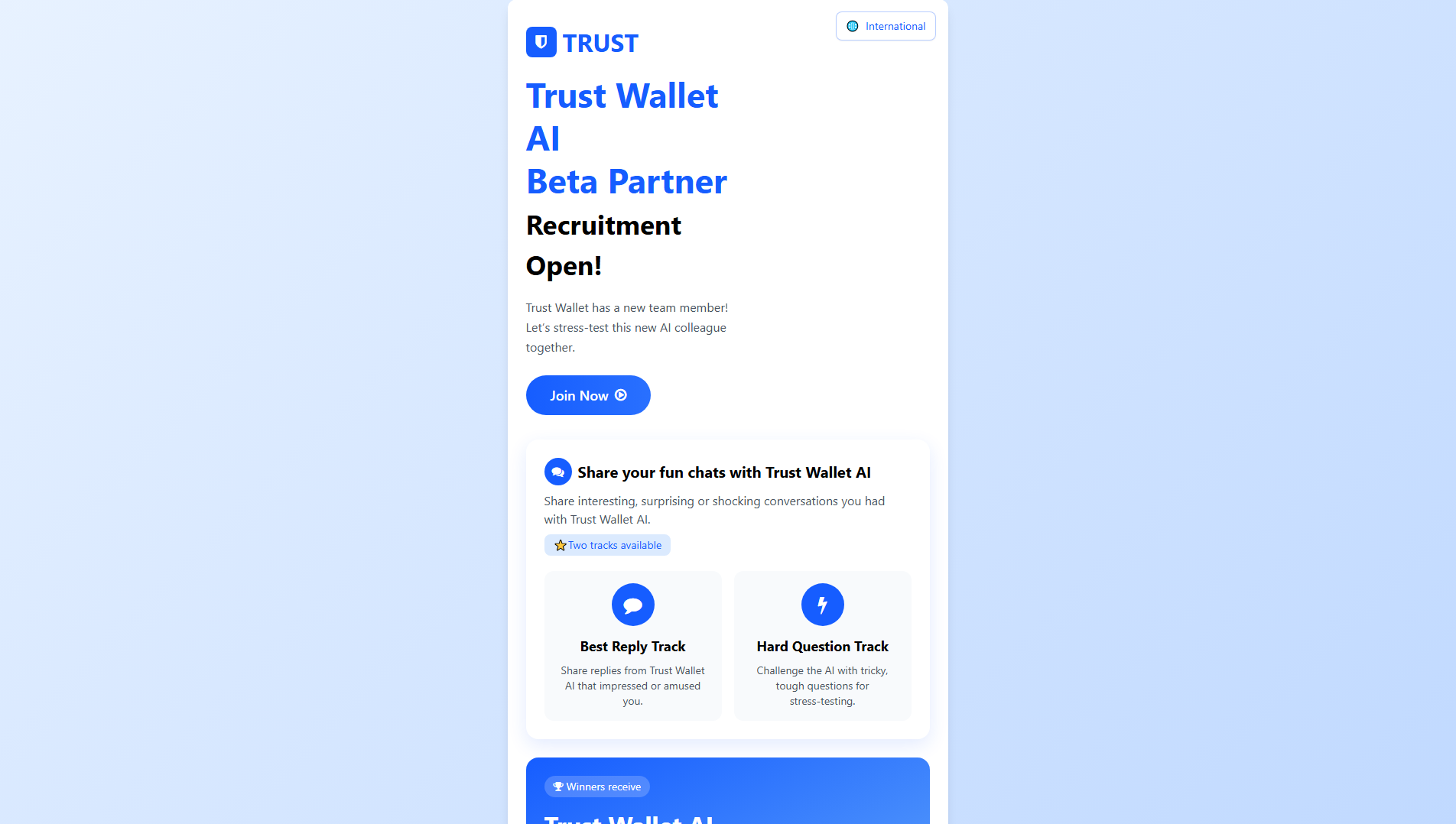
“Trust Wallet AI Beta Partner Recruitment”
4 / 89 engine detections
Open report1 threat-system alert
Open reportThreat flag recorded
Open reportDBL_PHISH
Malicious
Open reportno community references
Open reportprovider verdict: clean
Open report80/100
Open reportResults reflect each source’s collection time. Zero detections do not guarantee safety. OTX references are community publications.
| Detection System | Indicator | Verdict | Alert |
|---|---|---|---|
| Quad9 DNS | trust.tron11.com |
malicious | Sinkholed |
PhishDestroy threat report
trust.tron11.com is a phishing page that impersonated Trust Wallet behind the title "Trust Wallet AI Beta Partner Recruitment." It targeted Trust Wallet users and crypto holders drawn to early-access or partnership offers. PhishDestroy first saw it on 2026-09-06. The site has been offline since 2026-09-11, and on 2026-10-19 its domain no longer resolved in DNS.
The lure is an exclusive invitation to join an AI beta or partner program, styled to look like an official Trust Wallet initiative. Recruitment pitches of this kind usually ask the visitor to verify or connect their wallet to qualify. That often means typing a recovery phrase into a form or approving a connection request. A recovery phrase handed to such a page gives the operators full control of the wallet, and they can empty it at will. A malicious approval can let them move tokens without asking again.
Google Safe Browsing classifies the site as social engineering, and urlscan.io returned a malicious verdict with Trust Wallet detected as the imitated brand. Spamhaus lists the domain in its DBL as phishing. MetaMask and SEAL carry it on their blocklists alongside PhishDestroy. On VirusTotal, 4 of 89 engines flagged it as of 2026-09-08: ChainPatrol, alphaMountain.ai, Forcepoint ThreatSeeker and SOCRadar. That count is low, so most generic scanners would not have warned a visitor, while the crypto-focused blocklists did.
The domain was registered on 2026-08-15 through Realtime Register B.V., 22 days before PhishDestroy flagged it. It went dark five days after detection, which points to a short-lived campaign. The brand name sits on a subdomain of an unrelated parent name rather than on a lookalike of Trust Wallet's own domain. The site was hosted on the Zillion Network Inc. network in Canada.
If you typed your recovery phrase on this page, treat the wallet as compromised. Create a new wallet with a fresh phrase on a trusted device and move any remaining funds there immediately. If you connected a wallet or signed a transaction, revoke token approvals with a reputable approval checker and watch the wallet for unexpected transfers. Remember that Trust Wallet does not recruit partners through invitations that require your phrase or a wallet signature. Defenders should block the domain and its parent name, and hunt mail and chat logs for links offering Trust Wallet beta or partner programs.
Last checked
a2.share-dns.comb2.share-dns.netLocation describes the IP network.
da492c18a8980a73df3a088cb7326d9ed202212844f54366c83c32f3e3133659Saved certificate metadata. Certificate dates without a timezone are shown as stored. Transport encryption does not establish that the site is trustworthy.
Google PageSpeed Insights — mobile performance audit of trust.tron11.com · checked Sep 6, 2026
An estimated time describes an observation window. It does not prove a registrar action or the exact moment a site became unavailable.
Dated changes retained by the monitor and source collectors. Newest observations appear first; source states are not proof of a takedown.
Unknown→dns_inactive
dns_nxdomain
Unknown→dns_inactive
dns_nxdomain
Unknown→dns_inactive
dns_nxdomain
Unknown→dns_inactive
dns_nxdomain
Unknown→dns_inactive
dns_nxdomain
Unknown→dns_inactive
dns_nxdomain
Unknown→dns_inactive
dns_nxdomain
Unknown→dns_inactive
dns_nxdomain
dns_inactive
dns_nxdomain
Reachable→Unavailable
No flag recorded→Flag recorded
Reachable
Threat flag recorded
View source4/89 engine detections
View sourcePD-20260906-0B4DF5
trust.tron11.com
View sourcePage captured
View source104 stored lookalike domains
Showing 100 of 104
Each lane is one reason a domain is linked to this host. Node size marks VirusTotal detections and dashed nodes are already offline. The full lists follow below.
Same favicon hash or the same page title as this host.
Reports with the same collector label. A shared label does not establish impersonation or common ownership. View matching reports →
Registered through the same registrar. A registrar serves millions of unrelated customers, so this groups reports rather than proving a link.
Compare what a browser and a crawler receive, and check for Keitaro traffic routing.
trust.tron11.com
PD-20260906-0B4DF5 Recipient: abuse@ntt.net If credentials, payment data, or files were exposed, report the incident immediately. Change affected passwords, revoke active sessions, and scan the device.


Select your country to get official cybercrime contacts, or create a complaint draft →.
Template-based draft · optional AI wording assistance requires separate consent
Choose the steps that match what you shared. Keep a copy of this report alongside your own records.
Stop using the suspicious site. Open the real service through its official app or an address you already trust.
Keep original emails, receipts, messages and screenshots in a secure place. A factual timeline helps the receiving authority understand what happened. IC3 evidence guidance ↗
trust.tron11.com)Even if you don't have all details — file a report anyway. Partial information still helps investigations.
A report is not a guarantee of recovery or investigation, but prompt, accurate transaction data can help authorities and service providers trace the incident.
Further guidance: NIST · phishing responseFBI IC3 · reports & evidenceFTC · recovery scams
Threat analysis using stored blocklist, WHOIS, DNS, and public scan evidence
Scan NowSubmit suspicious domains to our threat database — protect the community
ReportRecent phishing reports and observed availability changes
MonitorMonitor live threats or contest this listing if you believe it's a false positive
This report combines saved page captures, registration and network records, scanner results and PhishDestroy reporting history. Each source keeps its own observation date. Open a source report to inspect the original result.
The AI-assisted analysis was written on . It describes the evidence available at that time; later source checks can change.
A capture documents what was shown. A scanner result records that provider’s assessment at the time of its check. Neither a valid certificate nor a zero-detection result is a guarantee of safety.