URLQuery
2 det.
Open report
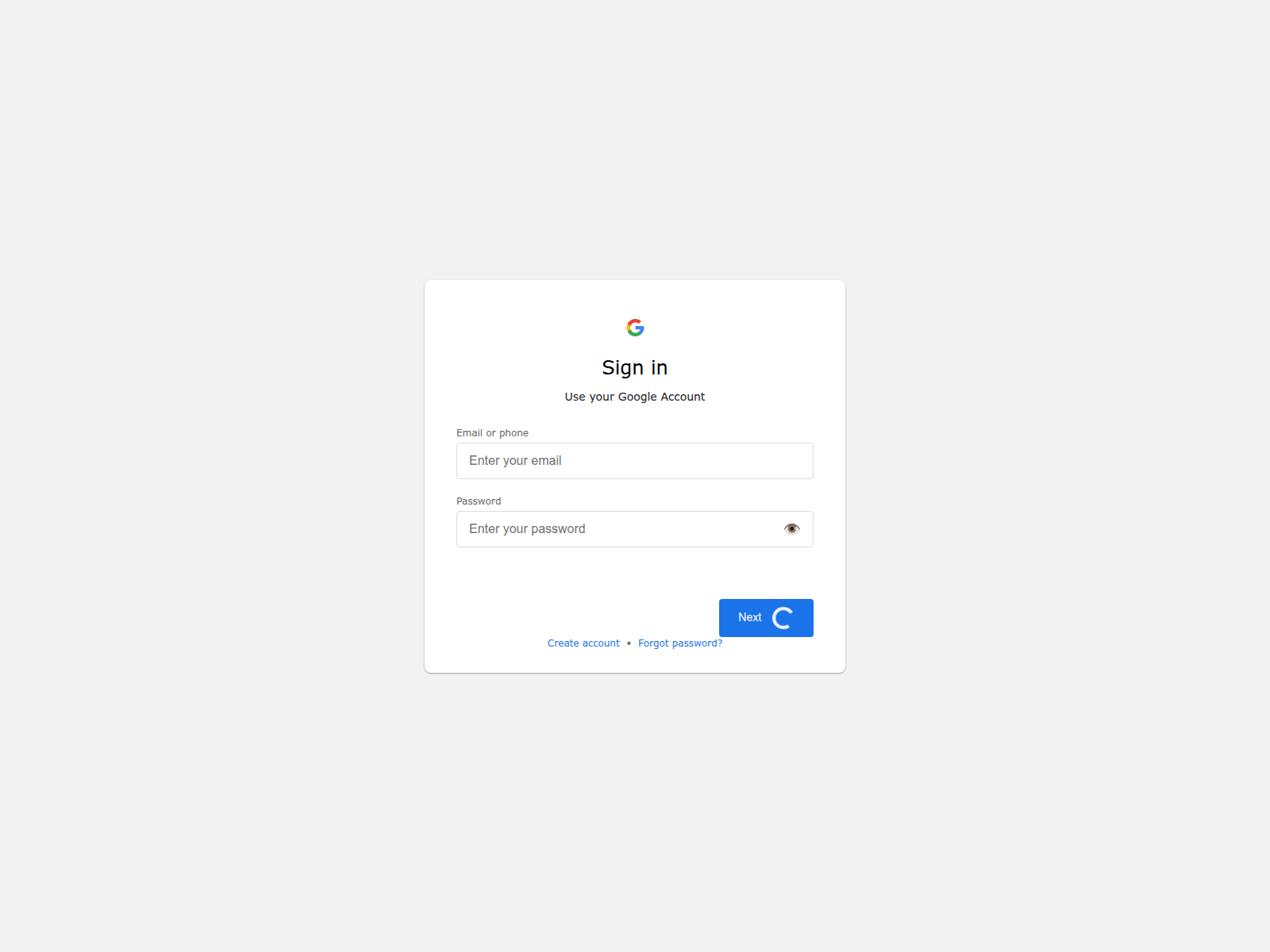
On 2026-11-12, carlosjosez1981-collab.github.io displayed a centered white card on a light gray background, headed "Sign in" with the instruction "Use your Google Account" beneath a Google "G" logo. The form provides an "Email or phone" field with placeholder "Enter your email" and a "Password" field with placeholder "Enter your password" plus an eye-shaped visibility toggle. A blue "Next" button sits at the bottom right of the card, with "Create account" and "Forgot password?" links below it.
Use caution — do not enter credentials or personal information.
 185.199.108.153GitHub, Inc · CDN
Risk score, higher = worse · How this score works
Pick what happened and tick the steps as you go. The ticks are kept only in this browser.
Expert view has every section: DNS, TLS, network requests, hashes and the raw JSON.
PhishDestroy first recorded carlosjosez1981-collab.github.io on 2026-11-12. Google Safe Browsing flags it. Risk: critical (evidence score 100/100). Status: HTTP 404 · Content unavailable. Hosting: Fastly, Inc. Do not enter credentials or connect a wallet.
185.199.108.153GitHub, Inc · CDN URLScan capture · 2026-11-12 16:30 UTC · SHA-256 07fdbf2a…a8dfdca
PhishDestroy analysis, reviewed version
On 2026-11-12, carlosjosez1981-collab.github.io displayed a centered white card on a light gray background, headed "Sign in" with the instruction "Use your Google Account" beneath a Google "G" logo. The form provides an "Email or phone" field with placeholder "Enter your email" and a "Password" field with placeholder "Enter your password" plus an eye-shaped visibility toggle. A blue "Next" button sits at the bottom right of the card, with "Create account" and "Forgot password?" links below it.
The stored VirusTotal domain result reports 0 detections out of 92 engines.
2 det.
Open reportThreat flag recorded
Open reportMalicious
SHA-256 cf010c26…2efd982
Separate stored monitor snapshot; does not replace the primary report record or establish current availability.
Scan report
Open report25 / 100 · heuristic score · 1 brand reference · 0 classifications
Content heuristic only; not the final score
Open reportNarrative generation metadata
Open reportThe narrative generation date is separate from observation dates. These are the retained publication fields, not an additional independent detection.
Results reflect each source’s collection time. Zero detections do not guarantee safety. OTX references are community publications.
Stored page, network and scanner observations, grouped by source and observation time.
| Mail configuration | Spf lookups: 0 |
|---|---|
| Caa records | Count: 6; Domain: carlosjosez1981-collab.github.io; Issuers: letsencrypt.org, sectigo.com, digicert.com |
| Protective DNS results | Resolvers: 12; Blocked count: 0 |
| TLS connection | Alpn: h2; Cipher: TLS_AES_128_GCM_SHA256; Protocol: TLSv1.3; Versions: TLSv1.2, TLSv1.3; Authorized: ✓; Forward secrecy: ✓ |
| Ports | Open: 80, 443 |
| DNS server | NS: (IP: 205.251.197.59; Host: ns-1339.awsdns-39.org), (IP: 205.251.198.86; Host: ns-1622.awsdns-10.co.uk), (IP: 205.251.193.137; Host: ns-393.awsdns-49.com), (IP: 205.251.194.180; Host: ns-692.awsdns-22.net), (IP: 198.51.44.5; Host: dns1.p05.nsone.net), (IP: 198.51.45.5; Host: dns2.p05.nsone.net), (IP: 198.51.44.69; Host: dns3.p05.nsone.net), (IP: 198.51.45.69; Host: dns4.p05.nsone.net); Zone: github.io |
| Location | IP: 2606:50c0:8001::153; ASN: 54113; Org: Fastly, Inc.; City: San Francisco; Country: US |
| SSL | Issuer: Let's Encrypt / YR1; Subject: *.github.io |
| DNS records | A: 185.199.109.153, 185.199.111.153, 185.199.110.153, 185.199.108.153; Aaaa: 2606:50c0:8003::153, 2606:50c0:8000::153, 2606:50c0:8002::153, 2606:50c0:8001::153 |
| Dnssec | Ds: ✗; Rrsig: ✗; Dnskey: ✗ |
| Hsts | Message: Site does not serve any HSTS headers. |
| HTTP security policies | Xframeoptions: ✗; Referrerpolicy: ✗; Xxssprotection: ✗; Permissionspolicy: ✗; Xcontenttypeoptions: ✗; Contentsecuritypolicy: default-src 'none'; style-src 'unsafe-inline'; img-src data:; connect-src 'self'; Stricttransportpolicy: ✗; Crossoriginopenerpolicy: ✗; Crossoriginembedderpolicy: ✗; Crossoriginresourcepolicy: ✗ |
| Get IP | IP: 2606:50c0:8000::153; Family: 6 |
| HTTP headers | Headers: Server: GitHub.com; Content type: text/html; charset=utf-8; Content security policy: default-src 'none'; style-src 'unsafe-inline'; img-src data:; connect-src 'self'; Via: 1.1 varnish; X cache: HIT; X cache hits: 2; X served by: cache-par-lfpg1960053-PAR |
PhishDestroy rates carlosjosez1981-collab.github.io as critical risk (evidence score 100/100) from the recorded evidence; it was first recorded on 2026-11-12. Google Safe Browsing flags it. The local score and a listing do not prove fraud. Check each source’s date and the exact URL.
Because of the risk signals above, do not connect a wallet, sign messages or approve token permissions on carlosjosez1981-collab.github.io. A confirmed blockchain transaction cannot be reversed.
Keep the address, dates, payment or transaction details and messages for a report to the police or another competent authority. A report does not guarantee that money is returned. Step-by-step help: emergency guide.
07fdbf2a…a8dfdca SHA-256 of the prepared copy given to the model: 99764ab3…04f19c8 07fdbf2a99fcb9b7a5735be8465bb90537ce92135b5b722d51817663aa8dfdca · 11188 bytes a5897d1e1050a8fe959c82997f82b331cad25f3807b5138b7a3e00a4c9a98fe3 · 12674 bytes e112700cfa8ce814178fb4ebd2698502f4c2da3c3b52296a13dcfc9c80a53de0 · 26610 bytes 0628b8a9e855591780143c63964e87c89490945d003d9ed46ad7f2faec8ec8de · 8817 bytes 0628b8a9e855591780143c63964e87c89490945d003d9ed46ad7f2faec8ec8de · 8817 bytes d62a3127668331a934313cec16ba6d3451db51c1de03d5b161c99630cfea95e2 · 12603 bytes 388a94e3dd6bf58675a1eb9a5e20c2cef1adda01c53745331cd59b9c8d5334c1 · 11204 bytes f1b0426df8498efe674f57b24d0f725cf7064e17d0868bf4cb22aa6f0f95789e · 12176 bytes 185.199.108.153 Fastly shared edge origin IP hidden Edge-IP reputation is not attributed to this domain. 185.199.108.153San Francisco, USEdge-IP reputation is not attributed to this domain.
ns-692.awsdns-22.netLocation describes the IP network.
f2f9a159ce50a0a168b3eaeaf2fced5addd49ba38e2bf63248f057a139fc7856*.github.com*.github.io*.githubusercontent.comgithub.comgithub.iogithubusercontent.comSaved certificate metadata. Certificate dates without a timezone are shown as stored. Transport encryption does not establish that the site is trustworthy.
No phishing content was served at the latest check.
An estimated time describes an observation window. It does not prove a registrar action or the exact moment a site became unavailable.
Network requests: 2 SHA-256 hashes: 2 URLScan scan:
Network requests that the URLScan browser recorded while loading the page. URLScan does not provide a hash for every request. PhishDestroy retrieved this list on 2026-11-12 18:36 UTC.
Open this scan on URLScan 01a1d106-98ca-7225-a9e1-48e6e0e500a0 ↗
Loads saved data; the suspicious site is not opened.
| # | Network request | HTTP method · status | Type | Uncompressed size | Response body SHA-256 |
|---|
Dated changes retained by the monitor and source collectors. Newest observations appear first; source states are not proof of a takedown.
No flag recorded→Flag recorded
No page content
no page content in the HTTP response
Recorded events: 9. These records describe collected evidence, outgoing notifications and publication; they do not confirm a complete investigation or a takedown.
Lifecycle
We scan suspicious URLs, inspect public results and send evidence through the appropriate abuse-reporting channels. The dated events above show what is recorded for this domain. The directory below explains the wider workflow.
Capture the rendered page, requests and visible infrastructure.
Compare the available engine results and retain the analysis timestamp.
Check whether Google currently lists the URL as unsafe.
Inspect a public scan and its recorded network and classification data.
Look for indicator references and related community intelligence.
Compare archived captures and preserve historical context.
Look for matching indicators and associated threat records.
Inspect certificate records and related hostnames.
Compare security resolver responses and record observed blocking.
Inspect the public DNS, TLS, HTTP and technology surface.
Security services used for scanning, reputation checks and reporting are listed below. A service being listed is not evidence that it received, accepted or acted on this particular domain. Recorded submissions appear in the notification history above.
 GoogleSafe Browsing↗ GoogleWeb Risk↗
 MicrosoftSmartScreen↗
 VirusTotalURL analysis↗
 CloudflareRadar / abuse reporting↗
 YandexSafe Browsing↗
 URLScan.ioPublic scan↗
 ESETSample / URL submission↗
 BitdefenderURL submission↗
 NortonSafe Web↗
 SymantecSiteReview↗
 AviraURL reporting↗
 Avast / AVGURL reporting↗
 KasperskyOpenTIP↗
 Dr.WebOnline scanner↗
 NetcraftAbuse reporting↗
 PhishTankCommunity reporting↗
 APWG eCXPhishing intelligence↗
 PhishStatsPublic feed↗
 Phish.ReportHosting abuse↗
 SpamhausDomain reputation↗
 PolySwarmMulti-engine analysis↗
 CheckPhishURL scan↗
 QutteraMalware scan↗
 URLqueryBrowser analysis↗
 Criminal IPAsset intelligence↗
 CRDFThreat Center↗
 ScamadviserReputation check↗
 MyWOTCommunity reputation↗
Browse this domain’s complete history by source. The download includes every record of the selected source. Dates retain their original field labels.
Download all records as JSON| ID | Stored data |
|---|
Similar title Supporting signal 4
Brand label: Google Supporting signal 8
Each spoke is one reason a domain is linked to this report. Node size marks VirusTotal detections, dashed nodes are already offline, and the full lists follow below. Full list of related reports
Same favicon file hash, or a recorded page title that starts with the same 20 characters. A content match does not establish a shared phishing kit or owner.
Reports with the same collector label. A shared label does not establish impersonation or common ownership. View matching reports →
Recently added threat reports.
Compare what a browser and a crawler receive, and check for Keitaro traffic routing.
carlosjosez1981-collab.github.io Act on what you actually did. Entered a password: change it, and wherever you reused it. Paid or gave card details: contact your bank or payment service. Downloaded a file: scan the device. Then report the incident.
The draft stays only with you.
First secure your money: call your bank or revoke wallet approvals. Immediate steps →



Emergency help from security researchers when a crypto wallet is being drained right now.

Report scams and fraud to the US Federal Trade Commission. Reports go into a database used by law enforcement.


Report cyber incidents and phishing to the US Cybersecurity and Infrastructure Security Agency.

Forward scam emails and text messages to the National Cyber Security Centre, which takes down the malicious sites it finds.
Emailreport@phishing.gov.uk Text messages7726
Directory of national incident response teams (CSIRTs) in the EU. Find the team for your country.

Forward phishing emails to the Anti-Phishing Working Group.
Emailreportphishing@apwg.org
National Cyber Crime Reporting Portal. For financial fraud, also call the 1930 helpline straight away.
Helpline1930


Choose the steps that match what you shared. Keep a copy of this report alongside your own records.
Stop using the suspicious site. Open the real service through its official app or an address you already trust.
Keep original emails, receipts, messages and screenshots in a secure place. A factual timeline helps the receiving authority understand what happened. IC3 evidence guidance ↗
carlosjosez1981-collab.github.io)Even if you don't have all details — file a report anyway. Partial information still helps investigations.
A report is not a guarantee of recovery or investigation, but prompt, accurate transaction data can help authorities and service providers trace the incident.
Further guidance: NIST · phishing responseFBI IC3 · reports & evidenceFTC · recovery scams
Threat analysis using stored blocklist, WHOIS, DNS, and public scan evidence
Scan NowSubmit suspicious domains to our threat database — protect the community
ReportRecent phishing reports and observed availability changes
MonitorMonitor live threats or contest this listing if you believe it's a false positive
This report combines saved page captures, registration and network records, scanner results and PhishDestroy reporting history. Each source keeps its own observation date. Open a source report to inspect the original result.
The AI-assisted analysis was written on . It describes the evidence available at that time; later source checks can change.
A capture documents what was shown. A scanner result records that provider’s assessment at the time of its check. Neither a valid certificate nor a zero-detection result is a guarantee of safety.