claim-downtofinance.com presents a cryptocurrency token airdrop for DownToFinance that prompts visitors to connect their Web3 wallets. If you already connected your wallet to this page, revoke any token approvals immediately.
Page title: “$DTF Airdrop”
More about the sources
Recorded security signals
Stored VirusTotal result: 4/92 engines flagged. Malicious: 1. Suspicious: 3. Analysis time (as stored): 2026-11-20 02:44 UTC. Retrieved (as stored): 2026-11-22 11:19 UTC. Listed by external blocklists: ScamSniffer. Use caution — do not enter credentials or personal information.
Expert view has every section: DNS, TLS, network requests, hashes and the raw JSON.
Analysis
Domain summary
PhishDestroy first recorded claim-downtofinance.com on 2026-11-22. Stored VirusTotal result: 4/92 engines flagged. Malicious: 1. Suspicious: 3. Analysis time (as stored): 2026-11-20 02:44 UTC. Retrieved (as stored): 2026-11-22 11:19 UTC. Listed by external blocklists: ScamSniffer. Risk: critical (evidence score 75/100). Registrar: NiceNIC. Status: Last known active. Hosting: Cloudflare, Inc. Do not enter credentials or connect a wallet.
URLScan capture · 2026-11-22 11:16 UTC · SHA-256 e457040e…d7c6b74
PhishDestroy analysis, reviewed version
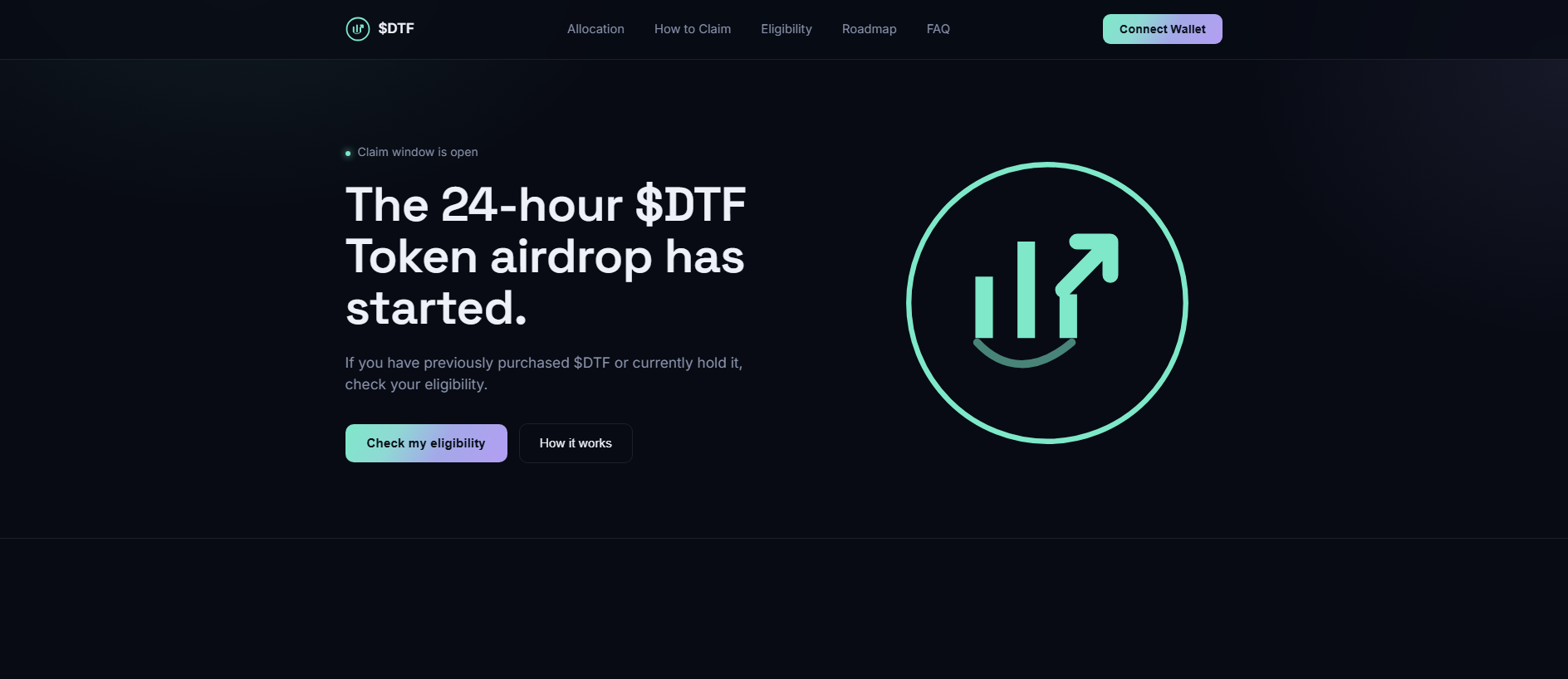
The DownToFinance token claim page layout
The page features a dark theme with bright mint-green accents and white text, displaying a top navigation bar with links for Allocation, How to Claim, Eligibility, Roadmap, FAQ, and a prominent "Connect Wallet" button. The main hero section announces "The 24-hour $DTF Token airdrop has started" with a subtitle prompting visitors to check their eligibility if they hold or previously purchased $DTF. Below this heading, two interactive buttons reading "Check my eligibility" and "How it works" sit alongside a graphic of a rising bar chart. Further down, a "How to claim" section outlines a four-step process while reassuring visitors that "At no point will you be asked for your private key or wallet seed phrase."
Wallet connection risks and telemetry
The site loads external scripts from api.web3modal.org to prompt visitors for a Web3 wallet connection, which can grant malicious smart contracts permission to drain tokens from an approved wallet. LevelBlue, Fortinet and Ermes flag the domain, and VirusTotal showed 4 of 92 engines flagging it on 20 Nov 2026, and ScamSniffer blocks it, pointing to known malicious infrastructure. PhishDestroy's evidence score for it is 60/100 (high), so visitors should treat the page with extreme caution.
Registration context and domain history
The domain was registered on 14 Sep 2026 through NICENIC INTERNATIONAL GROUP CO., LIMITED, and it still responded on 22 Nov 2026 at 12:17 UTC. Because the registration date predates our first sighting by several weeks, the domain sat dormant or was repurposed before launching this active token claim campaign.
Source evidenceVirusTotal 4 / 926 sources
SourceResultRecorded · UTCOpen
VirusTotal
4 / 92 engine detections
Analysis:
Open report VirusTotalOriginal source recordObserved: 15 fields
This is a separate stored result. Its counts, vendors and dates do not replace the provider observation above. A retrieval date is not an analysis date.
claim-downtofinance.com presents a DownToFinance token airdrop inviting visitors to connect Web3 wallets, flagged by 4 VirusTotal engines.
AI summary
The DownToFinance token claim page layout The page features a dark theme with bright mint-green accents and white text, displaying a top navigation bar with links for Allocation, How to Claim, Eligibility, Roadmap, FAQ, and a prominent "Connect Wallet" button. The main hero section announces "The 24-hour $DTF Token airdrop has started" with a subtitle prompting visitors to check their eligibility if they hold or previously purchased $DTF. Below this heading, two interactive buttons reading "Check my eligibility" and "How it works" sit alongside a graphic of a rising bar chart. Further down, a "How to claim" section outlines a four-step process while reassuring visitors that "At no point will you be asked for your private key or wallet seed phrase." Wallet connection risks and telemetry The site loads external scripts from api.web3modal.org to prompt visitors for a Web3 wallet connection, which can grant malicious smart contracts permission to drain tokens from an approved wallet. LevelBlue, Fortinet and Ermes flag the domain, and VirusTotal showed 4 of 92 engines flagging it on 20 Nov 2026, and ScamSniffer blocks it, pointing to known malicious infrastructure. PhishDestroy's evidence score for it is 60/100 (high), so visitors should treat the page with extreme caution. Registration context and domain history The domain was registered on 14 Sep 2026 through NICENIC INTERNATIONAL GROUP CO., LIMITED, and it still responded on 22 Nov 2026 at 12:17 UTC. Because the registration date predates our first sighting by several weeks, the domain sat dormant or was repurposed before launching this active token claim campaign.
Headers: Server: cloudflare; Content type: text/html; Strict transport security: max-age=63072000; includeSubDomains; preload; Content security policy: frame-ancestors http: https:; X content type options: nosniff
Network Security Intelligence Registrar context
Registrar contextNiceNIC
Stored registration data identifies NICENIC INTERNATIONAL GROUP CO., LIMITED (IANA 3765) as the registrar. PhishDestroy maintains separate NiceNIC abuse-report research; registrar association is contextual and is not an independent detection for this domain.
Is claim-downtofinance.com a legitimate airdrop site?
VirusTotal showed 4 of 92 engines flagging it on 20 Nov 2026, and ScamSniffer blocks it. You should avoid interacting with its prompts.
What happens if I connected my wallet on claim-downtofinance.com?
Connecting your wallet can expose your token balances to automated scripts designed to request malicious allowances. You should immediately open your wallet settings, inspect active DApp connections, and revoke any unfamiliar token approvals.
Did the site ask for my seed phrase?
While the text on the page explicitly states that "At no point will you be asked for your private key or wallet seed phrase," token drainers often rely solely on malicious smart contract approvals rather than direct seed phrase theft.
Certificate fingerprint0d468189ef0643be6a4bffc4d7b08fa7a38e91f8aea2165909d59c46301ed1dbCertificate names · 2 SANs
*.claim-downtofinance.com
claim-downtofinance.com
Saved certificate metadata. Certificate dates without a timezone are shown as stored. Transport encryption does not establish that the site is trustworthy.
Network requests that the URLScan browser recorded while loading the page. URLScan does not provide a hash for every request. PhishDestroy retrieved this list on 2026-11-22 11:18 UTC.
Loads saved data; the suspicious site is not opened.
Captured network requests
#
Network request
HTTP method · status
Type
Uncompressed size
Response body SHA-256
Stored observation history1
Dated changes retained by the monitor and source collectors. Newest observations appear first; source states are not proof of a takedown.
Domain monitor · First collection record
Reachable
All retained availability observations2
Source: availability monitor. Every retained observation remains separate, including records with the same date or evidence hash but different sources or DNS states. An unknown state is not proof that the site is offline.
Recorded events: 12. These records describe collected evidence, outgoing notifications and publication; they do not confirm a complete investigation or a takedown.
The domain remains reachable or access-restricted; future checks may update this observation.
ongoing
Recorded activity
4 entries
Lifecycle
Domain registered
VirusTotal analysis with detections+67 d 1 h
Added to PhishDestroy+56 h 33 min
Wayback Machine
Page archived
+2 min
Added to PhishDestroy
claim-downtofinance.com
same minute
URLScan
Page captured
+56 h 33 min
VirusTotal
4/92 engine detections
How we investigate & report
Public scans, evidence and abuse channels
We scan suspicious URLs, inspect public results and send evidence through the appropriate abuse-reporting channels. The dated events above show what is recorded for this domain. The directory below explains the wider workflow.
01Public scans & evidence collection10 sources and tool groups
Inspect the public DNS, TLS, HTTP and technology surface.
02Abuse reports & follow-upRegistrar, hosting and security channels
Identify the responsible provider. Match registration and hosting records to the relevant abuse contact.
Prepare an evidence package. Include the URL, public scan references, captures and the recorded observations.
Send the report. Keep outgoing report records and recipient information when available.
Recheck and publish updates. Track later scanner verdicts, provider responses and site availability.
Security services used for scanning, reputation checks and reporting are listed below. A service being listed is not evidence that it received, accepted or acted on this particular domain. Recorded submissions appear in the notification history above.
You are not alone and there is nothing to be ashamed of. Scammers are sophisticated criminals who exploit trust. Reporting your experience is the most powerful weapon against fraud — your report can prevent others from becoming victims and help law enforcement take action. Secure your accounts and funds first, then report. If credentials were compromised, report immediately. Do not engage with recovery scammers.
Act on what you actually did. Entered a password: change it, and wherever you reused it. Paid or gave card details: contact your bank or payment service. Downloaded a file: scan the device. Then report the incident.
Choose the steps that match what you shared. Keep a copy of this report alongside your own records.
What should I do immediately?
Urgent
Stop using the suspicious site. Open the real service through its official app or an address you already trust.
Entered a password — change it on that service and on every other site where you used the same password
Turn on two-factor authentication — where the service offers it; an authenticator app is stronger than SMS codes
Paid or entered card or bank details — contact your bank or payment service through the contacts on your card or its official website
Downloaded a file — do not open it and scan the device with security software
Shared a seed phrase or private key — move the remaining funds to a new wallet with a new seed phrase; the exposed wallet is no longer safe
Connected a wallet but signed nothing — disconnect the site in the wallet and reject pending requests; a connection by itself does not move funds
Approved token spending (approve / permit) — revoke that approval with a token-approval checker (revoke.cash)
Sent crypto — save the transaction hash, your address and the receiving address; blockchain transactions cannot be reversed
What information should I collect for my report?
FBI guidelines
Keep original emails, receipts, messages and screenshots in a secure place. A factual timeline helps the receiving authority understand what happened. IC3 evidence guidance ↗
Payment records — if you paid, save the receipt, amount, date, payment provider and recipient details.
Exact dates & times — of each transaction and first contact with scammer
Screenshots — scam website, chat messages, emails, wallet transactions, social media
All URLs & domains used by the scammer (including claim-downtofinance.com)
Communications — emails, texts, phone numbers, usernames the scammer used
Even if you don't have all details — file a report anyway. Partial information still helps investigations.
Where should I report the scam?
FBI IC3 — Internet Crime Complaint Center (US federal reporting)
Your bank or payment provider — contact its fraud team promptly through official contact details if money or card information was exposed.
Local police — creates an official record, even if they can't act immediately
A report is not a guarantee of recovery or investigation, but prompt, accurate transaction data can help authorities and service providers trace the incident.
How do phishing scams typically work?
Fake websites — pixel-perfect clones of legitimate sites with slightly altered domains
Pig butchering — trust built over weeks via Telegram/WhatsApp/dating apps, then money stolen
Recovery scams — fraudsters pose as recovery agents and demand upfront fees. Never share a seed phrase or pay before independently verifying the provider
AI-powered scams — deepfakes, automated phishing, and AI-generated sites making fraud harder to detect
How can I protect myself in the future?
Bookmark official sites — never click links from emails, DMs, or ads
Verify domains — check on PhishDestroy before interacting. Check HTTPS, spelling, domain age
"Too good to be true" = scam — guaranteed returns, celebrity endorsements, urgent deadlines
Beware of recovery scammers! Recovery scammers may pose as investigators, lawyers, or tracing services. Do not pay upfront fees or disclose credentials.Learn more about recovery fraud →
About this reportSources, observation dates and corrections
This report combines saved page captures, registration and network records, scanner results and PhishDestroy reporting history. Each source keeps its own observation date. Open a source report to inspect the original result.
The AI-assisted analysis was written on . It describes the evidence available at that time; later source checks can change.
A capture documents what was shown. A scanner result records that provider’s assessment at the time of its check. Neither a valid certificate nor a zero-detection result is a guarantee of safety.

 NiceNIC
 104.21.17.156


 Microsoft
 Cloudflare
 Yandex
 ESET
 Bitdefender
 Norton
 Symantec
 Avira
 Avast / AVG
 Kaspersky
 Dr.Web
 Netcraft
 PhishTank
 APWG eCX
 PhishStats
 Phish.Report
 PolySwarm
 CheckPhish
 Quttera
 URLquery
 Criminal IP
 CRDF
 Scamadviser
 MyWOT