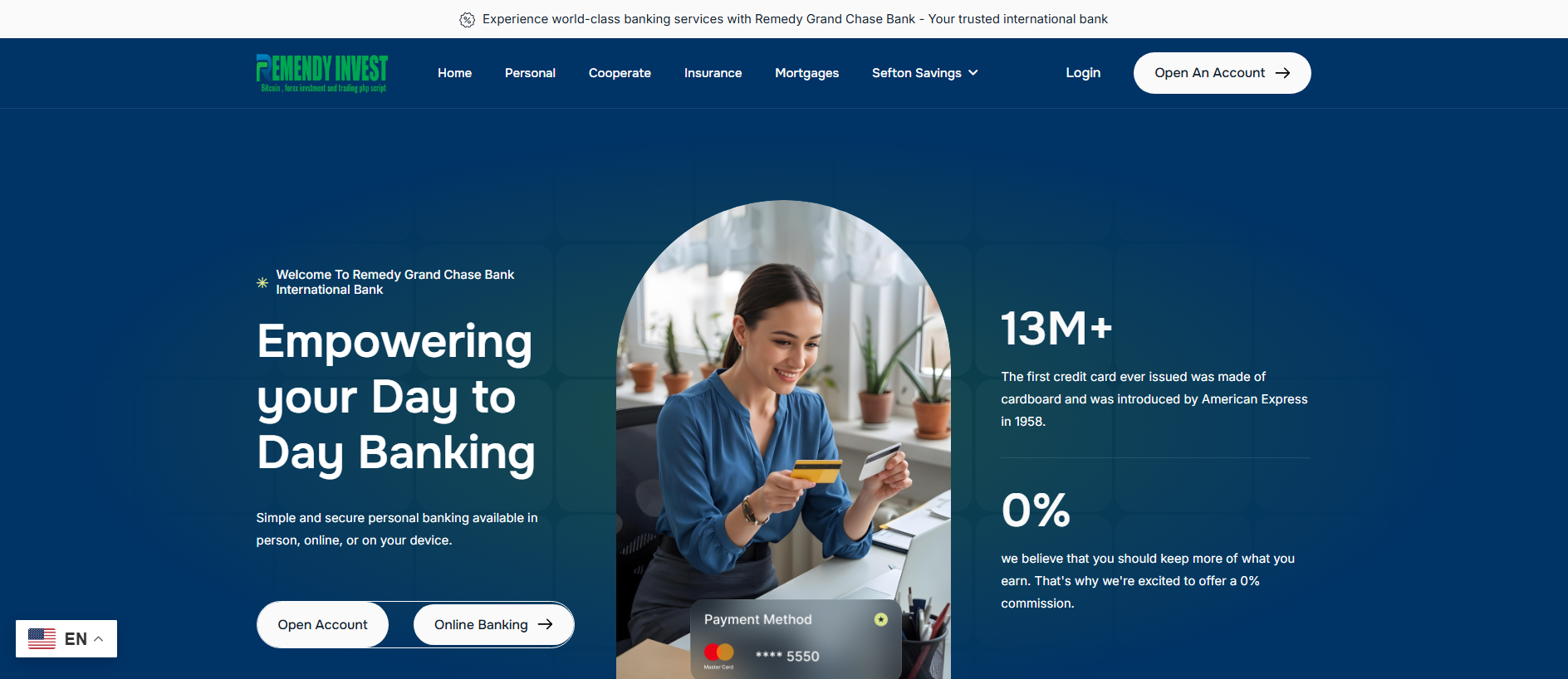
oldchase.online was an impersonation phishing page posing as Chase Bank and aimed at Chase customers and people looking to open a new bank account. Its page title read "Remedy Grand Chase Bank- Your New Favorite Bank", which borrows the Chase name while adding a meaningless prefix. PhishDestroy first saw it on 2026-08-18. The site has been offline since 2026-09-11, and its DNS was still inactive when we last checked on 2026-10-19.
诈骗手法解析
Bank impersonation pages copy the look of a real banking portal so visitors believe they are signing in to their own account. Anyone who types a username, password, one-time code, card number or personal details hands them straight to the operators. Those operators can then log in to the real account, move money, or reuse the identity data for further fraud. The "Your New Favorite Bank" title suggests the page also pitched itself as a place to open an account, which invites victims to submit even more personal information.
证据
Twelve of 91 VirusTotal engines flagged the domain as of 2026-08-28. The vendors included alphaMountain.ai, BitDefender, CRDF, Forcepoint ThreatSeeker, Fortinet, G-Data, Gridinsoft and LevelBlue. That is a modest but meaningful spread of independent vendors agreeing on a brand-new domain within ten days of its registration. The domain also appears in four AlienVault OTX threat pulses and on the PhishDestroy blocklist.
基础设施
The domain was registered through HOSTINGER operations, UAB on 2026-08-17, and PhishDestroy caught it the next day. That one-day gap fits a throwaway domain set up for a short campaign. It resolved to Cloudflare's network, with an address located in Canada, so the server behind it stayed hidden from view. Its TLS certificate came from Google Trust Services, which means the browser padlock offered no assurance that the site belonged to Chase.
What to do
If you entered Chase login details on this site, change your password through the official Chase app or by typing the bank's address yourself. Do the same on any other account that shares that password, and review your two-factor authentication settings. Call Chase using the number on your card to report the incident, check recent transactions, and ask about replacing any card whose details you typed. If you submitted your Social Security number or ID documents, consider a credit freeze. Security teams should block the domain and search mail and proxy logs for users who visited it between 2026-08-17 and 2026-09-11.
oldchase.online — Chase Bank Impersonation Phishing
AI 描述
oldchase.online was a phishing site impersonating Chase Bank, built to capture online banking logins and personal details from Chase customers.
AI摘要
Overview oldchase.online was an impersonation phishing page posing as Chase Bank and aimed at Chase customers and people looking to open a new bank account. Its page title read "Remedy Grand Chase Bank- Your New Favorite Bank", which borrows the Chase name while adding a meaningless prefix. PhishDestroy first saw it on 2026-08-18. The site has been offline since 2026-09-11, and its DNS was still inactive when we last checked on 2026-10-19. How the scam works Bank impersonation pages copy the look of a real banking portal so visitors believe they are signing in to their own account. Anyone who types a username, password, one-time code, card number or personal details hands them straight to the operators. Those operators can then log in to the real account, move money, or reuse the identity data for further fraud. The "Your New Favorite Bank" title suggests the page also pitched itself as a place to open an account, which invites victims to submit even more personal information. Evidence Twelve of 91 VirusTotal engines flagged the domain as of 2026-08-28. The vendors included alphaMountain.ai, BitDefender, CRDF, Forcepoint ThreatSeeker, Fortinet, G-Data, Gridinsoft and LevelBlue. That is a modest but meaningful spread of independent vendors agreeing on a brand-new domain within ten days of its registration. The domain also appears in four AlienVault OTX threat pulses and on the PhishDestroy blocklist. Infrastructure The domain was registered through HOSTINGER operations, UAB on 2026-08-17, and PhishDestroy caught it the next day. That one-day gap fits a throwaway domain set up for a short campaign. It resolved to Cloudflare's network, with an address located in Canada, so the server behind it stayed hidden from view. Its TLS certificate came from Google Trust Services, which means the browser padlock offered no assurance that the site belonged to Chase. What to do If you entered Chase login details on this site, change your password through the official Chase app or by typing the bank's address yourself. Do the same on any other account that shares that password, and review your two-factor authentication settings. Call Chase using the number on your card to report the incident, check recent transactions, and ask about replacing any card whose details you typed. If you submitted your Social Security number or ID documents, consider a credit freeze. Security teams should block the domain and search mail and proxy logs for users who visited it between 2026-08-17 and 2026-09-11. Useful links urlscan.io scan and screenshot: https://urlscan.io/result/01a015f8-1c3f-754c-b010-7616fd2de3e6/ VirusTotal report: https://www.virustotal.com/gui/domain/oldchase.online Google Safe Browsing status: https://transparencyreport.google.com/safe-browsing/search?url=oldchase.online Report phishing to Google: https://safebrowsing.google.com/safebrowsing/report_phish/ Site owner? Request a review: https://phishdestroy.io/appeals/
证据层Availability: DNS inactiveContent: UnreachableDNS: NXDOMAIN
RDAP注册
观测时间线last reachable: 2026-08-23 22:15 UTCcurrent episode first observed: 2026-09-30 16:14 UTCobserved RIP window: 2026-08-23 22:15 UTC → 2026-09-30 16:14 UTC · 905.98hmidpoint estimate ≈ 2026-09-11 19:15 UTC · precision very low · basis bounded
Availability, content, DNS and registration are independent evidence layers. NXDOMAIN, an unreachable origin or missing content alone does not prove registrar action. A registrar or provider is credited only when a direct technical marker identifies that actor. Report causality is shown separately.


 Hostinger
 172.67.221.89


 Microsoft
 Cloudflare
 Yandex
 ESET
 Bitdefender
 Norton
 Symantec
 Avira
 Avast / AVG
 卡巴斯基
 Dr.Web
 Netcraft
 PhishTank
 APWG eCX
 PhishStats
 Phish.Report
 Spamhaus
 PolySwarm
 CheckPhish
 Quttera
 URLquery
 Criminal IP
 CRDF
 MyWOT