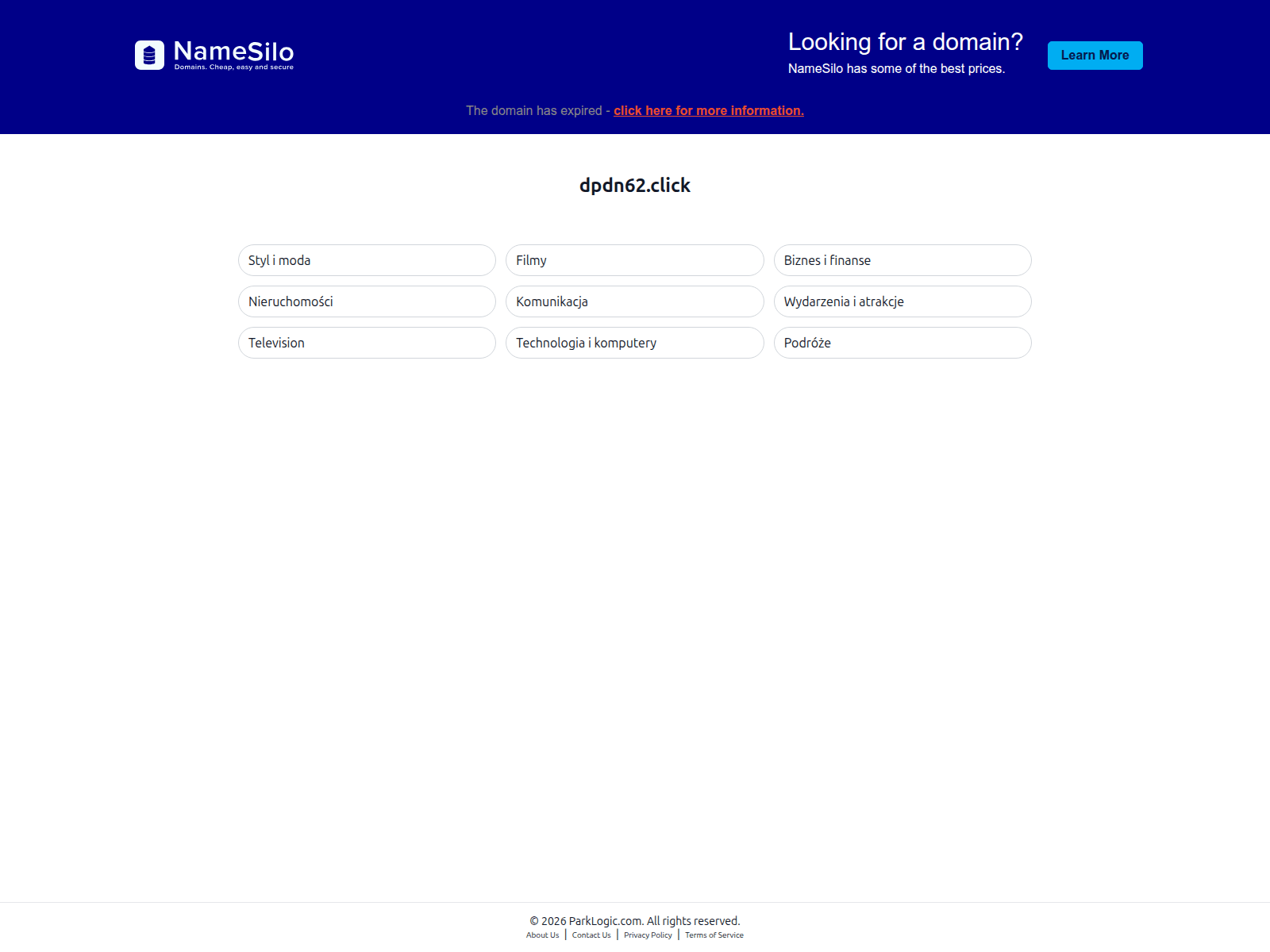
dpdn62.click is an impersonation phishing page that poses as a legitimate service so that visitors trust it and type in sensitive information. PhishDestroy first detected it on 2026-10-06. When checked on 2026-10-19 it was still online and serving live content, so anyone who receives a link to it today is still exposed.
诈骗手法解析
The page presents itself with the title "Redirecting...". That title does not match a branded login screen, but we classify the site as impersonation phishing. Schemes of this type usually reach victims through a link in a text message, email or chat that claims to come from a trusted company. The link leads to a lookalike page that asks for account credentials, personal details or card information, often with an urgent pretext. Whatever the victim enters goes straight to the operators, who use it to take over accounts or make fraudulent payments.
证据
On 2026-10-06, 18 of 92 VirusTotal engines flagged the domain. The vendors include alphaMountain.ai, AlphaSOC, BitDefender, Chong Lua Dao, CyRadar, ESET, Emsisoft and Forcepoint ThreatSeeker, a mix of commercial antivirus firms and dedicated anti-phishing projects. Google Safe Browsing separately lists it under SOCIAL_ENGINEERING, which means browsers that use that service will warn visitors before the page loads. PhishDestroy carries it on its blocklist.
基础设施
The domain was registered on 2025-09-10 through NameSilo, LLC, roughly thirteen months before it was flagged. That gap suggests the name was held in reserve rather than put to use immediately. The site runs on Akamai Connected Cloud (the AKAMAI-LINODE-AP network, labelled Singapore), with the IP 172.237.129.236 geolocated to the US. Its free Let's Encrypt certificate shows a padlock in the address bar, which says nothing about whether the site is safe.
What to do
If you opened this page but entered nothing, close it and delete the message that brought you there. If you typed in a password, change it at once on the real service and on any account that shares it, then turn on two-factor authentication. If you entered card or bank details, call your bank to block the card and dispute any charges you do not recognise, and treat follow-up calls or messages about the incident as suspect. Defenders should block dpdn62.click at the DNS and proxy level, search mail and SMS gateway logs for links to the domain, and contact any users who clicked.
dpdn62.click is a live impersonation phishing page flagged for social engineering, built to trick visitors into handing over logins or payment details.
AI摘要
Overview dpdn62.click is an impersonation phishing page that poses as a legitimate service so that visitors trust it and type in sensitive information. PhishDestroy first detected it on 2026-10-06. When checked on 2026-10-19 it was still online and serving live content, so anyone who receives a link to it today is still exposed. How the scam works The page presents itself with the title "Redirecting...". That title does not match a branded login screen, but we classify the site as impersonation phishing. Schemes of this type usually reach victims through a link in a text message, email or chat that claims to come from a trusted company. The link leads to a lookalike page that asks for account credentials, personal details or card information, often with an urgent pretext. Whatever the victim enters goes straight to the operators, who use it to take over accounts or make fraudulent payments. Evidence On 2026-10-06, 18 of 92 VirusTotal engines flagged the domain. The vendors include alphaMountain.ai, AlphaSOC, BitDefender, Chong Lua Dao, CyRadar, ESET, Emsisoft and Forcepoint ThreatSeeker, a mix of commercial antivirus firms and dedicated anti-phishing projects. Google Safe Browsing separately lists it under SOCIAL_ENGINEERING, which means browsers that use that service will warn visitors before the page loads. PhishDestroy carries it on its blocklist. Infrastructure The domain was registered on 2025-09-10 through NameSilo, LLC, roughly thirteen months before it was flagged. That gap suggests the name was held in reserve rather than put to use immediately. The site runs on Akamai Connected Cloud (the AKAMAI-LINODE-AP network, labelled Singapore), with the IP 172.237.129.236 geolocated to the US. Its free Let's Encrypt certificate shows a padlock in the address bar, which says nothing about whether the site is safe. What to do If you opened this page but entered nothing, close it and delete the message that brought you there. If you typed in a password, change it at once on the real service and on any account that shares it, then turn on two-factor authentication. If you entered card or bank details, call your bank to block the card and dispute any charges you do not recognise, and treat follow-up calls or messages about the incident as suspect. Defenders should block dpdn62.click at the DNS and proxy level, search mail and SMS gateway logs for links to the domain, and contact any users who clicked. Useful links urlscan.io scan and screenshot: https://urlscan.io/result/01a10bc6-e28b-74b9-8125-7d27ba06c7c1/ VirusTotal report: https://www.virustotal.com/gui/domain/dpdn62.click Google Safe Browsing status: https://transparencyreport.google.com/safe-browsing/search?url=dpdn62.click Report phishing to Google: https://safebrowsing.google.com/safebrowsing/report_phish/ Site owner? Request a review: https://phishdestroy.io/appeals/
Stored registration data identifies NameSilo as the registrar. PhishDestroy maintains separate registrar investigations; that broader material is contextual and is not an independent detection for this domain.
证据层Availability: DNS inactiveContent: UnreachableDNS: NXDOMAIN
RDAP注册
观测时间线last reachable: 2026-10-25 03:26 UTClast content: 2026-10-25 03:26 UTCcurrent episode first observed: 2026-10-26 08:55 UTCobserved RIP window: 2026-10-25 03:26 UTC → 2026-10-26 08:55 UTC · 29.47hmidpoint estimate ≈ 2026-10-25 18:10 UTC · precision medium · basis bounded
Availability, content, DNS and registration are independent evidence layers. NXDOMAIN, an unreachable origin or missing content alone does not prove registrar action. A registrar or provider is credited only when a direct technical marker identifies that actor. Report causality is shown separately.

 NameSilo


 Microsoft
 Cloudflare
 Yandex
 ESET
 Bitdefender
 Norton
 Symantec
 Avira
 Avast / AVG
 卡巴斯基
 Dr.Web
 Netcraft
 PhishTank
 APWG eCX
 PhishStats
 Phish.Report
 Spamhaus
 PolySwarm
 CheckPhish
 Quttera
 URLquery
 Criminal IP
 CRDF
 Scamadviser
 MyWOT