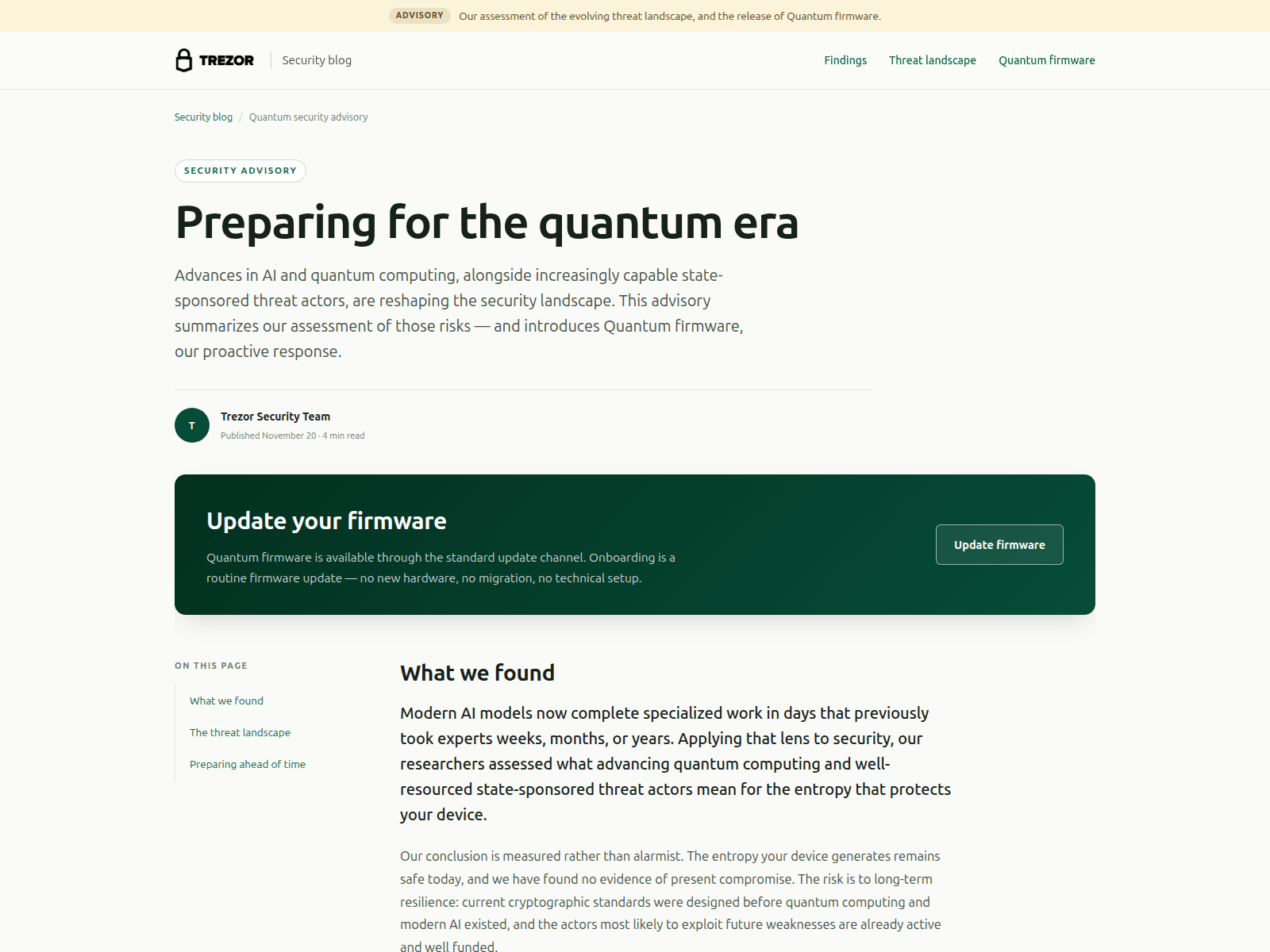
This site mimics the Trezor security blog, featuring an article titled "Preparing for the quantum era" alongside a prominent "Update firmware" button designed to entice visitors. Anyone who interacted with the update prompt should immediately disconnect their hardware wallet and ensure their recovery phrase remains private.
URLScan截图 · 2026-11-21 01:06 UTC · SHA-256 78ee665f…ecdb748
PhishDestroy分析,审阅版
为保留原始取证记录,下方的 PhishDestroy AI 详细分析仍使用英文。
Fake Trezor security blog and firmware update prompt
The page opens with a banner reading "ADVISORY Our assessment of the evolving threat landscape, and the release of Quantum firmware." It mirrors the Trezor brand and presents a security blog titled "Preparing for the quantum era". The article discusses AI, quantum computing, and state-sponsored threat actors, complete with an author attribution to the "Trezor Security Team" and a publication date of November 20. A dark green box in the middle of the page urges visitors to "Update your firmware" with a button labelled "Update firmware". The sidebar and layout match typical corporate blog posts, while the top navigation links point to sections like "Findings", "Threat landscape", and "Quantum firmware".
Recent domain registration and security telemetry
Because it was registered on 20 Nov 2026 and reported the same day, the domain presents a sharp contrast to an established manufacturer like Trezor, whose official domain is trezor.io. Furthermore, urlscan classified the page as malicious, and 3 of 92 VirusTotal engines flagged it on 20 Nov 2026; PhishFort, Fortinet and alphaMountain.ai are among the engines flagging the site. Finally, it still answered requests on 21 Nov 2026 at 02:06 UTC.
Recommended precautions
Visitors should always navigate to the official domain, trezor.io, directly rather than following links from search results or external blogs. If you clicked the update button or entered sensitive details, check your device connections immediately and never input your seed phrase into any website.
blogsite-trezorsuite.com mimics a Trezor blog about quantum threats to prompt firmware updates, flagged by urlscan and 3 VirusTotal engines. Use trezor.io.
AI摘要
Fake Trezor security blog and firmware update prompt The page opens with a banner reading "ADVISORY Our assessment of the evolving threat landscape, and the release of Quantum firmware." It mirrors the Trezor brand and presents a security blog titled "Preparing for the quantum era". The article discusses AI, quantum computing, and state-sponsored threat actors, complete with an author attribution to the "Trezor Security Team" and a publication date of November 20. A dark green box in the middle of the page urges visitors to "Update your firmware" with a button labelled "Update firmware". The sidebar and layout match typical corporate blog posts, while the top navigation links point to sections like "Findings", "Threat landscape", and "Quantum firmware". Recent domain registration and security telemetry Because it was registered on 20 Nov 2026 and reported the same day, the domain presents a sharp contrast to an established manufacturer like Trezor, whose official domain is trezor.io. Furthermore, urlscan classified the page as malicious, and 3 of 92 VirusTotal engines flagged it on 20 Nov 2026; PhishFort, Fortinet and alphaMountain.ai are among the engines flagging the site. Finally, it still answered requests on 21 Nov 2026 at 02:06 UTC. Recommended precautions Visitors should always navigate to the official domain, trezor.io, directly rather than following links from search results or external blogs. If you clicked the update button or entered sensitive details, check your device connections immediately and never input your seed phrase into any website.
证据层Availability: Content servingContent: Content served at rootDNS: Resolved
最新的 HTTP 观察结果内容在线提供普通 HTTP 内容90%2026-11-21 11:13 UTC
RDAP注册
观测时间线last reachable: 2026-11-21 11:13 UTClast content: 2026-11-21 11:13 UTC
Availability, content, DNS and registration are independent evidence layers. NXDOMAIN, an unreachable origin or missing content alone does not prove registrar action. A registrar or provider is credited only when a direct technical marker identifies that actor. Report causality is shown separately.

 Dominet (HK)
 172.67.190.116


 Microsoft
 Cloudflare
 Yandex
 ESET
 Bitdefender
 Norton
 Symantec
 Avira
 Avast / AVG
 卡巴斯基
 Dr.Web
 Netcraft
 PhishTank
 APWG eCX
 PhishStats
 Phish.Report
 PolySwarm
 CheckPhish
 Quttera
 URLquery
 Criminal IP
 CRDF
 Scamadviser
 MyWOT