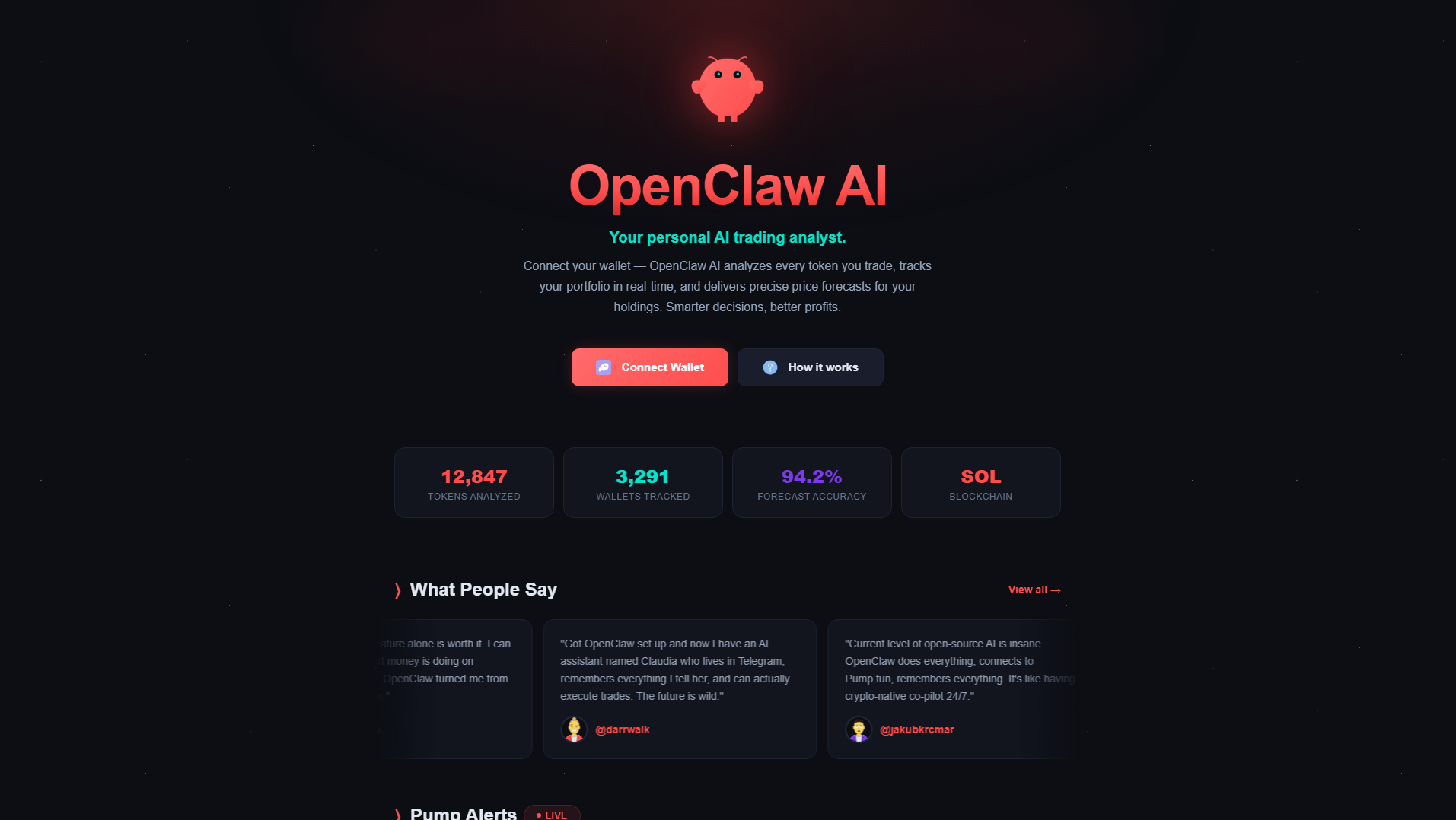
PhishDestroy first recorded openclawsai.online on 2026-06-19. Stored VirusTotal result: 10/92 engines flagged. Analysis time (as stored): 2026-10-29 23:49 UTC. Retrieved (as stored): 2026-10-30 03:12 UTC. Listed by external blocklists: MetaMask, SEAL.
Page title: “OpenClaw AI — Solana Token Analytics”
More about the sources
Recorded security signals
Stored VirusTotal result: 10/92 engines flagged. Analysis time (as stored): 2026-10-29 23:49 UTC. Retrieved (as stored): 2026-10-30 03:12 UTC. Listed by external blocklists: MetaMask, SEAL. Use caution — do not enter credentials or personal information.
PhishDestroy first recorded openclawsai.online on 2026-06-19. Stored VirusTotal result: 10/92 engines flagged. Analysis time (as stored): 2026-10-29 23:49 UTC. Retrieved (as stored): 2026-10-30 03:12 UTC. Listed by external blocklists: MetaMask, SEAL. Risk: critical (evidence score 100/100). Registrar: Global Domain Group. Status: Content unavailable. Hosting: CLOUDFLARENET - Cloudflare, Inc., US. Do not enter credentials or connect a wallet.
This domain, openclawsai.online, has been confirmed as a crypto drainer phishing site targeting cryptocurrency wallet users. Analysis indicates the infrastructure is designed to mimic legitimate decentralized application interfaces, likely deploying malicious scripts to siphon digital assets upon interaction. No direct brand impersonation has been observed, but the domain name suggests an attempt to exploit users searching for AI-related blockchain services. The absence of a known drainer kit fingerprint does not preclude the use of custom or obfuscated payloads, which are common in targeted phishing operations. Infrastructure analysis reveals the following technical indicators: the domain was registered on June 12, 2026, through Global Domain Group LLC, a registrar frequently associated with high-risk domains. It resolves to the IP address 104.21.12.112, a Cloudflare proxy endpoint that obscures the origin server. VirusTotal reports 10 out of 92 security vendors flagging the domain as malicious, while it appears on four distinct security blocklists. The domain is currently not listed in Google Safe Browsing (GSB) databases, though this may reflect a lag in detection rather than a clean status. The use of a content delivery network (CDN) proxy further complicates attribution and takedown efforts. As of the latest assessment, openclawsai.online has been taken offline, likely due to registrar intervention or hosting provider action. However, the residual risk remains elevated due to the domain's recent creation and the persistence of phishing infrastructure. Users who interacted with the domain prior to its takedown are advised to revoke any wallet permissions, rotate credentials, and monitor transaction histories for unauthorized activity. Organizations should update blocklists to include the domain and associated IP, while security teams are encouraged to analyze historical DNS resolution data for potential lateral movement or secondary infections.
What to do right now
Pick what happened and tick the steps as you go. The ticks are kept only in this browser.
This is a separate stored result. Its counts, vendors and dates do not replace the provider observation above. A retrieval date is not an analysis date.
Open report Page code check by a separate monitor · 0 / 100 · 2026-06-22 10:20 UTC
This dated monitor analysis is separate from the primary PhishDestroy analysis above. A heuristic score is not a measured probability.
Heuristic score
0
Analyzed at
2026-06-22T10:20:06Z
Source timestamp
2026-06-22 12:20:06
Technical metadata
PhishDestroy narrative
Narrative generation metadata
Open report Title, description and generation record
The narrative generation date is separate from observation dates. These are the retained publication fields, not an additional independent detection.
AI title
openclawsai.online: Confirmed Crypto Drainer Phishing Site
AI description
openclawsai.online identified as a crypto drainer phishing domain. Registered via Global Domain Group LLC, flagged by 15/95 security vendors on VirusTotal.
Earlier stored analysis, not reviewed; text generation time is separate from source observation dates.
Results reflect each source’s collection time. Zero detections do not guarantee safety. OTX references are community publications.
Collected source details
Stored page, network and scanner observations, grouped by source and observation time.
Every stored field, with its source and date
Security Signals
Scamadviser Warnings1/100
The Tranco rank (how much traffic) is rather low High risk financial services or content seems to be offered The age of this site is (very) young. The website was reported in the last 30 days as threat by DNSFilter This website appears to trade NFTs This website was reported by IPQS for phishing. This website has been classified as suspicious by IPQS
We found a valid SSL certificate
Network Security Intelligence
SSL CertificateInvalid
SSL certificate is invalid or expired. Issuer:
Other domains of OpenClaw AI
PhishDestroy has recorded 2 other domains with the same name as openclawsai.online. Sites like this often move to a new address when one is blocked; each domain has its own report.
PhishDestroy rates openclawsai.online as critical risk (evidence score 100/100) from the recorded evidence; it was first recorded on 2026-06-19. Stored VirusTotal result: 10/92 engines flagged. Analysis time (as stored): 2026-10-29 23:49 UTC. Retrieved (as stored): 2026-10-30 03:12 UTC. Listed by external blocklists: MetaMask, SEAL. The local score and a listing do not prove fraud. Check each source’s date and the exact URL.
Is openclawsai.online safe to connect a wallet?
Because of the risk signals above, do not connect a wallet, sign messages or approve token permissions on openclawsai.online. A confirmed blockchain transaction cannot be reversed.
What should I do if I used openclawsai.online?
Entered a password — change it on that service and on every other site where you used the same password
Turn on two-factor authentication — where the service offers it; an authenticator app is stronger than SMS codes
Paid or entered card or bank details — contact your bank or payment service through the contacts on your card or its official website
Connected a wallet but signed nothing — disconnect the site in the wallet and reject pending requests; a connection by itself does not move funds
Approved token spending (approve / permit) — revoke that approval with a token-approval checker
Shared a seed phrase or private key — move the remaining funds to a new wallet with a new seed phrase; the exposed wallet is no longer safe
Downloaded a file — do not open it and scan the device with security software
Keep the address, dates, payment or transaction details and messages for a report to the police or another competent authority. A report does not guarantee that money is returned. Step-by-step help: emergency guide.
What we count Elapsed time from the first stored abuse report to the first observation that the content was unavailable. This does not establish the cause.
What each report contains Stored outgoing-report records may reference evidence available at the time, such as vendor verdicts, registration data, hosting details, classifications, or screenshots. This page does not infer the exact payload delivered, receipt, acknowledgement, or action by a recipient.
Technical detailsProvenance & timestamps
First Detected2026-06-19
DOM Analysisanalyzed 2026-06-22score 100/1001 brand signal
Submitted URLhttps://openclawsai.online/
Favicon Hash
ICANN OVERSIGHT
Accreditation and RAA context
Registrar accreditation and DNS abuse obligations
For this gTLD, the registrar above operates under an ICANN accreditation agreement. The links below provide the official fee schedule and current DNS abuse compliance guidance.
Accreditation is a contract, not a safety certification.
RAA §3.18 establishes abuse-contact and handling requirements. This report can document stored outbound notices and later technical observations; it does not by itself establish receipt, investigation, remediation, or contractual non-compliance.
Certificate fingerprint8b2a48dfe8ee0e9c2b0f12a6a327c719972b0b10448be84e038edb6d1a1f971dCertificate names · 2 SANs
openclawsai.online
*.openclawsai.online
Saved certificate metadata. Certificate dates without a timezone are shown as stored. Transport encryption does not establish that the site is trustworthy.
Primary outcomeDNS inactivereason: DNS NXDOMAIN80% confidence
Attributionsource: Dns Cache
Evidence layersAvailability: DNS inactiveContent: UnreachableDNS: NXDOMAIN
RDAP registration
Observed timelinelast reachable: 2026-07-02 10:19 UTCcurrent episode first observed: 2026-09-30 16:14 UTCobserved RIP window: 2026-07-02 10:19 UTC → 2026-09-30 16:14 UTC · 2,165.93hmidpoint estimate ≈ 2026-08-16 13:17 UTC · precision very low · basis bounded
Availability, content, DNS and registration are independent evidence layers. NXDOMAIN, an unreachable origin or missing content alone does not prove registrar action. A registrar or provider is credited only when a direct technical marker identifies that actor. Report causality is shown separately.
Network requests that the URLScan browser recorded while loading the page. URLScan does not provide a hash for every request. PhishDestroy retrieved this list on 2026-10-29 03:53 UTC.
Recorded events: 13. These records describe collected evidence, outgoing notifications and publication; they do not confirm a complete investigation or a takedown.
The latest stored checks indicate that the reported content is unavailable; this does not establish who or what caused the change.
Time to First Unavailability
Hours from detection to the first unavailable observation: 1401
Recorded activity
3 entries
Lifecycle
Domain registered
Added to PhishDestroy+6 d 19 h
VirusTotal analysis with detections+132 d 19 h
VirusTotal
10/92 engine detections
+132 d 19 h
Added to PhishDestroy
openclawsai.online
same minute
URLScan
Page captured
How we investigate & report
Public scans, evidence and abuse channels
We scan suspicious URLs, inspect public results and send evidence through the appropriate abuse-reporting channels. The dated events above show what is recorded for this domain. The directory below explains the wider workflow.
01Public scans & evidence collection10 sources and tool groups
Inspect the public DNS, TLS, HTTP and technology surface.
02Abuse reports & follow-upRegistrar, hosting and security channels
Identify the responsible provider. Match registration and hosting records to the relevant abuse contact.
Prepare an evidence package. Include the URL, public scan references, captures and the recorded observations.
Send the report. Keep outgoing report records and recipient information when available.
Recheck and publish updates. Track later scanner verdicts, provider responses and site availability.
Security services used for scanning, reputation checks and reporting are listed below. A service being listed is not evidence that it received, accepted or acted on this particular domain. Recorded submissions appear in the notification history above.
Supporting signal — Shares a page feature, infrastructure or a collector label; not proof of one operator.
Discovery only — Same registrar or CDN edge: listed for navigation, not evidence of a link.
Each spoke is one reason a domain is linked to this report. Node size marks VirusTotal detections, dashed nodes are already offline, and the full lists follow below. Full list of related reports
Content matches7
Same favicon file hash, or a recorded page title that starts with the same 20 characters. A content match does not establish a shared phishing kit or owner.
You are not alone and there is nothing to be ashamed of. Scammers are sophisticated criminals who exploit trust. Reporting your experience is the most powerful weapon against fraud — your report can prevent others from becoming victims and help law enforcement take action. Secure your accounts and funds first, then report. If credentials were compromised, report immediately. Do not engage with recovery scammers.
Act on what you actually did. Entered a password: change it, and wherever you reused it. Paid or gave card details: contact your bank or payment service. Downloaded a file: scan the device. Then report the incident.
Choose the steps that match what you shared. Keep a copy of this report alongside your own records.
What should I do immediately?
Urgent
Stop using the suspicious site. Open the real service through its official app or an address you already trust.
Entered a password — change it on that service and on every other site where you used the same password
Turn on two-factor authentication — where the service offers it; an authenticator app is stronger than SMS codes
Paid or entered card or bank details — contact your bank or payment service through the contacts on your card or its official website
Downloaded a file — do not open it and scan the device with security software
Shared a seed phrase or private key — move the remaining funds to a new wallet with a new seed phrase; the exposed wallet is no longer safe
Connected a wallet but signed nothing — disconnect the site in the wallet and reject pending requests; a connection by itself does not move funds
Approved token spending (approve / permit) — revoke that approval with a token-approval checker (revoke.cash)
Sent crypto — save the transaction hash, your address and the receiving address; blockchain transactions cannot be reversed
What information should I collect for my report?
FBI guidelines
Keep original emails, receipts, messages and screenshots in a secure place. A factual timeline helps the receiving authority understand what happened. IC3 evidence guidance ↗
Payment records — if you paid, save the receipt, amount, date, payment provider and recipient details.
Exact dates & times — of each transaction and first contact with scammer
Screenshots — scam website, chat messages, emails, wallet transactions, social media
All URLs & domains used by the scammer (including openclawsai.online)
Communications — emails, texts, phone numbers, usernames the scammer used
Even if you don't have all details — file a report anyway. Partial information still helps investigations.
Where should I report the scam?
FBI IC3 — Internet Crime Complaint Center (US federal reporting)
Your bank or payment provider — contact its fraud team promptly through official contact details if money or card information was exposed.
Local police — creates an official record, even if they can't act immediately
A report is not a guarantee of recovery or investigation, but prompt, accurate transaction data can help authorities and service providers trace the incident.
How do phishing scams typically work?
Fake websites — pixel-perfect clones of legitimate sites with slightly altered domains
Pig butchering — trust built over weeks via Telegram/WhatsApp/dating apps, then money stolen
Recovery scams — fraudsters pose as recovery agents and demand upfront fees. Never share a seed phrase or pay before independently verifying the provider
AI-powered scams — deepfakes, automated phishing, and AI-generated sites making fraud harder to detect
How can I protect myself in the future?
Bookmark official sites — never click links from emails, DMs, or ads
Verify domains — check on PhishDestroy before interacting. Check HTTPS, spelling, domain age
"Too good to be true" = scam — guaranteed returns, celebrity endorsements, urgent deadlines
Beware of recovery scammers! Recovery scammers may pose as investigators, lawyers, or tracing services. Do not pay upfront fees or disclose credentials.Learn more about recovery fraud →
About this reportSources, observation dates and corrections
This report combines saved page captures, registration and network records, scanner results and PhishDestroy reporting history. Each source keeps its own observation date. Open a source report to inspect the original result.
The AI-assisted analysis was written on . It describes the evidence available at that time; later source checks can change.
A capture documents what was shown. A scanner result records that provider’s assessment at the time of its check. Neither a valid certificate nor a zero-detection result is a guarantee of safety.

 Global Domain Group


 Microsoft
 Cloudflare
 Yandex
 ESET
 Bitdefender
 Norton
 Symantec
 Avira
 Avast / AVG
 Kaspersky
 Dr.Web
 Netcraft
 PhishTank
 APWG eCX
 PhishStats
 Phish.Report
 Spamhaus
 PolySwarm
 CheckPhish
 Quttera
 Criminal IP
 CRDF
 MyWOT