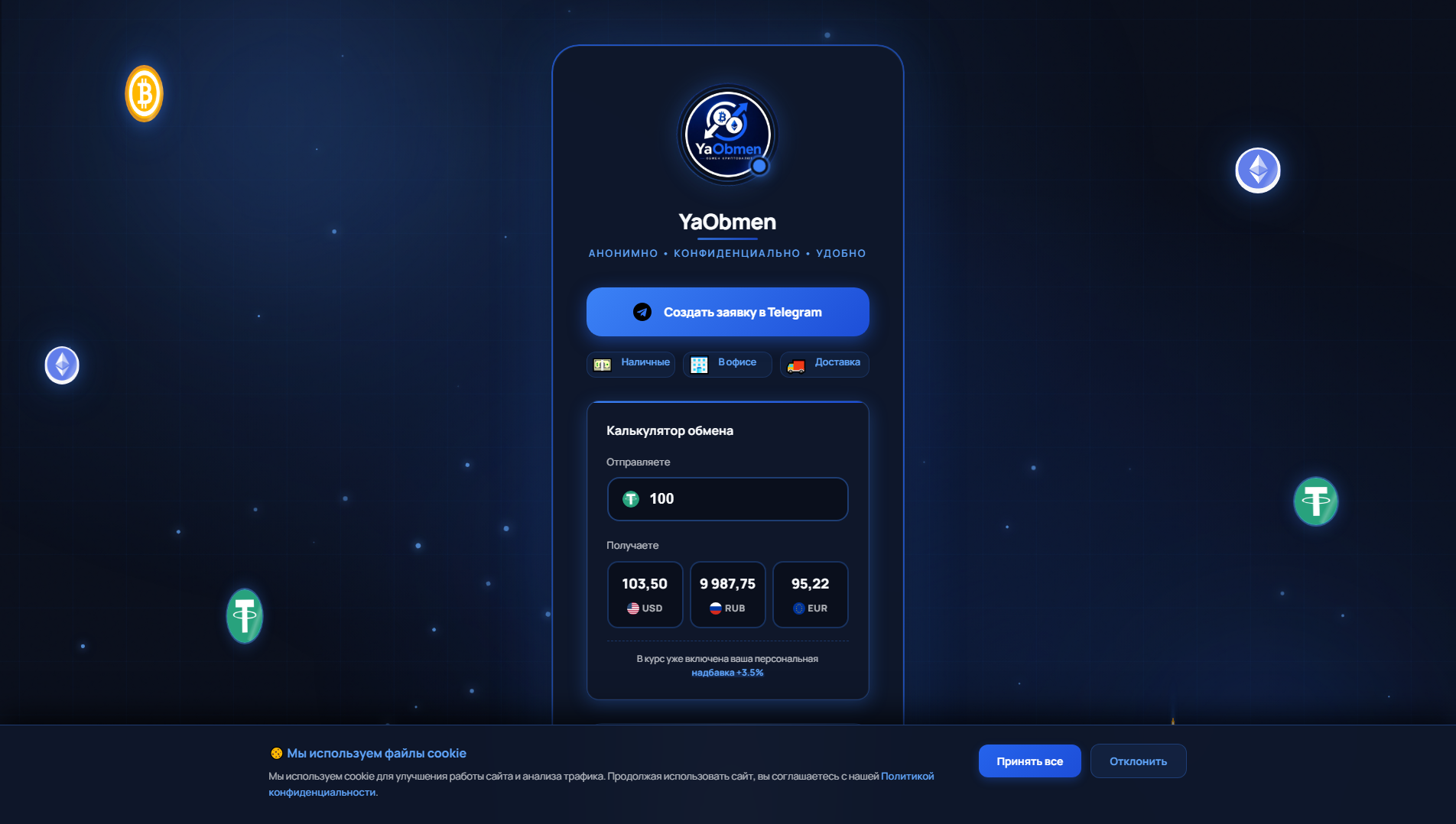
yaswap.online copied the branding of YaObmen, a USDT exchange service, under the Russian-language title "YaObmen — Выгодный обмен USDT | Наличные и переводы" ("profitable USDT exchange, cash and transfers"). It targeted Russian-speaking users who want to convert Tether into cash or bank transfers. PhishDestroy first flagged it on 2026-09-06. The site has been offline since 2026-09-11 and remained dead at the 2026-10-19 check, with its content blocked by the provider.
诈骗手法解析
Fake exchangers like this advertise better-than-market USDT rates for cash pickup or bank payouts, then give the victim a deposit address. The victim sends USDT and the promised cash or transfer never arrives. Operators often stall with requests for a "verification" or "processing" fee before cutting contact. Because the transfers are on-chain, the money is gone the moment it leaves the victim's wallet, and the familiar YaObmen name is what persuades people to send it.
证据
Fourteen of 89 VirusTotal engines flagged the domain as of 2026-09-12, including Kaspersky, BitDefender, Fortinet, Forcepoint ThreatSeeker, G-Data, Gridinsoft, CRDF and alphaMountain.ai. That is a broad mix of established vendors rather than a single outlier. Beyond PhishDestroy, MetaMask's and SEAL's blocklists also carry the domain. Wallet users who rely on those lists were warned at the point of interaction. Spamhaus lists it in its DBL as a spam domain, and the domain appears in four AlienVault OTX threat pulses.
基础设施
The domain was registered through NameCheap, Inc. on 2026-08-25, just 12 days before PhishDestroy caught it. It was offline five days after that, a short lifespan typical of disposable scam domains. Traffic ran through Cloudflare's US network, which hides the real origin server behind shared proxy addresses.
What to do
If you sent USDT to this site, do not pay any further "fee" or "unlock" charge, because no payout is coming. Save your transaction hashes, the deposit address you were given and any chat logs, and report them to the exchange you sent from and to the police. Ignore anyone offering to "recover" the funds for an upfront payment, since that is a follow-up scam. Only use exchangers you reach through a source you already trust, not through ads or links. Defenders should block yaswap.online at the DNS or proxy layer by name rather than IP, since the Cloudflare address is shared, and search logs for users who visited it.
yaswap.online is an impersonation phishing page posing as the YaObmen USDT exchange, targeting Russian-speaking users swapping crypto for cash.
AI摘要
Overview yaswap.online copied the branding of YaObmen, a USDT exchange service, under the Russian-language title "YaObmen — Выгодный обмен USDT | Наличные и переводы" ("profitable USDT exchange, cash and transfers"). It targeted Russian-speaking users who want to convert Tether into cash or bank transfers. PhishDestroy first flagged it on 2026-09-06. The site has been offline since 2026-09-11 and remained dead at the 2026-10-19 check, with its content blocked by the provider. How the scam works Fake exchangers like this advertise better-than-market USDT rates for cash pickup or bank payouts, then give the victim a deposit address. The victim sends USDT and the promised cash or transfer never arrives. Operators often stall with requests for a "verification" or "processing" fee before cutting contact. Because the transfers are on-chain, the money is gone the moment it leaves the victim's wallet, and the familiar YaObmen name is what persuades people to send it. Evidence Fourteen of 89 VirusTotal engines flagged the domain as of 2026-09-12, including Kaspersky, BitDefender, Fortinet, Forcepoint ThreatSeeker, G-Data, Gridinsoft, CRDF and alphaMountain.ai. That is a broad mix of established vendors rather than a single outlier. Beyond PhishDestroy, MetaMask's and SEAL's blocklists also carry the domain. Wallet users who rely on those lists were warned at the point of interaction. Spamhaus lists it in its DBL as a spam domain, and the domain appears in four AlienVault OTX threat pulses. Infrastructure The domain was registered through NameCheap, Inc. on 2026-08-25, just 12 days before PhishDestroy caught it. It was offline five days after that, a short lifespan typical of disposable scam domains. Traffic ran through Cloudflare's US network, which hides the real origin server behind shared proxy addresses. What to do If you sent USDT to this site, do not pay any further "fee" or "unlock" charge, because no payout is coming. Save your transaction hashes, the deposit address you were given and any chat logs, and report them to the exchange you sent from and to the police. Ignore anyone offering to "recover" the funds for an upfront payment, since that is a follow-up scam. Only use exchangers you reach through a source you already trust, not through ads or links. Defenders should block yaswap.online at the DNS or proxy layer by name rather than IP, since the Cloudflare address is shared, and search logs for users who visited it. Useful links urlscan.io scan and screenshot: https://urlscan.io/result/01a077d1-6dbf-7423-b3d7-5b97920fb2bc/ VirusTotal report: https://www.virustotal.com/gui/domain/yaswap.online Google Safe Browsing status: https://transparencyreport.google.com/safe-browsing/search?url=yaswap.online Archived copy: https://web.archive.org/web/20260906174830/https://yaswap.online/ Report phishing to Google: https://safebrowsing.google.com/safebrowsing/report_phish/ Site owner? Request a review: https://phishdestroy.io/appeals/
最新的 HTTP 观察结果观察到提供商阻塞Cloudflare 反钓鱼拦截功能CloudflarePhishing Interstitial95%服务提供商标识已验证2026-11-25 02:09 UTC
RDAP注册
观测时间线last reachable: 2026-09-15 22:18 UTCcurrent episode first observed: 2026-10-01 01:50 UTCobserved RIP window: 2026-09-15 22:18 UTC → 2026-10-01 01:50 UTC · 363.54hmidpoint estimate ≈ 2026-09-23 12:04 UTC · precision low · basis bounded
Availability, content, DNS and registration are independent evidence layers. NXDOMAIN, an unreachable origin or missing content alone does not prove registrar action. A registrar or provider is credited only when a direct technical marker identifies that actor. Report causality is shown separately.


 NameCheap


 Microsoft
 Cloudflare
 Yandex
 ESET
 Bitdefender
 Norton
 Symantec
 Avira
 Avast / AVG
 卡巴斯基
 Dr.Web
 Netcraft
 PhishTank
 APWG eCX
 PhishStats
 Phish.Report
 PolySwarm
 CheckPhish
 Quttera
 URLquery
 Criminal IP
 CRDF
 MyWOT