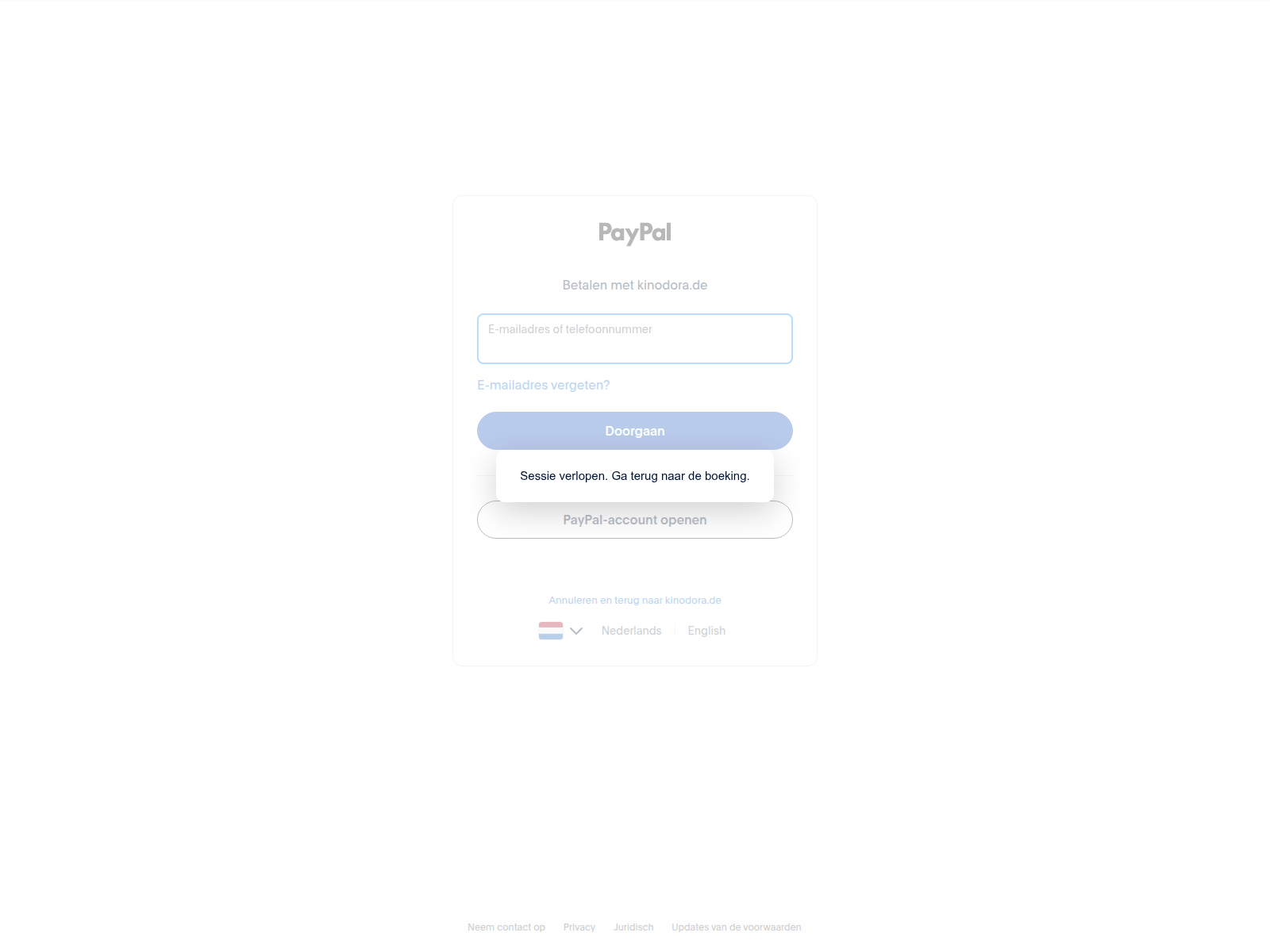
This site presents a login page mimicking PayPal in Dutch, asking visitors to enter their account credentials. If you entered your password here, change your PayPal login details immediately and secure your account.
URLScan截图 · 2026-11-21 23:04 UTC · SHA-256 4576692f…c9eb434
PhishDestroy分析,审阅版
为保留原始取证记录,下方的 PhishDestroy AI 详细分析仍使用英文。
PayPal login page layout and language
The page displays the PayPal logo centered inside a white container on a plain background, styled to mimic the authentic login experience. Below the brand heading, small text reads "Betalen met kinodora.de", indicating integration with the external subdomain rather than the official service at paypal.com. A central input field prompts the user for "E-mailadres of telefoonnummer", accompanied by a prominent blue submit button labeled "Doorgaan". A small notification box layered over the form states "Sessie verlopen. Ga terug naar de boeking.", while a secondary button offers to open a new account. At the bottom, a Dutch language selector with a flag icon sits alongside footer links for privacy and legal terms.
Credentials collection and security telemetry
The form is designed to capture user login credentials under the guise of processing a payment or session verification for kinodora.de. Spamhaus DBL lists it as phishing, and 3 of 92 VirusTotal engines flagged it on 16 Nov 2026, with security vendors including Gridinsoft, Bfore.Ai PreCrime and alphaMountain.ai among the detectors. PhishDestroy scores the evidence against it at 55/100 (high), which places the domain at a notable risk level for visitors providing personal data.
Shared hosting and related campaign infrastructure
Technical indicators link the target address to a broader network of suspicious registrations operated from the same hosting environment. Specifically, 3 other reported domains resolve to the same IP address and 8 use the same nameserver pair, pointing to a centralized setup used for deploying multiple credential harvesting templates. The neighboring instances include paypal.kinoberry.de, paypal.kinoloft.de and paypal.kinofino.de, which display similar setups or redirection patterns.
paypal.kinodora.de presents a PayPal login form in Dutch asking for credentials, flagged by Spamhaus DBL and 3 VirusTotal engines. Do not enter passwords.
AI摘要
PayPal login page layout and language The page displays the PayPal logo centered inside a white container on a plain background, styled to mimic the authentic login experience. Below the brand heading, small text reads "Betalen met kinodora.de", indicating integration with the external subdomain rather than the official service at paypal.com. A central input field prompts the user for "E-mailadres of telefoonnummer", accompanied by a prominent blue submit button labeled "Doorgaan". A small notification box layered over the form states "Sessie verlopen. Ga terug naar de boeking.", while a secondary button offers to open a new account. At the bottom, a Dutch language selector with a flag icon sits alongside footer links for privacy and legal terms. Credentials collection and security telemetry The form is designed to capture user login credentials under the guise of processing a payment or session verification for kinodora.de. Spamhaus DBL lists it as phishing, and 3 of 92 VirusTotal engines flagged it on 16 Nov 2026, with security vendors including Gridinsoft, Bfore.Ai PreCrime and alphaMountain.ai among the detectors. PhishDestroy scores the evidence against it at 55/100 (high), which places the domain at a notable risk level for visitors providing personal data. Shared hosting and related campaign infrastructure Technical indicators link the target address to a broader network of suspicious registrations operated from the same hosting environment. Specifically, 3 other reported domains resolve to the same IP address and 8 use the same nameserver pair, pointing to a centralized setup used for deploying multiple credential harvesting templates. The neighboring instances include paypal.kinoberry.de, paypal.kinoloft.de and paypal.kinofino.de, which display similar setups or redirection patterns.

 150.241.66.223


 Microsoft
 Cloudflare
 Yandex
 ESET
 Bitdefender
 Norton
 Symantec
 Avira
 Avast / AVG
 卡巴斯基
 Dr.Web
 Netcraft
 PhishTank
 APWG eCX
 PhishStats
 Phish.Report
 PolySwarm
 CheckPhish
 Quttera
 URLquery
 Criminal IP
 CRDF
 Scamadviser
 MyWOT