The authenticator was removed. The request was disputed.
A ticket image published on 13 October 2026 adds a concrete sequence to the dossier’s question: who can reset the safeguards, and what evidence do they accept?
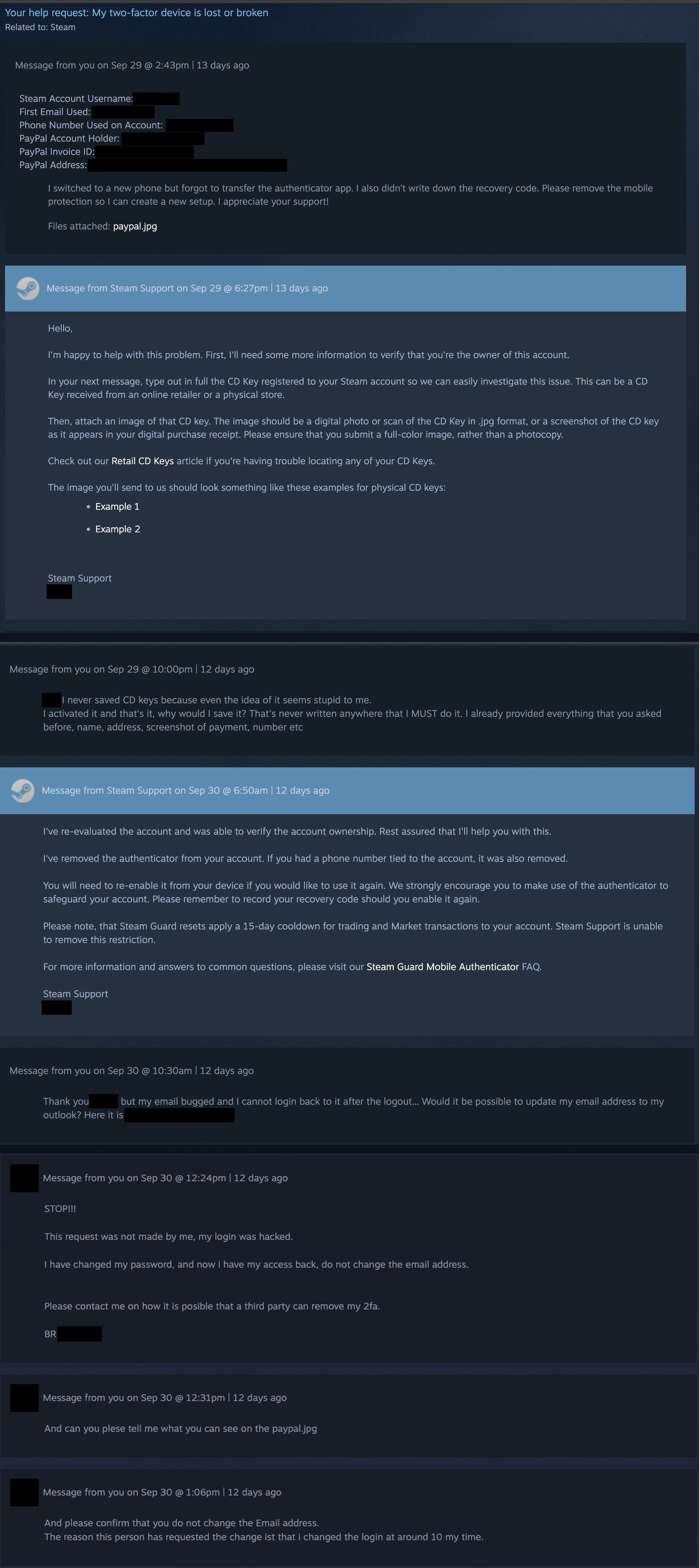
The published exchange first asks for a registered CD key. After the requester says they did not retain one, a support reply says ownership has been verified and the authenticator removed.
“I've removed the authenticator from your account.”
A later message challenges the request: This request was not made by me, my login was hacked. It asks support not to change the email address and to explain how a third party could remove two-factor authentication.
Published ticket image. Account, payment and staff identifiers were already covered in the supplied image. The full image preserves those redactions.
Removal requested
The requester describes a changed phone and a missing recovery code.
A CD key is requested
Support asks for the registered key and an image of it.
Authenticator removed
After a reassessment, support says ownership was verified.
The request is challenged
A later message says the request was unauthorized.
The poster identifies the first requester as an attacker. The image records the exchange, but does not authenticate the participants or reveal checks performed outside it. It does not establish staff complicity or a completed inventory theft. A related cross-post is also present in Tier B; it is not an additional victim. Times above are those shown in the image, with no timezone specified.
02 / The response and its limits
What the reply actually records.
Six ticket images have been read for these selected examples. Each full capture remains available. Their wording supports specific observations; the surrounding allegations need their own evidence.
Published ticket image. The preview isolates the support reply. The full capture also includes the player's request.
Dota 2 · published 14 July 2020
A reported theft. An economic reason for refusal.
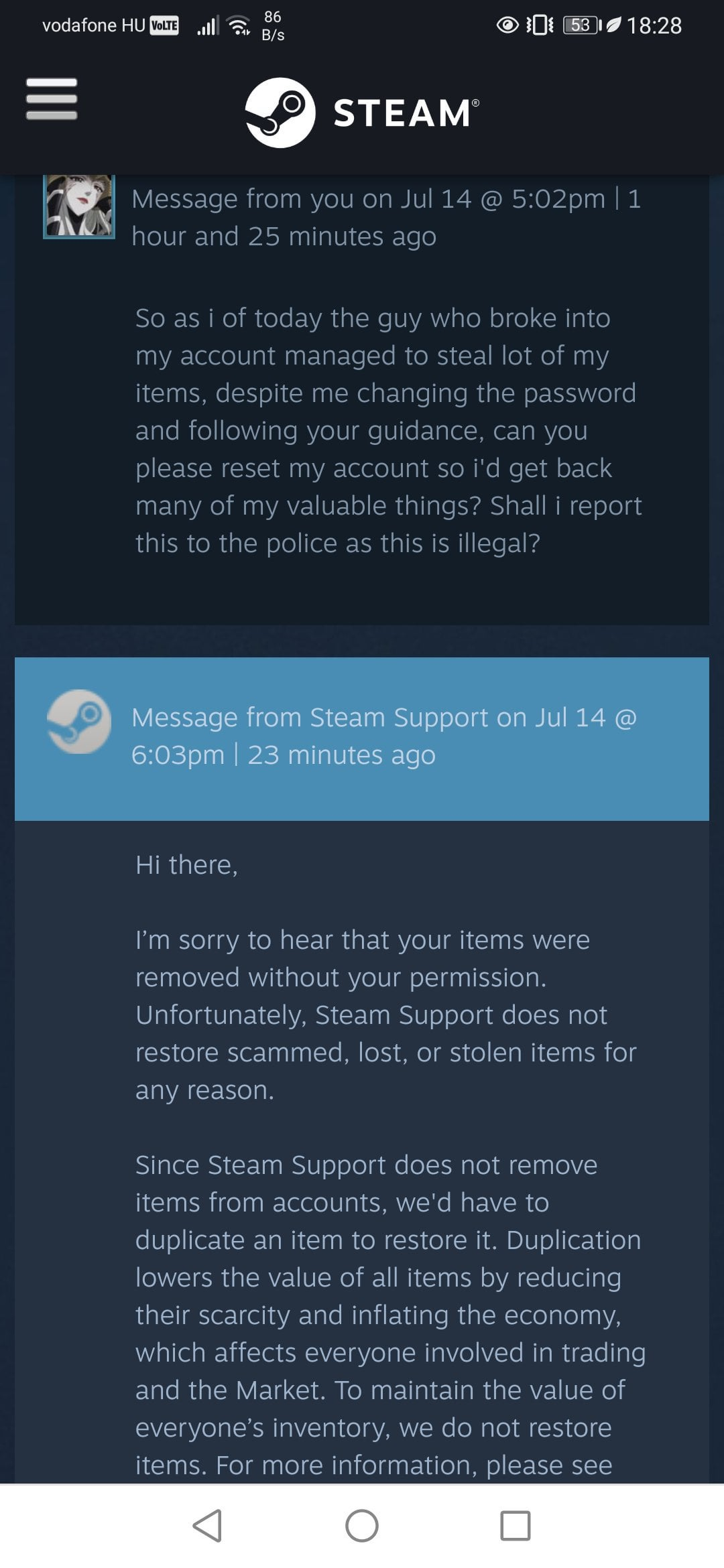
The player reports losing items after changing their password and following support guidance. The reply acknowledges removal without permission, refuses restoration, and invokes duplication, scarcity and the item economy.
“Steam Support does not restore scammed, lost, or stolen items for any reason.”
This is a published reply image. It does not establish the attack vector, the inventory value, or whether the account-security advice was followed successfully.
Published ticket image. The preview crops the Steam desktop frame. The full capture is available for context.
CS:GO · capture displays 23 April 2020
The substituted trade is described in the reply.
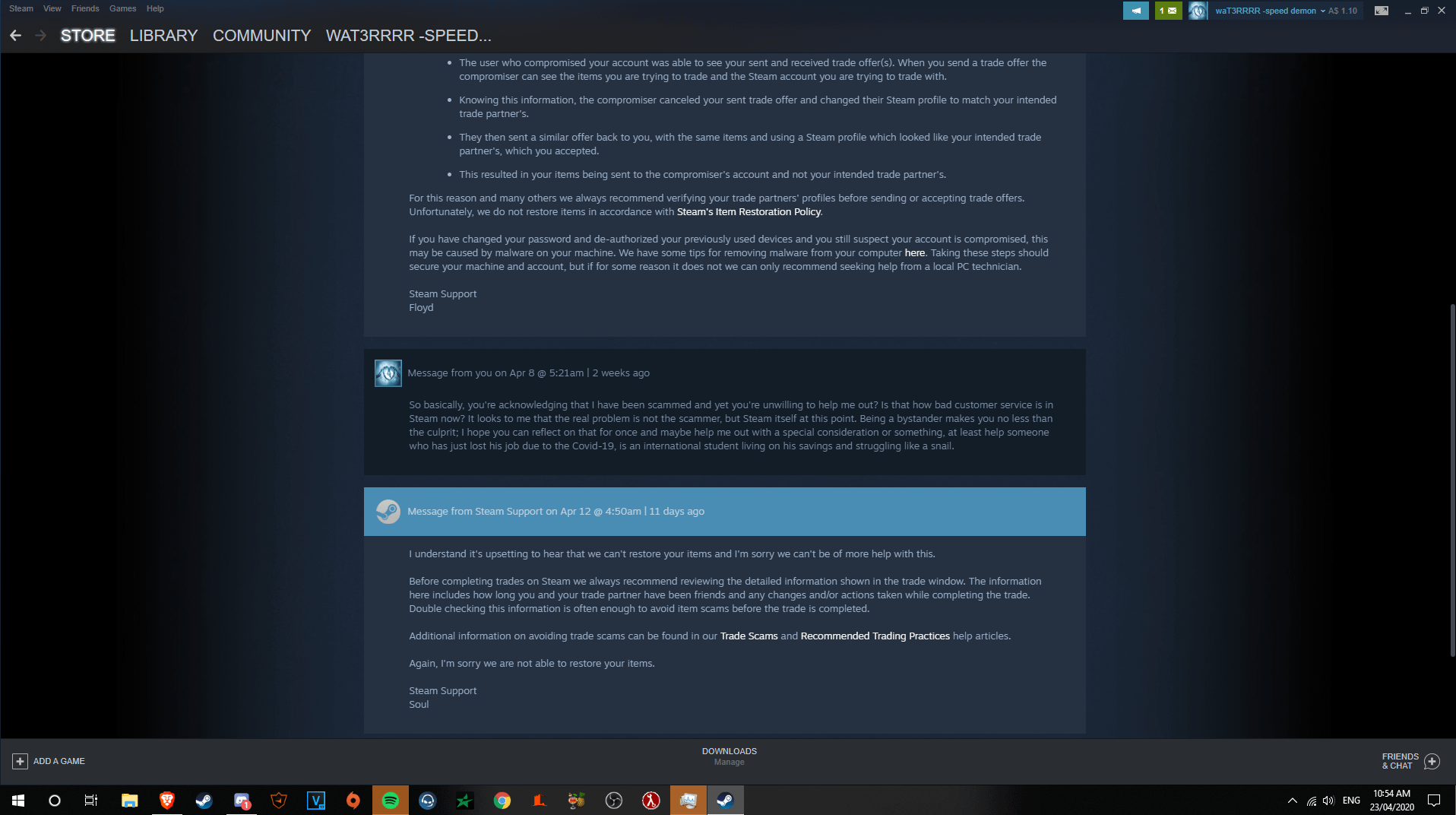
Support describes a compromiser observing and cancelling a trade offer, copying the intended partner's profile and sending a replacement offer. The same exchange refuses item restoration.
“Unfortunately, we do not restore items in accordance with Steam's Item Restoration Policy.”
The visible account describes trade substitution. This image alone does not prove that an API key, rather than another form of account access, enabled it. The date comes from the capture, not a verified publication timestamp.
Published ticket image. The full image includes the reply and the closed-request notice.
Community Market · published 21 January 2025
Unauthorized use acknowledged. The request closed.
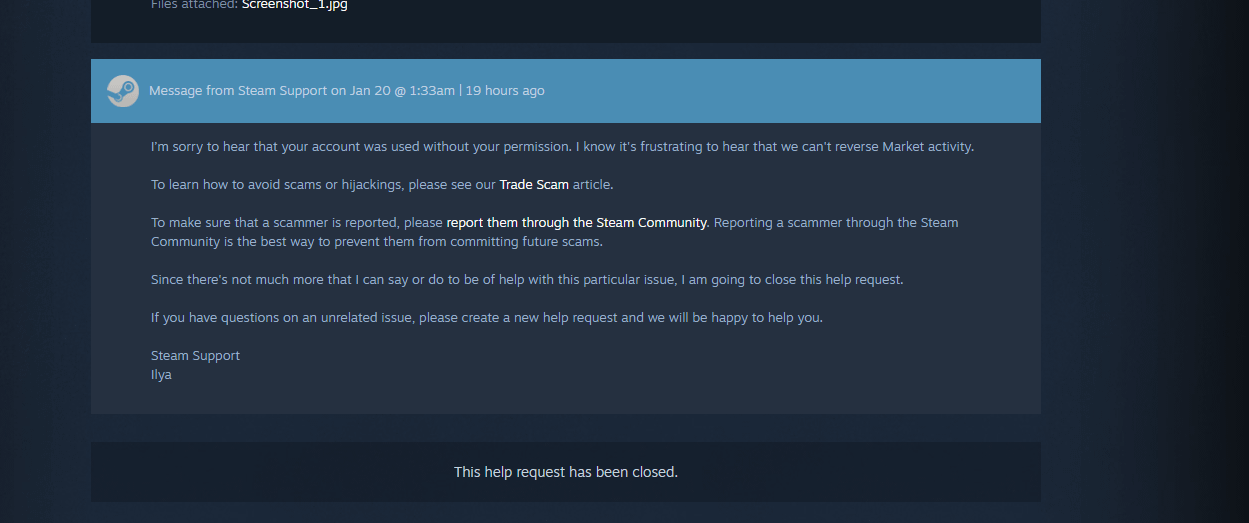
A reply dated 20 January acknowledges that the account was used without permission, says Market activity cannot be reversed, directs the user to report through the Community, and announces closure of the request. A closed-request notice is visible below it.
“Since there's not much more that I can say or do to be of help with this particular issue, I am going to close this help request.”
The image supports the wording and closure shown. It does not establish the value lost or the mechanism of unauthorized access. This Market reply predates the current CS2 Trade Protection system.
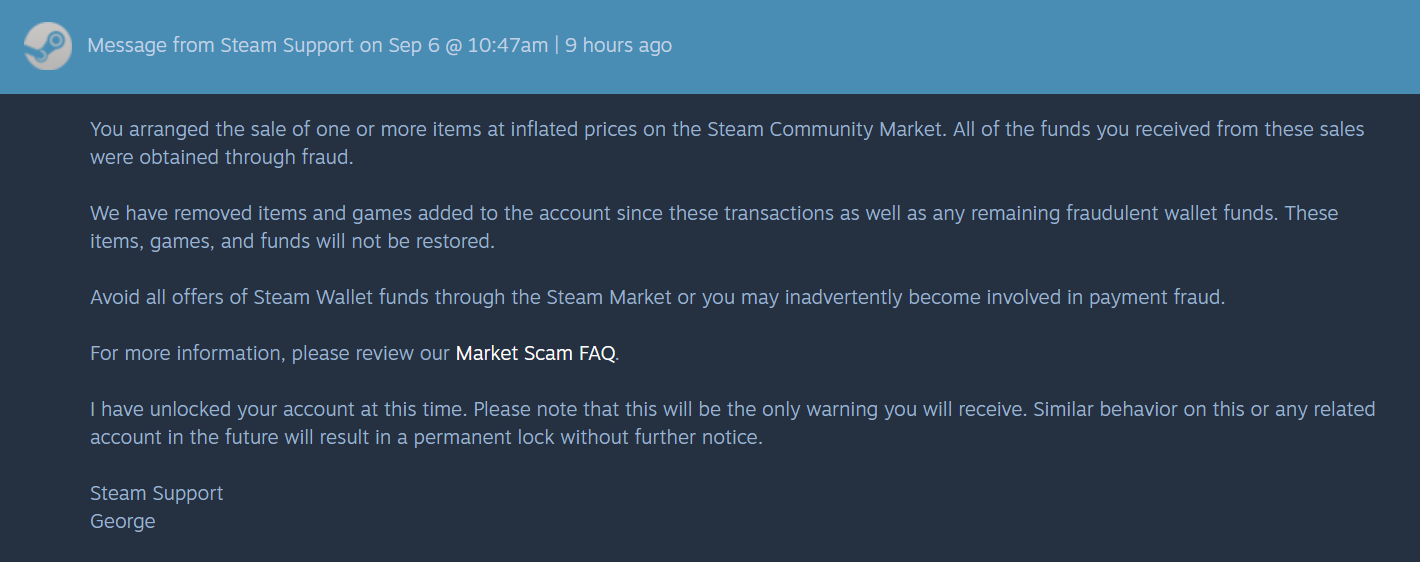
Published ticket image. The complete supplied reply is shown.
Market enforcement · published 8 September 2025
Items removed. The account unlocked with a warning.
The reply alleges that inflated-price sales involved fraudulent funds. It records the removal of items, games and Wallet funds, refuses their restoration, and says the account has been unlocked with a final warning.
“We have removed items and games added to the account since these transactions as well as any remaining fraudulent wallet funds.”
This is a recorded enforcement action and a partial resolution, not evidence that the fraud allegation was correct. It should not be counted as a simple refusal to help.
These are literal phrase matches in the collected support-text field, after normalizing whitespace and case. Policy pages, login text and search snippets are excluded from these counts. Repeated wording establishes reuse of language; it does not by itself establish that a bot handled a request.
03 / Keep the differences in the record
Restoration, deletion and reversal are different decisions.
The collection includes positive outcomes and statements of discretion. Counting every row as a refusal would erase that evidence.
Team Fortress 2 · reply displays 2 September
Deleted items: a reply describes discretion.
“We consider item restorations requests on a case-by-case basis”
In response to a question about deleted items, support describes case-by-case consideration and a typical 14-day window. The reply says support cannot explain the reason for the policy.
This concerns deleted items, not items transferred to another account. It is a statement about possible consideration, not proof that this player received a restoration. The supplied record does not establish the year.
“We have made an exception to our item restoration policy in this case”
The poster reports that a VAC ban was removed and items returned after an account compromise. The text quotes a support reply describing an exception to the restoration policy and reversal of actions taken during the compromise.
This is a quotation in a public post, not a ticket image inspected here. It describes a historical exception and does not establish a current entitlement or the frequency of restorations.
Start with Tier A report rows, or switch to Tier B and the policy material. Grouping combines repeated source URLs without pretending they are independent cases.
Titles, summaries, tags and transcriptions are collection material. The selected readings above have an additional editorial note. The default view separates policy pages and obvious non-case material from report rows.
9,051 rows, with source links and provenance.
Load the collection to search, filter and compare its records. The files below also work offline.
No records match these filters.
Try fewer words, another tier, or include policy material.
05 / Count what was supplied
A collection of records. Not a count of victims.
Collection dated 17 October 2026; integrated and counted on 18 October. The original archive is preserved with a SHA-256 fingerprint. Public reading files omit private contact details and credentials where detected.
Tier A: 2,961 rows. The collector labels 2,375 as quoted text, 571 as screenshot material and 15 as template matches. Of these rows, 2,935 contain non-empty support text. These labels do not authenticate the reply or prove the accompanying allegation.
Tier B: 6,090 rows. Reports and other incident material that did not qualify for the collector’s Tier A. A user’s description is not a quotation or admission by Valve.
8,252 distinct supplied source references; 7,965 normalized source groups across A+B. Grouping resolves relative Reddit links, removes tracking and language variants and normalizes thread URLs. Different URLs may still describe the same event.
9,030 rows have a public source URL. We resolved 44 relative Reddit paths. The other 21 rows cite local collection files and are explicitly marked as lacking a public source link; their paths are not published. These local references remain separate groups.
641 distinct image files were supplied. Six selected ticket images are reproduced here; other records retain links to their original publications.
223 policy-context rows, 20 login-page rows and 2 search-result rows are retained as context, outside the default report view. This is a limited source-type check, not a claim that every remaining row is relevant or verified.
5,727 Tier L leads are separate. They do not contribute to the 9,051-row total or the phrase counts. Reverse-image matches and search leads require verification and can repeat a single image.
Dates are not interchangeable. Register dates use valid supplied publication timestamps. A screenshot’s visible date or a ban expiry, including 2038 dates, is not silently treated as an incident date.
Why these counts differ from the supplied inventory
The delivered Tier A files contain 2,619 distinct values in the source field and 2,440 distinct non-empty support-text values. Its HTML exhibit file references 539 distinct image paths. The inventory text lists lower totals for these measures. Source fields include both web addresses and local references. This page uses counts recomputed from the delivered files, keeps their definitions explicit, and does not use either set as a count of independent cases.
Original collection tags · row counts, including context
Topic
Tier A
Tier B
Item restoration
860
544
Ban disputes
834
609
Account recovery
507
724
Reported theft
378
3,158
Closed or unanswered requests
266
755
Transaction reversals
79
29
API-key complaints
22
220
Authenticator removal
15
51
Total
2,961
6,090
The tags are inherited from the collector. For example, a restoration tag can contain a policy page or an exception. Read the source and the selected annotations before drawing a conclusion.
The exports preserve source IDs, links, collector tiers and tags. They contain the public reading fields, not an unredacted copy of every scraped page. The earlier 1,505-row support collection remains available as a separate historical file; the two totals are not added together.
Original archive SHA-256 54ae8632e3336df320b13cf5e8a09d50f428681563fdb15c810b8dd569b79b59