元のフォレンジック記録を保持するため、下の PhishDestroy AI 詳細分析は英語のままです。
Overview
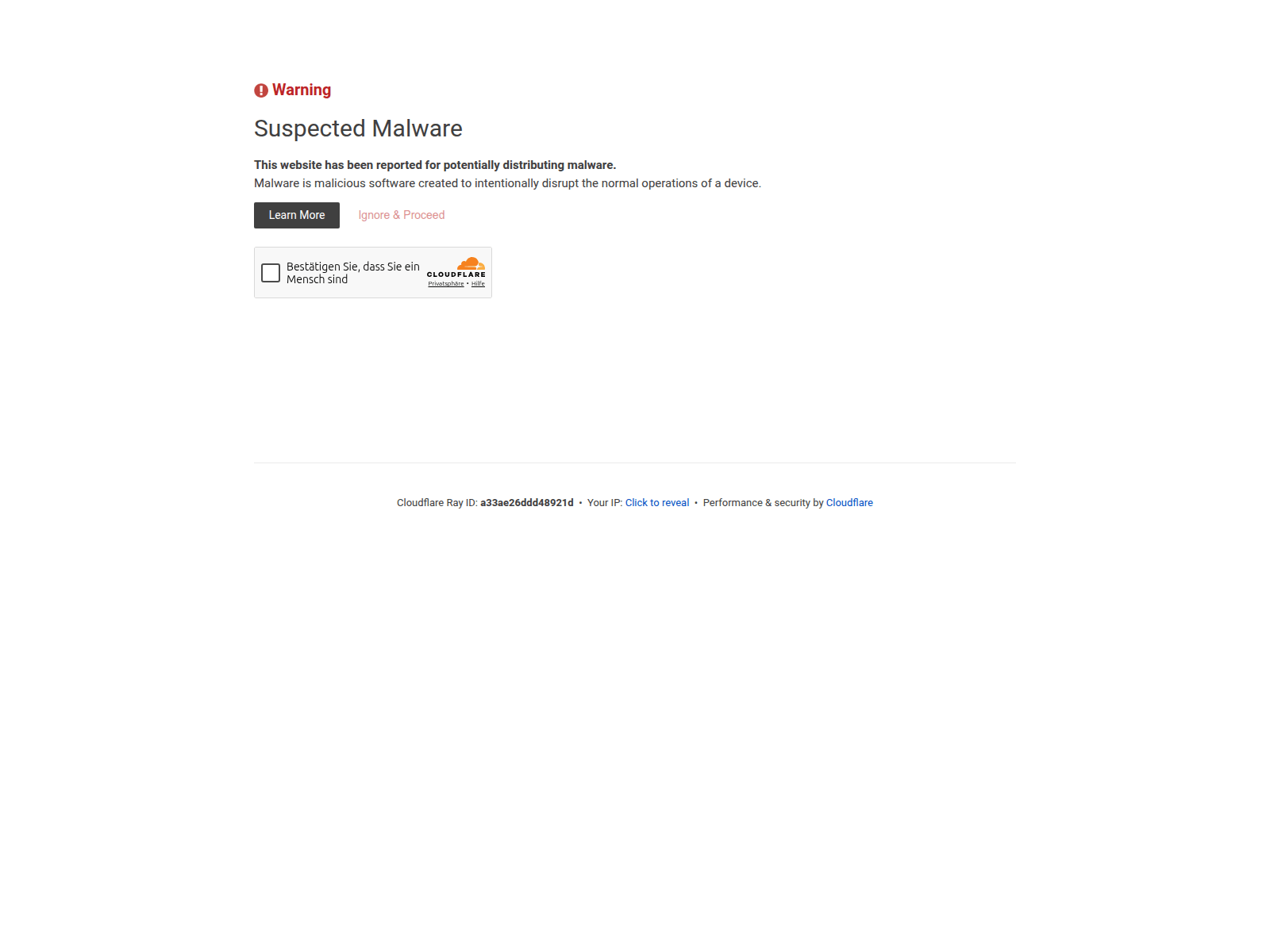
johncon.my is an impersonation phishing page that dressed itself up as a Cloudflare security notice under the title "Suspected Malware | Cloudflare". It targeted ordinary web visitors who are used to seeing Cloudflare interstitials and tend to trust them. PhishDestroy first saw the domain on 2026-08-27. The site has been offline since 2026-09-11 and was still dead when last checked on 2026-10-19.
詐欺の手口
Fake Cloudflare pages exploit a familiar moment: the visitor expects a quick security check before reaching a site. A "Suspected Malware" warning adds urgency, pushing the visitor to follow whatever the page says to clear the alert. In this kind of scheme that usually means entering login details, downloading a supposed fix, or pasting and running a command. The victim can lose account credentials or end up with malware on their machine. Cloudflare does not ask visitors to log in, install software or run commands to pass its checks.
証拠
Sixteen of 90 VirusTotal engines flagged the domain as of 2026-09-06, including BitDefender, ESET, Forcepoint ThreatSeeker, alphaMountain.ai, Certego, Chong Lua Dao, CRDF and CyRadar. That spread across unrelated vendors makes a false positive unlikely. urlscan.io rated the page malicious and recognized generic Cloudflare branding on it. The domain is also referenced in 9 AlienVault OTX threat pulses and is listed on the PhishDestroy blocklist.
インフラ
The site resolved to an address on Cloudflare, Inc.'s network, geolocated to Canada. Its certificate came from Google Trust Services (WE1), the issuer commonly used for Cloudflare-fronted sites. The padlock therefore said nothing about legitimacy, and the page looked technically convincing as a Cloudflare screen. It went offline about two weeks after PhishDestroy first saw it.
What to do
If you entered a password on this page, change it right away and turn on two-factor authentication. Change it on every other service where you reused it as well. If you downloaded a file or ran a command it suggested, disconnect the device and run a full scan with up-to-date security software. Then change passwords from a separate, clean device. Defenders should block johncon.my and search proxy and DNS logs for visits from 2026-08-27 onward. Users should also be reminded that genuine Cloudflare checks never ask for credentials, downloads or commands.
johncon.my was a Cloudflare impersonation phishing page posing as a "Suspected Malware" warning to trick visitors into trusting fake security prompts.
AIによる要約
Overview johncon.my is an impersonation phishing page that dressed itself up as a Cloudflare security notice under the title "Suspected Malware | Cloudflare". It targeted ordinary web visitors who are used to seeing Cloudflare interstitials and tend to trust them. PhishDestroy first saw the domain on 2026-08-27. The site has been offline since 2026-09-11 and was still dead when last checked on 2026-10-19. How the scam works Fake Cloudflare pages exploit a familiar moment: the visitor expects a quick security check before reaching a site. A "Suspected Malware" warning adds urgency, pushing the visitor to follow whatever the page says to clear the alert. In this kind of scheme that usually means entering login details, downloading a supposed fix, or pasting and running a command. The victim can lose account credentials or end up with malware on their machine. Cloudflare does not ask visitors to log in, install software or run commands to pass its checks. Evidence Sixteen of 90 VirusTotal engines flagged the domain as of 2026-09-06, including BitDefender, ESET, Forcepoint ThreatSeeker, alphaMountain.ai, Certego, Chong Lua Dao, CRDF and CyRadar. That spread across unrelated vendors makes a false positive unlikely. urlscan.io rated the page malicious and recognized generic Cloudflare branding on it. The domain is also referenced in 9 AlienVault OTX threat pulses and is listed on the PhishDestroy blocklist. Infrastructure The site resolved to an address on Cloudflare, Inc.'s network, geolocated to Canada. Its certificate came from Google Trust Services (WE1), the issuer commonly used for Cloudflare-fronted sites. The padlock therefore said nothing about legitimacy, and the page looked technically convincing as a Cloudflare screen. It went offline about two weeks after PhishDestroy first saw it. What to do If you entered a password on this page, change it right away and turn on two-factor authentication. Change it on every other service where you reused it as well. If you downloaded a file or ran a command it suggested, disconnect the device and run a full scan with up-to-date security software. Then change passwords from a separate, clean device. Defenders should block johncon.my and search proxy and DNS logs for visits from 2026-08-27 onward. Users should also be reminded that genuine Cloudflare checks never ask for credentials, downloads or commands. Useful links urlscan.io scan and screenshot: https://urlscan.io/result/01a05712-bc71-7684-9c63-b0eabf27d2e7/ VirusTotal report: https://www.virustotal.com/gui/domain/johncon.my Google Safe Browsing status: https://transparencyreport.google.com/safe-browsing/search?url=johncon.my Report phishing to Google: https://safebrowsing.google.com/safebrowsing/report_phish/ Site owner? Request a review: https://phishdestroy.io/appeals/
The owner of the website is using a service to hide their identity on WHOIS According to Tranco this site has a low rank This website is (very) young. We tried to analyze the content of the site but failed
Cloudflare is a web-infrastructure and website-security company, providing content-delivery-network services, DDoS mitigation, Internet security, and distributed domain-name-server services.
This report concerns an automated cryptocurrency laundering machine on the Polygon network that is used by the operators of an active macOS malware (stealer) campaign. CONTEXT The malware campaign delivers a macOS stealer via fake "CipherCheck — I'm not a robot" verification p
“This report concerns an automated cryptocurrency laundering machine on the Polygon network that is used by the operators of an active macOS malware (stealer) campaign. CONTEXT The malware campaign delivers a macOS stealer via fake "CipherCheck — I'm not a robot" verification pages. Victims are tricked into pasting a base64-encoded command into Terminal, which installs a persistent LaunchAgent and pulls a second-stage payload from a Polygon smart contract used as a C2 directory (contract 0xA3a”

 Global Domain Group
 172.67.134.113


 Microsoft
 Cloudflare
 Yandex
 ESET
 ビットディフェンダー
 Norton
 Symantec
 Avira
 Avast / AVG
 カスペルスキー
 Dr.Web
 ネットクラフト
 PhishTank
 APWG eCX
 PhishStats
 Phish.Report
 Spamhaus
 PolySwarm
 CheckPhish
 Quttera
 URLquery
 Criminal IP
 CRDF
 MyWOT