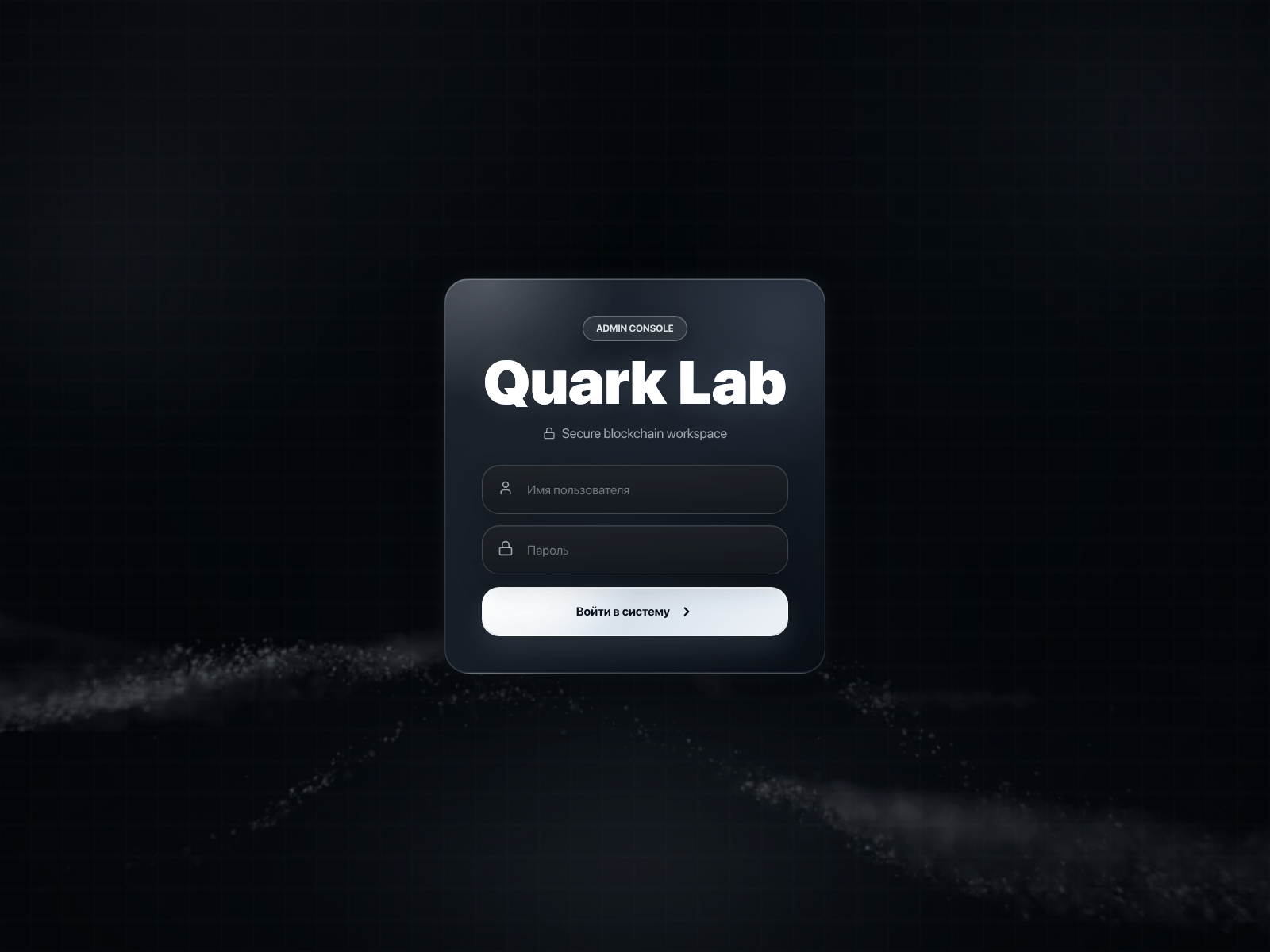
The site presents a login interface branded as Quark Lab that collects user credentials. Visitors who entered their information should immediately change their passwords on any accounts using the same credentials.
URLScanによるキャプチャ · 2026-11-20 20:01 UTC · SHA-256 f0dcfa7f…71a0597
PhishDestroyの分析(レビュー済み版)
元のフォレンジック記録を保持するため、下の PhishDestroy AI 詳細分析は英語のままです。
Quark Lab login interface
The page presents a dark, minimalist login dialog centered against a dark background with subtle particle effects. Above the main heading, a small badge reads "ADMIN CONSOLE" followed by the prominent title "Quark Lab". Directly beneath this, smaller text reads "Secure blockchain workspace". The interface provides two input fields with placeholder text in Russian, featuring icons for a user and a lock, which translate to "Имя пользователя" and "Пароль". At the bottom of the card, a prominent white button with the text "Войти в систему" and a right arrow invites the visitor to submit their credentials. The layout focuses entirely on capturing user authentication details within a pseudo-professional workspace facade.
Credential collection and vendor feedback
The form asks visitors to enter their account username and password inside the designated fields. Because 1 of 92 VirusTotal engines flagged it on 19 Nov 2026, with Forcepoint ThreatSeeker listing the address as suspicious, security telemetry notes the presence of this unverified login portal. Entering credentials here directly transmits them to whoever controls the underlying server, risking unauthorized access to any matching accounts.
Registration timeline
It was registered on 17 Nov 2026, 3 days before it was first reported, utilizing NICENIC INTERNATIONAL GROUP CO., LIMITED as the registrar. The address still responded on 20 Nov 2026 at 21:02 UTC. Such a short interval between creation and public reporting offers little time for establishing operational history or trust.
adlkaskdlaskdlaskdasd.xyz presents a Quark Lab workspace login form requesting credentials, flagged by 1 VirusTotal engine. Change passwords if entered.
Dga domains DGA Domains Security threats Security Risks New Domains
レジストラの背景情報NiceNIC
Stored registration data identifies NICENIC INTERNATIONAL GROUP CO., LIMITED (IANA 3765) as the registrar. PhishDestroy maintains separate NiceNIC abuse-report research; registrar association is contextual and is not an independent detection for this domain.
出典NICENIC INTERNATIONAL GROUP CO., LIMITEDmechanism: Registrar clientHoldsource: Rdap Status Collector
エビデンスレイヤーAvailability: DNS inactiveContent: UnreachableDNS: NXDOMAINRegistration: Registrar clientHold
RDAP登録レジストラのclientHoldNICENIC INTERNATIONAL GROUP CO., LIMITED · IANA 3765RDAP HTTP 200source: Rdap Status CollectorclientDeleteProhibitedclientHoldclientTransferProhibitedServertransferprohibitedexpires 2027-11-17 23:59 UTCチェック済み 2026-11-25 08:34 UTC
レジストラのアクションマーカー検証済みclientHoldマーカーNICENIC INTERNATIONAL GROUP CO., LIMITED · IANA 3765当報告書との因果関係は立証されていない
観測されたタイムラインlast reachable: 2026-11-22 12:07 UTClast content: 2026-11-22 12:07 UTCcurrent episode first observed: 2026-11-23 06:03 UTCobserved RIP window: 2026-11-22 12:07 UTC → 2026-11-23 06:03 UTC · 17.94hmidpoint estimate ≈ 2026-11-22 21:05 UTC · precision medium · basis bounded
Availability, content, DNS and registration are independent evidence layers. NXDOMAIN, an unreachable origin or missing content alone does not prove registrar action. A registrar or provider is credited only when a direct technical marker identifies that actor. Report causality is shown separately.
使用技術 · 1 identified
N
Nginx
Nginx is a web server that can also be used as a reverse proxy, load balancer, mail proxy and HTTP cache.
Registrar policy. Per Nicenic International Group Co., Limited's published terms: ““Services may be used only for lawful purposes… fraud, abuse and illegal activity prohibited. Violations may result in immediate suspension.” + dedicated abuse handling and takedown”
Applicable law. Domestic legal framework (Hong Kong (China)): Crimes Ordinance Cap.200 (Fraud), Theft Ordinance Cap.210 §16A (fraud by deception), Personal Data (Privacy) Ordinance Cap.486.

 NiceNIC
 94.26.90.44


 Microsoft
 Cloudflare
 Yandex
 ESET
 ビットディフェンダー
 Norton
 Symantec
 Avira
 Avast / AVG
 カスペルスキー
 Dr.Web
 ネットクラフト
 PhishTank
 APWG eCX
 PhishStats
 Phish.Report
 PolySwarm
 CheckPhish
 Quttera
 URLquery
 Criminal IP
 CRDF
 Scamadviser
 MyWOT