Inside the Machine: How Crypto Scammers
Hijack Bing & DuckDuckGo
An investigative report with live SEMrush data exposing two parallel SEO attack operations pushing crypto phishing sites to the top of Bing and DuckDuckGo search results. 10 domains. 2 attack vectors. 100,000+ potential victims per month.

All data in this report was collected via SEMrush API and phishdestroy.io for cybersecurity research purposes. Domain names are published to warn users, not to promote them.
The Two Attack Vectors
Our investigation uncovered two completely different, parallel operations running simultaneously to push phishing sites to the top of Bing and DuckDuckGo results.
Vector A: The Yahoo SERP Injection Attack
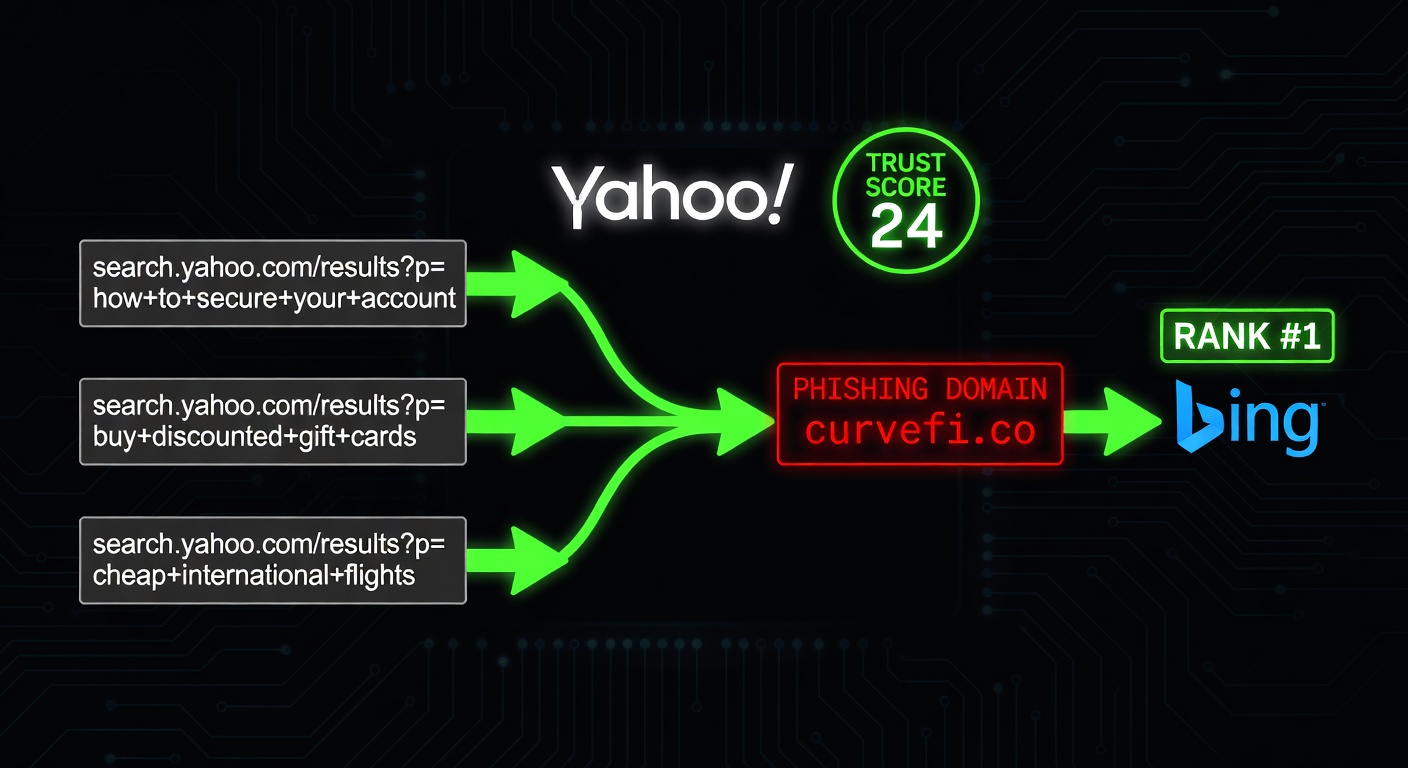
This is arguably the most technically elegant black-hat SEO attack we have documented in 2026. It exploits a fundamental flaw in how Bing evaluates link authority — specifically, its inability to distinguish between genuine editorial links and dynamically generated search result pages from trusted domains.
The Mechanism — Step by Step
Step 1 — Generating the trusted carrier URL. Attackers craft URLs on Yahoo’s mobile search endpoints across multiple international subdomains: no.search.yahoo.com (Norway), fr.search.yahoo.com (France), mx.search.yahoo.com (Mexico), pl.search.yahoo.com (Poland), gr.search.yahoo.com (Greece), qc.search.yahoo.com (Quebec), chfr.search.yahoo.com (Swiss French), co.search.yahoo.com (Colombia). These pages carry Yahoo’s inherited Authority Score: 23–24.
Step 2 — Embedding the phishing anchor. Each URL contains a completely random, innocent search query — “pele+fifa”, “Jean-Paul+Sartre”, “Radio+Stars”, “jucheck.exe” — but the anchor text reads: curvefi.co Curve Finance. The randomized queries ensure no pattern-matching by spam filters.
Step 3 — Forced crawl & indexation. Attackers push Bingbot to crawl these URLs using mass ping services, forum/blog comment injections, and automated crawl triggering tools.
Google’s algorithm: “This is a dynamic search page. No link equity transfer.”
Bing’s algorithm: “yahoo.com links to curvefi.co with anchor ‘Curve Finance DEX’. Ranking signal accepted. ✓”
Result: phishing site climbs to TOP 3 for “Curve Finance” on Bing and DuckDuckGo.
Raw SEMrush Evidence — curvefi.co
| AS | Source Domain | Anchor Text |
|---|---|---|
| 24 | chfr.search.yahoo.com | www.curvefi.co Curve Finance |
| 24 | co.search.yahoo.com | curvefi.co Curve Finance |
| 24 | fr.search.yahoo.com | curvefi.co Curve Finance |
| 24 | mx.search.yahoo.com | www.curvefi.co Curve Finance |
| 24 | no.search.yahoo.com | www.curvefi.co Curve Finance |
| 24 | pl.search.yahoo.com | www.curvefi.co Curve Finance |
| 23 | gr.search.yahoo.com | www.curvefi.co Curve Finance |
| 23 | qc.search.yahoo.com | curvefi.co Curve Finance |
The brutal irony: The site has zero organic keywords, zero traffic in SEMrush’s database — yet it appears in Bing/DDG results for “Curve Finance” because of Yahoo’s borrowed authority.
Vector B: The Coordinated PBN Network
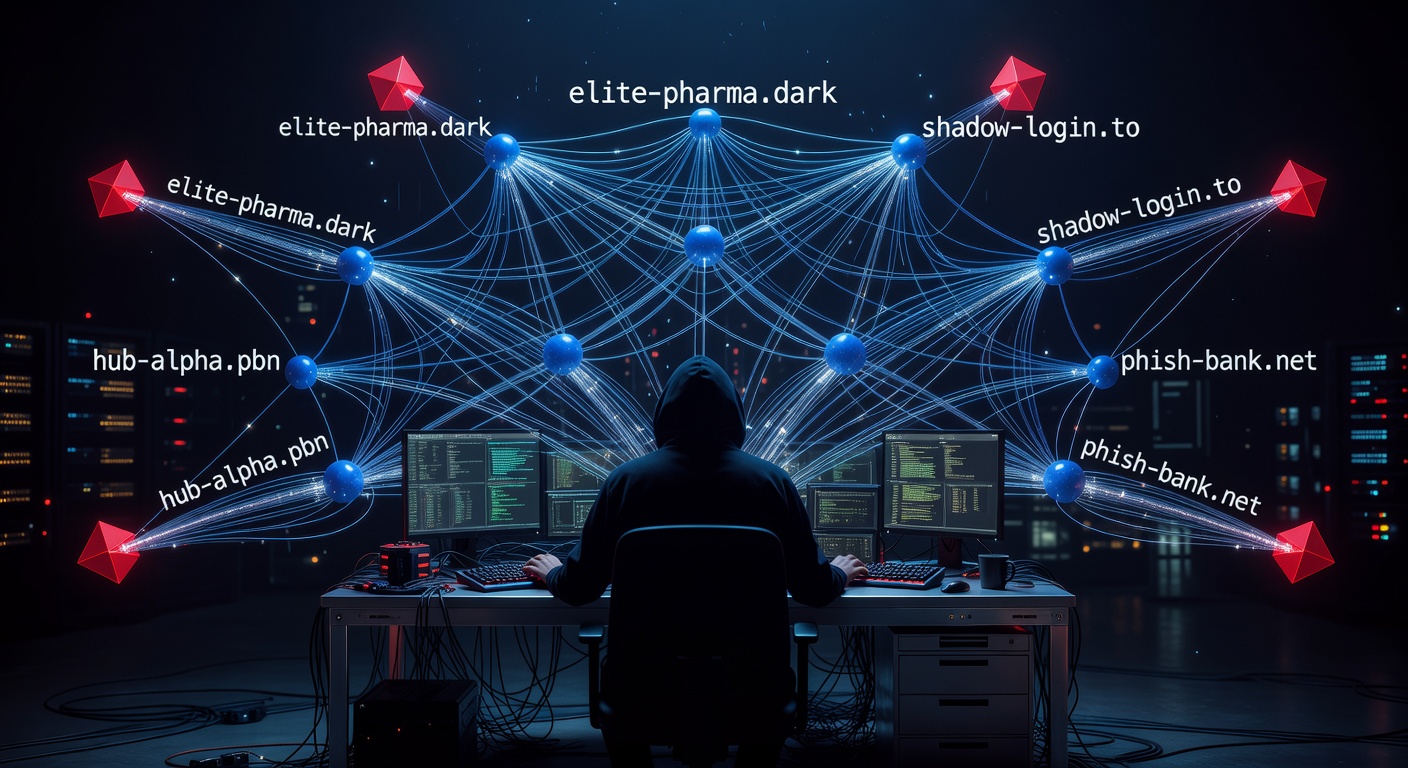
This is where the investigation gets truly alarming. Five separate phishing sites — rabbys.at, dexscreener.at, monero-wallet.at, trezorsuite.at, and keplr.me — all share an identical set of backlink sources. This is not coincidence. This is a single organized criminal operation running multiple phishing campaigns from one infrastructure.
The Smoking Gun — Shared Infrastructure
| PBN Donor Domain | AS | rabbys | dexscr | monero | trezor |
|---|---|---|---|---|---|
lewievuittton.com | 65 | ✓ | ✓ | ✓ | ✓ |
lyricamed.us.com | 61 | ✓ | ✓ | ✓ | ✓ |
creatfx.com | 60 | ✓ | ✓ | ✓ | ✓ |
jba.com.jo | 56 | ✓ | ✓ | ✓ | ✓ |
jornaldevinhedo.com | 56 | ✓ | ✓ | ✓ | ✓ |
jasaaspalhotmix.com | 54 | ✓ | ✓ | ✓ | ✓ |
magna-eg.com | 50 | ✓ | ✓ | ✓ | ✓ |
markjohnsonbuilders | 50 | ✓ | ✓ | ✓ | ✓ |
nextplayflix.com | 49 | ✓ | ✓ | ✓ | ✓ |
The top PBN donor (AS 65) is itself a typosquat of Louis Vuitton. This PBN donor is a scam site propping up other scam sites — criminal infrastructure all the way down.
Phishing Domain Profiles
| Domain | Impersonates | Keywords | Top Target | Volume |
|---|---|---|---|---|
dexscreener.at | DexScreener | 64 | “dexscreener” #42 | 60,500/mo |
rabbys.at | Rabby Wallet | 15 | “rabby wallet” #51 | 5,400/mo |
trezorsuite.at | Trezor Suite | 7 | “trezor suite” #32 | 4,400/mo |
aster-dex.at | Aster DEX | 13 | “aster交易所” #25 | 3,600/mo |
monero-wallet.at | Monero Wallet | 4 | “xmr wallet online” #26 | 210/mo |
keplr.me | Keplr Wallet | 0 | Comment spam stealth | N/A |
bscscan.cfd | BSCScan | 0 | Bulk spam links | N/A |
curvefinance.co | Curve Finance | 0 | Yahoo injection only | N/A |
curvefi.co | Curve Finance | 0 | Yahoo injection only | N/A |
app-crv.net | Curve app | 0 | Mixed techniques | N/A |
Users searching “trezor suite download” are actively looking to install wallet software. A phishing site at position #3–5 on DuckDuckGo means users downloading malware thinking it’s a hardware wallet interface. This is not theoretical — it is happening right now.
The AI-Powered Article Farm
The aster-dex.at variant uses a hybrid approach, combining Yahoo injection with AI-generated blog content placed on compromised or purpose-built sites across Vietnam, Italy, Indonesia, and Switzerland.

The blog articles all have near-identical titles: “Why Token Swaps and Liquidity Pools Still Trip Up Even Seasoned DEX Traders”, “Why Automated Market Makers Still Surprise Traders”. These are AI-generated articles placed on sites with AS 21–36, all linking to aster-dex.at.
Comment Spam Infiltration
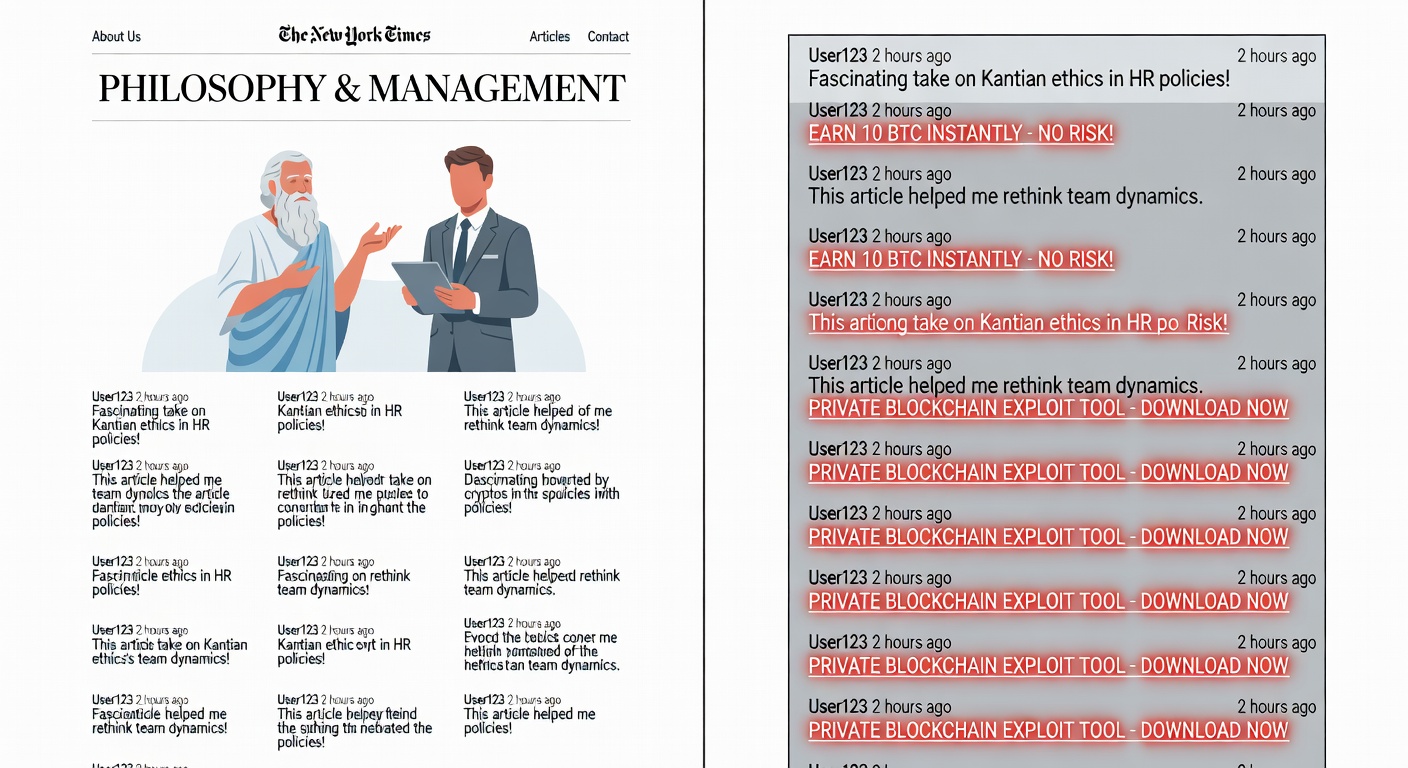
keplr.me takes a different approach entirely — pure comment spam on unrelated high-authority sites. Fake user names like “ZackaryThymn”, “Fritzkah”, “Jamesboach” inject crypto wallet anchors into philosophy education sites (filozofija.edu.rs, AS 45), employee engagement platforms (bavave.com, AS 63), and arts festivals (lea-festival.com, AS 50).
The Bottom of the Barrel: Automated Tool Spam
bscscan.cfd uses the crudest possible method: paid bulk backlink packages from sites literally named rankongoogle.agency and linksjump.click. All sources have AS = 0. The .cfd TLD is a known spam indicator. Yet on Bing, even this partially works — volume of low-quality links can influence rankings on brand-new domains with no negative history.
Why Bing & DuckDuckGo Are Specifically Vulnerable
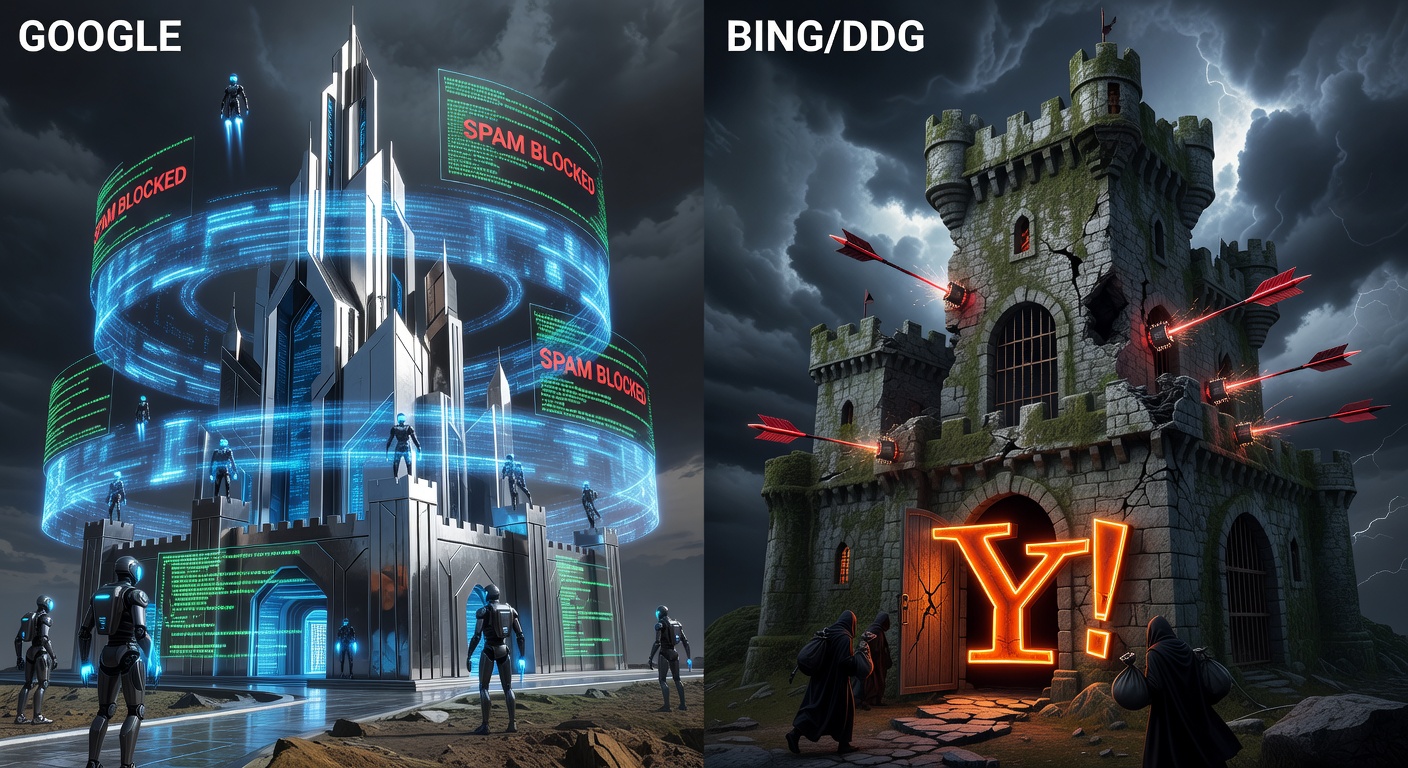
| Feature | Bing | |
|---|---|---|
| Dynamic page detection | No link equity from search result pages | Yahoo search pages treated as editorial content |
| Spam ML maturity | 15+ years SpamBrain training data | Less mature; PBN AS 50–65 still works |
| Brand protection | Aggressive; curvefinance.co flagged quickly | .at/.co TLD scams survive longer |
| AI content farms | Detection deployed 2023+ | AI farms on .vn, .it still earn passing scores |
| Phishing blocking | Safe Browsing blocks known domains fast | SmartScreen misses newly registered scam domains |
DDG uses Bing’s index as its primary data source, inheriting all of Bing’s vulnerabilities. Privacy-focused users who prefer DDG are often crypto-savvy — making them higher-value targets. DDG has no independent spam reporting mechanism; reports go to Bing.
Keyword Targeting Strategy
The keyword profiles reveal surgical precision in target selection. Operators target not just primary brand terms but typosquats (“rabbi wallet”, “rubby wallet”, “dexscrenner”) and even Chinese-language queries (“aster交易所” ranking #25).
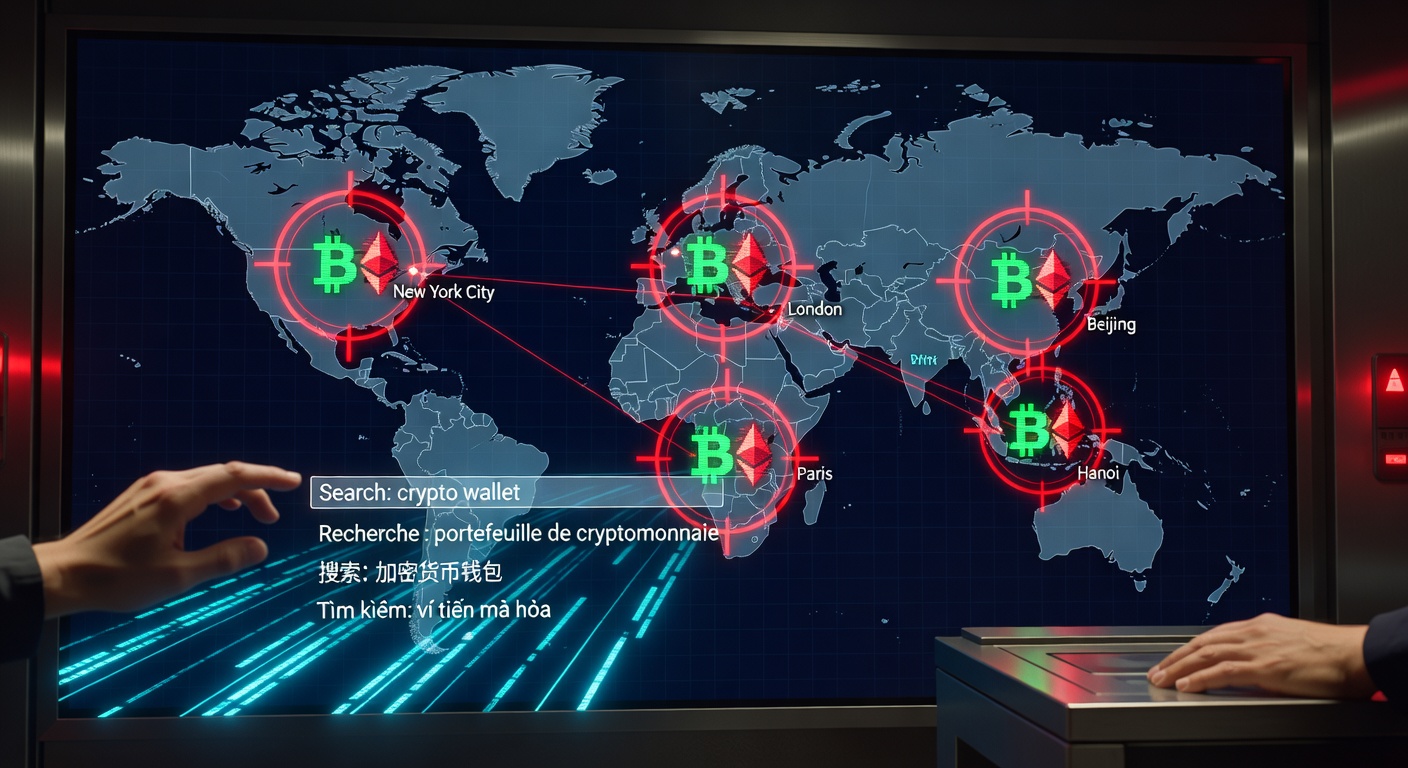
| Target Keyword | Monthly Volume | Scam Domain | Position |
|---|---|---|---|
| dexscreener | 60,500 | dexscreener.at | #42 |
| rabby wallet | 5,400 | rabbys.at | #51–71 |
| trezor suite | 4,400 | trezorsuite.at | #32–85 |
| aster dex | 3,600 | aster-dex.at | #63 |
| dexscrenner typo | 2,400 | dexscreener.at | #45 |
| aster交易所 Chinese | 1,000 | aster-dex.at | #25 |
| trezor suite download | 260 | trezorsuite.at | #54 |
| rabbi wallet typo | 210 | rabbys.at | #54 |
| xmr wallet online | 210 | monero-wallet.at | #55–69 |
Historical Context: The Trust Wallet / DuckDuckGo Problem
These attacks are not new. The problem was significantly more severe when wallets like Trust Wallet used DuckDuckGo as their default in-app search engine. Users searching for DeFi protocols from within their wallet were served phishing results as the #1 result — with zero complex SEO required. The combination of a privacy-focused search engine with weaker spam detection and a crypto wallet with a built-in browser created a perfect storm for phishing.
Even after Trust Wallet switched away from DDG as the default, the underlying vulnerability persists. Any user who manually chooses DuckDuckGo for privacy — a demographic that heavily overlaps with crypto users — remains exposed to these exact attacks today. The scam operations documented in this report have been running variations of this technique for several years, adapting as search engines slowly patch individual vectors.
How to Protect Yourself
REAL Curve Finance → curve.fi (NOT .co, .net) •
DexScreener → dexscreener.com (NOT .at) •
Rabby → rabby.io (NOT .at, .me) •
Trezor Suite → suite.trezor.io (NOT trezorsuite.at) •
Keplr → keplr.app (NOT .me) •
BSCScan → bscscan.com (NOT .cfd)
- NEVER connect your wallet from a search result
- Bookmark legitimate sites directly
- Use DDG’s
!bangshortcut:!g curve financeforces Google search - Install MetaMask’s phishing detection extension
- Check any domain at PhishDestroy before connecting
Recommendations to Microsoft/Bing
- Dynamic page detection: Classify search result pages (Yahoo, Baidu, Google) and strip link equity from outbound links
- Coordinated PBN detection: When 9 domains link to 5 different sites with identical patterns, flag as manipulation
- Brand impersonation layer: Detect TLD substitution attacks (
dexscreener.at≈dexscreener.com) - .AT domain monitoring: Enhanced scrutiny for newly registered .at domains in crypto SERPs
- DuckDuckGo fast-track: Create dedicated spam removal API that DDG can access directly
Conclusion
This is not opportunistic spam. This is a professionally organized, multi-brand, multi-vector SEO operation specifically engineered to exploit the gap between Google’s and Bing’s spam detection capabilities. Every user who searches for “Trezor Suite download” on DuckDuckGo today may see a wallet-draining phishing site before they see the real one. The technical fix exists. The question is whether Bing will implement it.
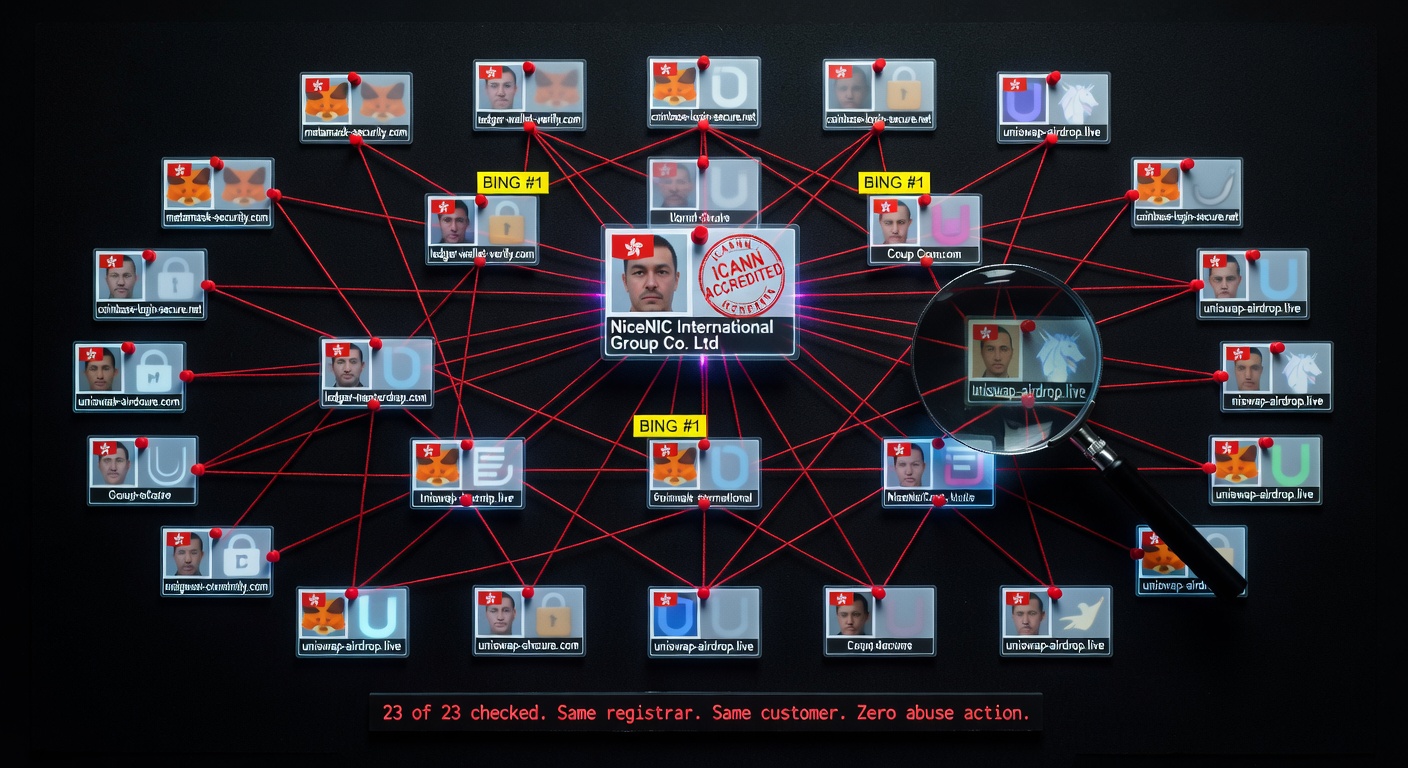
One Operator, 26 Domains, One Registrar
We ran RDAP queries on all 26 phishing domains. Every single one returned the same registrar: NiceNIC International Group Co., Limited. Not most. Not a majority. All 23 of 23 successfully queried — identical registrar, with 3 rate-limit errors before verification (their infrastructure patterns match).
RDAP Registration Data — Batch Registration Evidence
| Domain | Impersonates | Created | Cloudflare NS Pair |
|---|---|---|---|
star-gate-finance-stargate.finance | Stargate Finance | 2025-09-08 | terry/ximena |
app-vesper.finance | Vesper Finance | 2025-09-08 | terry/ximena |
app-vvs.finance | VVS Finance | 2025-09-08 | terry/ximena |
orbit-protocol-lending.net | Orbit Protocol | 2025-10-10 | terry/ximena |
vvsfnance.com | VVS Finance | 2025-07-12 | april/kayden |
spooky-swap.net | SpookySwap | 2025-04-15 | april/kayden |
thorwsap.com | THORSwap | 2025-07-24 | april/kayden |
hyperlokc.com | Hyperlock Finance | 2025-07-12 | arnold/destiny |
shadow-ex.net | Shadow Exchange | 2025-06-24 | amos/tricia |
v2velodrome.com | Velodrome Finance | 2025-09-04 | dayana/marvin |
layerbank-v3.com | LayerBank | 2024-09-07 | austin/cheryl |
biasterswap.xyz | BiSwap | 2024-09-07 | lady/langston |
v2-olympusdao.com | OlympusDAO | 2026-03-29 | nash/romina |
uncx.org | UNCX Network | 2025-12-24 | cory/megan |
amblent.cc | Ambient Finance | 2026-02-09 | nicole/salvador |
juicefi.cc | Juice Finance | 2026-02-09 | nicole/salvador |
rhea-finance.com | Rhea Finance | 2025-05-30 | — |
rhea-finance.net | Rhea Finance | 2025-05-30 | — |
rhea-rhea.org | Rhea Finance | 2025-05-30 | — |
silo-finance-silofinance.net | Silo Finance | 2025-05-30 | — |
Shared Cloudflare NS pairs and identical creation dates prove batch registration:
- 2025-09-08: star-gate + app-vesper + app-vvs (all
terry/ximena) - 2025-05-30: rhea-finance.com + .net + rhea-rhea.org + silo-finance (4 domains, one session)
- 2026-02-09: amblent.cc + juicefi.cc (
nicole/salvador) - 2024-09-07: layerbank-v3.com + biasterswap.xyz — operation running 18+ months
The $2 Playbook — Step by Step
Forget sophisticated SEO. Forget months of link building. Here is the complete, verified attack sequence that produces Bing #1 results.

Step 1: Typosquat Registry
| Real Project | Real Domain | Phishing Domain | Technique |
|---|---|---|---|
| VVS Finance | vvs.finance | vvsfnance.com | Dropped letter (i) |
| THORSwap | thorswap.com | thorwsap.com | Swapped letters (a/w) |
| Hyperlock | hyperlock.fi | hyperlokc.com | Swapped letters (c/k) |
| Arbitrum Bridge | bridge.arbitrum.io | arbtrumbridge.cc | Swap + cheap TLD |
| Ambient Finance | ambient.finance | amblent.cc | Phonetic misspelling |
| Thruster Finance | thruster.finance | thnuster.cc | Dropped letter (r→n) |
| Optimism Bridge | app.optimism.io | optrnismbirdge.cc | Multiple typos |
| Stargate Finance | stargate.finance | star-gate-finance-stargate.finance | Keyword stuffing |
Step 2: Clone the Title Tag ($0, 5 minutes)
The operator copies the exact <title> tag and meta description from the real project’s website. This is the single most important step. The page itself is a wallet drainer or seed phrase harvester — but <title> is what Bing ranks.
Step 3: Submit to the Cloaked PBN ($0, 1 minute)
The operator visits any of 15 PBN sites (bye.fyi, atomizelink.icu, etc.), types the domain into a form labeled “Enter your URL”, and clicks “Shorten.” One submit creates a page on all 15 sites simultaneously — they share one database.
Step 4: Wait (2-8 weeks, $0)
app.thnuster.cc reached Bing #1 for “Thruster Finance” with exactly 1 backlink — a cached Yahoo SERP page. The PBN wasn’t even necessary.
Total Cost Breakdown
| What | Cost | Time |
|---|---|---|
| Domain (.cc/.com via NiceNIC) | $1-2 | 2 min |
| Cloudflare DNS (free plan) | $0 | 1 min |
| Clone title tag from real site | $0 | 5 min |
| Submit to PBN (bye.fyi etc.) | $0 | 1 min |
| Wait for indexation | $0 | 2-8 weeks |
| TOTAL | $1-2 | ~10 min |
Inside the Cloaking Engine
We fetched and analyzed the actual HTML source code from the PBN network. Every page on every domain runs the same cloaking engine.
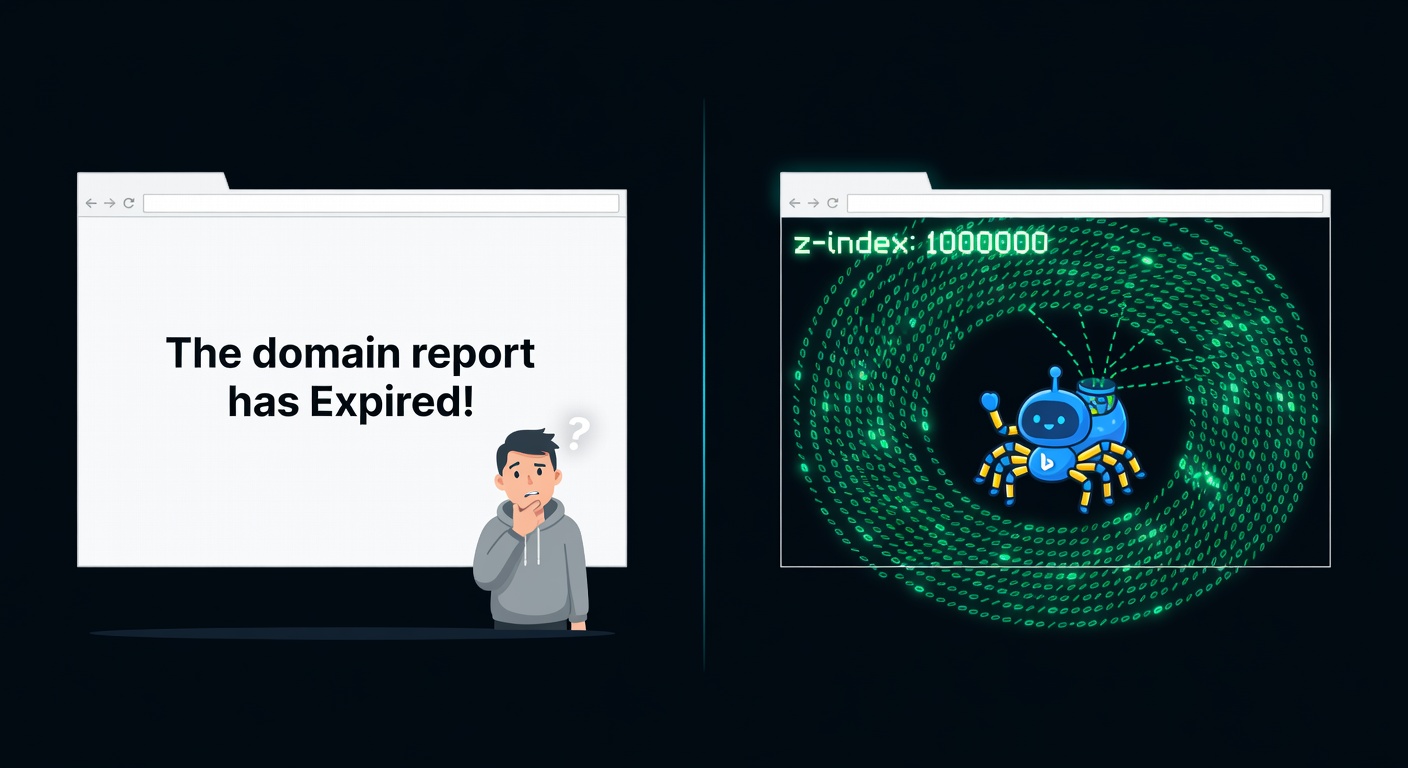
z-index: 1000000 wall hides 3,500 linksPage Architecture: 400KB HTML, 3,500+ links, 4 Layers
<body style="overflow: hidden;">
  <div style="position:absolute; top:0; left:0;
              width:100%; height:5000px;
              background:white; z-index:1000000;
              font-size:32px; text-align:center;">
    <p>The domain report has Expired!</p>
  </div>
White div covers the entire viewport. z-index:1000000 ensures nothing renders above. overflow:hidden on body prevents scrolling past. User sees “Expired” and leaves.
// work.js — identical on all 15 domains:
window.location.replace("https://scrib.li/ai-article-generator");
If user bypasses the white wall, JavaScript redirects to scrib.li (affiliate monetization). Triple protection against human visitors.
Bingbot ignores CSS overlay — it parses raw HTML. It sees a “URL Shortener” site with a search form. Looks legitimate.
<p>Learn More Here <a rel="nofollow"
     href="https://PHISHING-TARGET.finance">PHISHING-TARGET.finance</a></p>
... x 3,500 links ...
The phishing domain is buried among 3,500 random domains. Bing treats rel="nofollow" as an indexation signal — it crawls the target anyway.
Proof: One Network, One Database
orbit-protocol-lending.net appears across multiple PBN domains with sequential IDs from the same database:

| PBN Domain | URL Pattern | ID |
|---|---|---|
blogsphere.top | /stats/49207 | 49207 |
optimizeflow.top | /stats/49207 | 49207 |
websites.freemyip.com | /share/49207 | 49207 |
shortenurls.eu | /share/49207 | 49207 |
jake.eu | /share/49207 | 49207 |
dailymusings.top | /stats/49208 | 49208 |
screenshots.wiki | /report/49208 | 49208 |
atomizelink.icu | /report/49208 | 49208 |
byteshort.xyz | /report/49208 | 49208 |
Same IDs across different “brands” = one backend, one operator. 15 domains. Same HTML template. Same CSS (style.css). Same JavaScript (work.js). Same 3,500-link pages.
The Second PBN — Domain Checker Network
A separate, more aggressive link network provides dofollow backlinks to select targets. Master server: all-aged-domains.com — a WordPress 6.6.2 installation serving CSS, JS, and templates to 50-80 satellite domains.
| Feature | Network A (Cloaked PBN) | Network B (Domain Checker) |
|---|---|---|
| Sites | ~15 | ~50-80 |
| Cloaking | Yes (CSS + JS redirect) | No |
| Link type | 99.4% nofollow | 99.99% dofollow |
| Links per page | ~3,500 | ~10,000 |
| Page size | 400KB | 4MB |
| CMS | Custom PHP | WordPress 6.6.2 |
| Master server | Shared database (sequential IDs) | all-aged-domains.com |
| Google Tag Manager | No | Yes (tracks traffic) |
Despite having 10× more backlinks and all dofollow, Network B targets did NOT reach Bing #1. biasterswap.xyz has 110 dofollow links. layerbank-v3.com has 98. Neither ranks #1.
Meanwhile, app.thnuster.cc has 1 backlink and ranks #1.
The nofollow cloaked PBN + title match works better than mass dofollow spam for Bing.
Why Bing Falls for This

The Title-Match Vulnerability
app.thnuster.cc has exactly ONE backlink — a cached Yahoo SERP page. It ranks #1 in Bing for “Thruster Finance.” This proves Bing’s ranking for low-competition brand queries relies primarily on:
- Title tag exact-match to the search query
- Domain is indexed (any signal — even one nofollow link — suffices)
- No negative trust signals (domain is new, clean history)
Google would require substantial authority signals and would cross-reference against known brand domains. Bing does not.
| Metric | Bing | |
|---|---|---|
| Phishing domains at #1 | 7 | 0 |
| Phishing domains in top 10 | 7 | 0 |
| Time to rank from domain creation | 2-8 weeks | never |
Bing #1 Results (verified via SerpAPI, April 2026)
| Query | #1 Result (Phishing) | Backlinks |
|---|---|---|
| “Stargate Finance” | star-gate-finance-stargate.finance | 20 |
| “Shadow Exchange” | shadow-ex.net | 16 |
| “UNCX Network” | www.uncx.org | 51 |
| “Thruster Finance” | app.thnuster.cc | 1 |
| “Orbit Protocol” | orbit-protocol-lending.net | 15 |
| “VVS Finance” | vvsfnance.com (#1) + www.app-vvs.finance (#10) | 36 + 37 |
Updated Protection List (Part II brands)
Stargate Finance → stargate.finance (NOT star-gate-finance-stargate.finance) •
VVS Finance → vvs.finance (NOT vvsfnance.com) •
THORSwap → thorswap.com (NOT thorwsap.com) •
Velodrome → velodrome.finance (NOT v2velodrome.com) •
UNCX → uncx.network (NOT uncx.org) •
SpookySwap → spooky.fi (NOT spooky-swap.net) •
OlympusDAO → olympusdao.finance (NOT v2-olympusdao.com) •
Thruster → thruster.finance (NOT thnuster.cc) •
Ambient → ambient.finance (NOT amblent.cc)
Recommendations (Part II)
To Microsoft/Bing:
- Title-match alone is not authority. A matching title should not rank a new domain #1 for brand queries. Require domain age, backlink authority, or brand verification signals.
- Detect CSS-based cloaking. Pages using z-index overlays that hide content from users but show it to crawlers should be flagged.
- Detect coordinated PBN networks. 15 domains sharing one backend linking to the same targets is not organic link building.
- Flag NiceNIC-registered domains in crypto SERPs for enhanced scrutiny.
- Create a DuckDuckGo spam fast-track. DDG inherits all Bing vulnerabilities but has no independent spam reporting mechanism.
To NiceNIC International Group Co., Limited:
26 phishing domains. One customer. Batch-registered over 18 months. Zero abuse action taken. This is now publicly documented. Reference: When Abuse Reports Go Nowhere and NiceNIC: Systemic Enabler.
To Cloudflare:
All 26 domains use Cloudflare DNS and proxy. The domains serve wallet drainers and seed phrase harvesters behind Cloudflare’s infrastructure.
Part II Conclusion
This is not opportunistic spam. This is a professionally operated, 18-month-long campaign by a single operator who has discovered that Bing’s ranking algorithm can be defeated with a $2 domain and a copied title tag. Seven phishing sites currently sit at position #1 in Bing — above the legitimate platforms they impersonate.
The cloaking infrastructure we documented — 15 identical sites with shared databases, CSS-based content hiding, and JavaScript redirect fallbacks — represents a purpose-built tool for search engine manipulation at scale.
Google blocks all 26 domains. Bing ranks 7 of them at #1. The technical fix exists. The evidence is public. The domains are documented. The registrar is identified. The question remains: will anything be done?
Related Investigations