




 ChainPatrol
 Web-Check
  SOCRadar
  LeakIX
FBI IC3
Denuncie crimes possibilitados pela Internet nos Estados Unidos
Federal tips line1-800-CALL-FBI
The sent-report ledger records the first outgoing report at .
The recorded recipient is abuse@vercel.com.
The latest stored availability evidence still shows the domain reachable; 1 month has elapsed since the first outgoing report.
ICANN RAA §3.18 describes registrar abuse-contact and handling obligations. This section records outgoing timestamps, listed recipients, case identifiers, and later availability. It does not by itself prove receipt, acknowledgement, investigation, remediation, or contractual non-compliance.

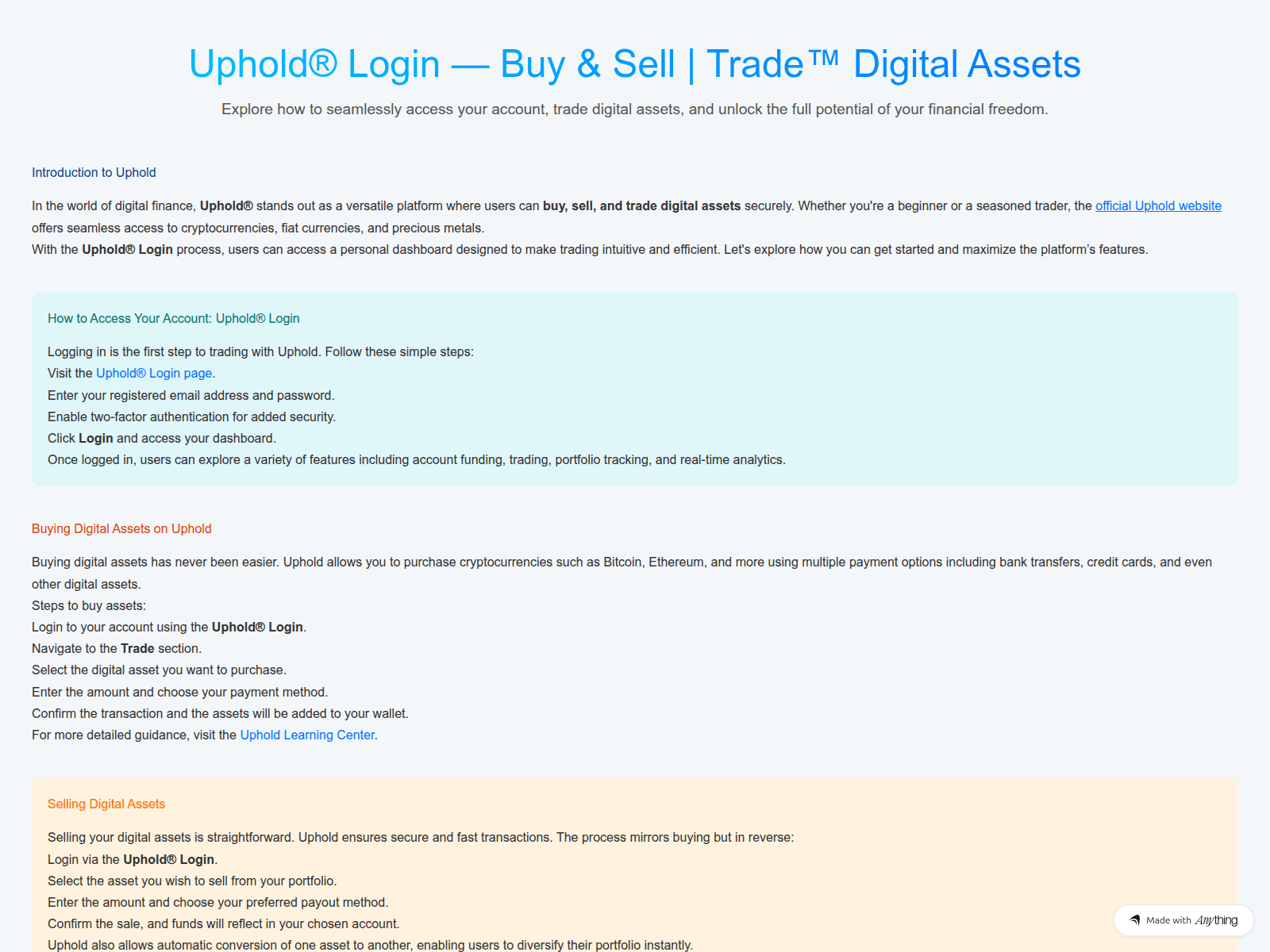
“Trade Digital Assets”
en-us-upheld.created.app — Não verificado. Representação da marca: Uphold; Tipo de golpe: Impersonation. Resumo das evidências: VirusTotal 13/91 (alphaMountain.ai, Chong Lua Dao, CyRadar, Ermes, ESET); URLQuery 1 alert; URLScan malicious verdict; Google Safe Browsing flagged; 2 external blocklist matches (MetaMask, SEAL); PhishDestroy score 95/100. Registrador: Name.com.
A análise detalhada do PhishDestroy AI permanece em inglês para preservar o registro forense original.
The domain en-us-upheld.created.app is currently active and serves a page titled “Trade Digital Assets”. Google Safe Browsing has classified the URL under the SOCIAL_ENGINEERING category, indicating a high‑confidence indication of credential‑stealing behavior. The site returns HTTP 200, confirming that the content is being served as expected.
Network analysis shows the domain resolves to the IPv4 address 216.150.1.129, which is owned by a US‑based infrastructure provider known for cloud hosting services. The TLS certificate is issued by Let’s Encrypt and is valid for the current year, suggesting the operators have maintained a legitimate‑looking HTTPS surface. Technology fingerprinting identifies a stack comprising Node.js, React, Next.js, and a content delivery network backed by the same cloud provider, together with feature flagging services and HSTS enforcement.
Reputation services reinforce the malicious assessment: Google Safe Browsing flags the site for social engineering, and VirusTotal reports that five out of ninety‑five scanners have identified the domain as malicious. The domain appears on three independent security blocklists and is actively blocked by PhishDestroy, MetaMask, and SEAL, indicating that multiple downstream protection platforms have observed abusive activity. Nameserver information could not be retrieved, which may reflect a deliberate attempt to obscure DNS configuration.
Defenders should treat en-us-upheld.created.app as a high‑risk indicator and add it to deny lists across perimeter firewalls, DNS filtering, and endpoint protection solutions. Monitoring for new subdomains under the created.app namespace is advisable, as the observed pattern suggests the infrastructure could be reused for further credential‑harvesting campaigns. Incident response teams should also consider sinkholing traffic to the resolved IP address to disrupt the command‑and‑control flow and to gather additional telemetry on potential victims.

| Detection System | Indicator | Verdict | Alert |
|---|---|---|---|
| OpenDNS | en-us-upheld.created.app |
phishing | Phishing Block |
 (SE)
(SE)
 Walnut, US
For the registrable domain created.app behind this subdomain, the registrar above operates under an ICANN accreditation agreement. The links below provide the official fee schedule and current DNS abuse compliance guidance.
RAA §3.18 establishes abuse-contact and handling requirements. This report can document stored outbound notices and later technical observations; it does not by itself establish receipt, investigation, remediation, or contractual non-compliance.
Node.js is an open-source, cross-platform, JavaScript runtime environment that executes JavaScript code outside a web browser.
nodejs.org 100% de confiançaReact is an open-source JavaScript library for building user interfaces or UI components.
reactjs.org 100% de confiançaVercel is a cloud platform for static frontends and serverless functions.
vercel.com 100% de confiançaNext.js is a React framework for developing single page Javascript applications.
nextjs.org 100% de confiançaLaunchDarkly is a continuous delivery and feature flags as a service platform that integrates into a company's current development cycle.
launchdarkly.com 100% de confiançaHTTP Strict Transport Security (HSTS) informs browsers that the site should only be accessed using HTTPS.
www.rfc-editor.org 100% de confiançaCloud CDN uses Google's global edge network to serve content closer to users.
cloud.google.com 100% de confiançaGoogle PageSpeed Insights — mobile performance audit of en-us-upheld.created.app · checked Jul 12, 2026
PD-20260712-294F02 Recipient: abuse@vercel.com Se você inseriu credenciais de conta, informações pessoais ou de pagamento, ou baixou um arquivo deste domínio, tome medidas imediatas. Abaixo estão os recursos para ajudá-lo a relatar o incidente e se proteger.


Selecione seu país para obter contactos oficiais do cibercrime ou crie um rascunho de reclamação →.
Esses relatórios são resolvidos para o mesmo IP de borda compartilhado. Eles ajudam na descoberta de relatórios, mas não implicam propriedade comum ou um servidor de origem compartilhado.
These domains also target Uphold users. View all Uphold threats →
Relatórios adicionados recentemente do banco de dados PhishDestroy. Esses links de descoberta não implicam infraestrutura ou propriedade compartilhada.
Análise de ameaças usando lista de bloqueio armazenada, WHOIS, DNS e evidências de verificação pública
Digitalize agoraEnvie domínios suspeitos para nosso banco de dados de ameaças — proteja a comunidade
DenunciarRelatórios recentes de phishing e alterações de disponibilidade observadas
MonitorarMonitore ameaças em tempo real ou conteste esta listagem caso acredite que se trate de um falso positivo
 att-process-navigator-ff48ed14.buildaispace.app
  vaultstaking.app
  zoom-meetings.live
  warrantytrustwallet.com
  en-uphold-login-auth.tem3.io
  uphldd.zapier.app
  sso-auth-uphold-eng.square.site