VirusTotal
0 / 92 engine detections
Open report
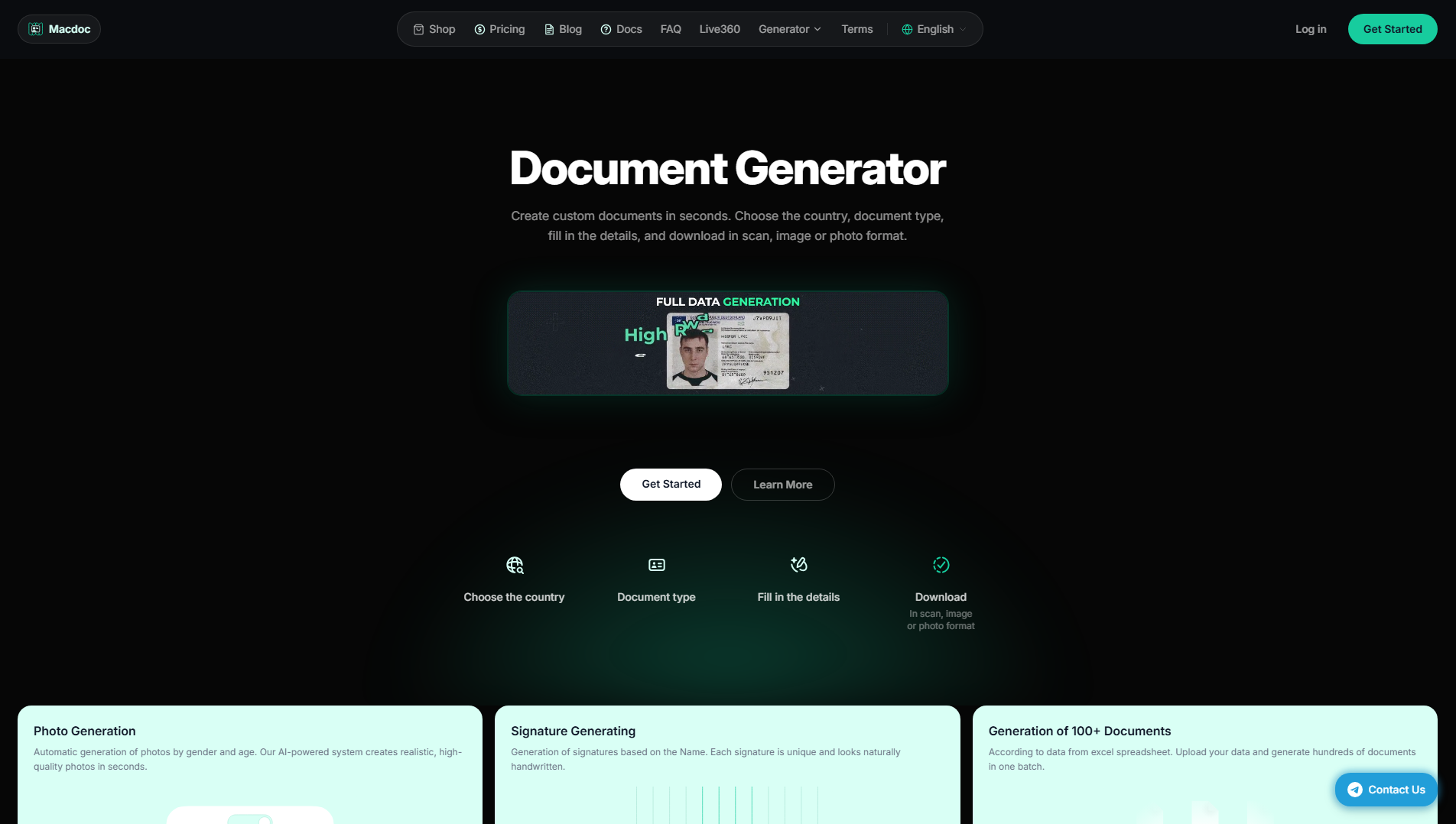
“Macdoc - The Only Fake Ai ID Document Passport License Card Generator With KYC Verified Tools”
0 / 92 engine detections
Open reportScan report
Open reportno community references
Open reportprovider verdict: clean
Open reportNo threat flag
Open reportPage capture
Open reportResults reflect each source’s collection time. Zero detections do not guarantee safety. OTX references are community publications.
PhishDestroy threat report
macdoc.org is an active website that currently shows no obvious branding or legitimate content. PhishDestroy first recorded the domain on 2026-10-19 and found it still alive as of that date. The site was registered on 2026-03-12, suggesting it operated for several months before detection. Its lack of legitimate content and rapid appearance on anti‑phishing lists point to a use as a lure for cryptocurrency‑related fraud. No clear impersonation of a trusted brand is visible, but its presence on our blocklist indicates malicious intent aimed at crypto users.
Although the exact payload is not visible, the domain’s classification as suspicious suggests it may be used to lure crypto‑wallet owners into revealing private keys, seed phrases, or approving unauthorized transactions. Attackers typically present a fake login or investment page that captures credentials or triggers wallet approvals, allowing them to empty the victim’s holdings.
VirusTotal scanned macdoc.org on 2026-10-19 with 92 engines and reported zero detections, indicating the site does not host known malware signatures. The domain is listed on PhishDestroy’s blocklist, which is the sole external listing identified. No detections were reported by other major services such as Google Safe Browsing or Spamhaus.
The domain was registered on 2026-03-12 through Registrar of Domain Names REG.RU LLC. It resolves to IP 104.21.55.155, indicating hosting on a shared service provider that can obscure the operator’s true location. The seven‑month gap between registration and first detection suggests the operators waited before activating the malicious page. Hosting on a generic CDN makes takedown more challenging and allows rapid redeployment if needed.
Anyone who visited macdoc.org should change any passwords used on the site and, if a crypto wallet was connected, immediately revoke all app approvals and move funds to a new wallet. Monitor account activity for unauthorized transactions and report the incident to the wallet provider. Security teams should add the domain to web‑filter blocklists, monitor DNS queries for the host, and share indicators of compromise with industry feeds.
Edge-IP reputation is not attributed to this domain.
kiki.ns.cloudflare.comleonard.ns.cloudflare.comLocation describes the IP network.
a603e90cc2fee75982535696f16660ea3988b1ff15f231d64cbc094ffe35d97aSaved certificate metadata. Certificate dates without a timezone are shown as stored. Transport encryption does not establish that the site is trustworthy.
Hostnames retained in the domain record or Certificate Transparency cache. A hostname alone does not establish current availability or malicious activity.
mail.macdoc.orgDomain recordwww.macdoc.orgDomain recordThe original observation time is not recorded for these hostnames.
Google PageSpeed Insights — mobile performance audit of macdoc.org · checked Oct 19, 2026
Timestamped response metadata retained by the local collection pipeline. Each value below belongs to the displayed archive time.
http://macdoc.org/Content-Type: text/html; charset=UTF-8Cache-Control: private, max-age=0, no-store, no-cache, must-revalidate, post-check=0, pre-check=0Server: cloudflareh2=":443"; ma=60private, max-age=0, no-store, no-cache, must-revalidate, post-check=0, pre-check=0a4cfcb08598c9747-FRAkeep-alive7320text/html; charset=UTF-8Mon, 19 Oct 2026 12:30:16 GMTThu, 01 Jan 1970 00:00:01 GMTsame-origin60cloudflareSAMEORIGINValues retained by the collector; long values may be shortened during collection.
An estimated time describes an observation window. It does not prove a registrar action or the exact moment a site became unavailable.
Dated changes retained by the monitor and source collectors. Newest observations appear first; source states are not proof of a takedown.
Reachable
PD-20261019-416EFE
No threat flag
View source0/92 engine detections
View sourcemacdoc.org
View sourcePage captured
View sourceEach lane is one reason a domain is linked to this host. Node size marks VirusTotal detections and dashed nodes are already offline. The full lists follow below.
Shared edge IP; unrelated tenants may be present.
Registered through the same registrar. A registrar serves millions of unrelated customers, so this groups reports rather than proving a link.
Compare what a browser and a crawler receive, and check for Keitaro traffic routing.
macdoc.org
PD-20261019-416EFE Recipient: abuse@reg.ru Registrar: REG.RU (Russia) Policy Violations: Abuse policy + ICANN contractual obligations; phishing classified as bad-faith use in UDRP; domains may be suspended/removed Applicable Laws: Criminal Code RF Art.159 (fraud), Art.272 (illegal access), Art.273 (malware creation), Art.274.1 (critical infrastructure interference)
If credentials, payment data, or files were exposed, report the incident immediately. Change affected passwords, revoke active sessions, and scan the device.


Select your country to get official cybercrime contacts, or create a complaint draft →.
Template-based draft · optional AI wording assistance requires separate consent
Choose the steps that match what you shared. Keep a copy of this report alongside your own records.
Stop using the suspicious site. Open the real service through its official app or an address you already trust.
Keep original emails, receipts, messages and screenshots in a secure place. A factual timeline helps the receiving authority understand what happened. IC3 evidence guidance ↗
macdoc.org)Even if you don't have all details — file a report anyway. Partial information still helps investigations.
A report is not a guarantee of recovery or investigation, but prompt, accurate transaction data can help authorities and service providers trace the incident.
Further guidance: NIST · phishing responseFBI IC3 · reports & evidenceFTC · recovery scams
Threat analysis using stored blocklist, WHOIS, DNS, and public scan evidence
Scan NowSubmit suspicious domains to our threat database — protect the community
ReportRecent phishing reports and observed availability changes
MonitorMonitor live threats or contest this listing if you believe it's a false positive
This report combines saved page captures, registration and network records, scanner results and PhishDestroy reporting history. Each source keeps its own observation date. Open a source report to inspect the original result.
The AI-assisted analysis was written on . It describes the evidence available at that time; later source checks can change.
A capture documents what was shown. A scanner result records that provider’s assessment at the time of its check. Neither a valid certificate nor a zero-detection result is a guarantee of safety.