
 ChainPatrol
 Web-Check
  SOCRadar
  LeakIX
FBI IC3
Melden Sie internetbasierte Kriminalität in den Vereinigten Staaten
Federal tips line1-800-CALL-FBI

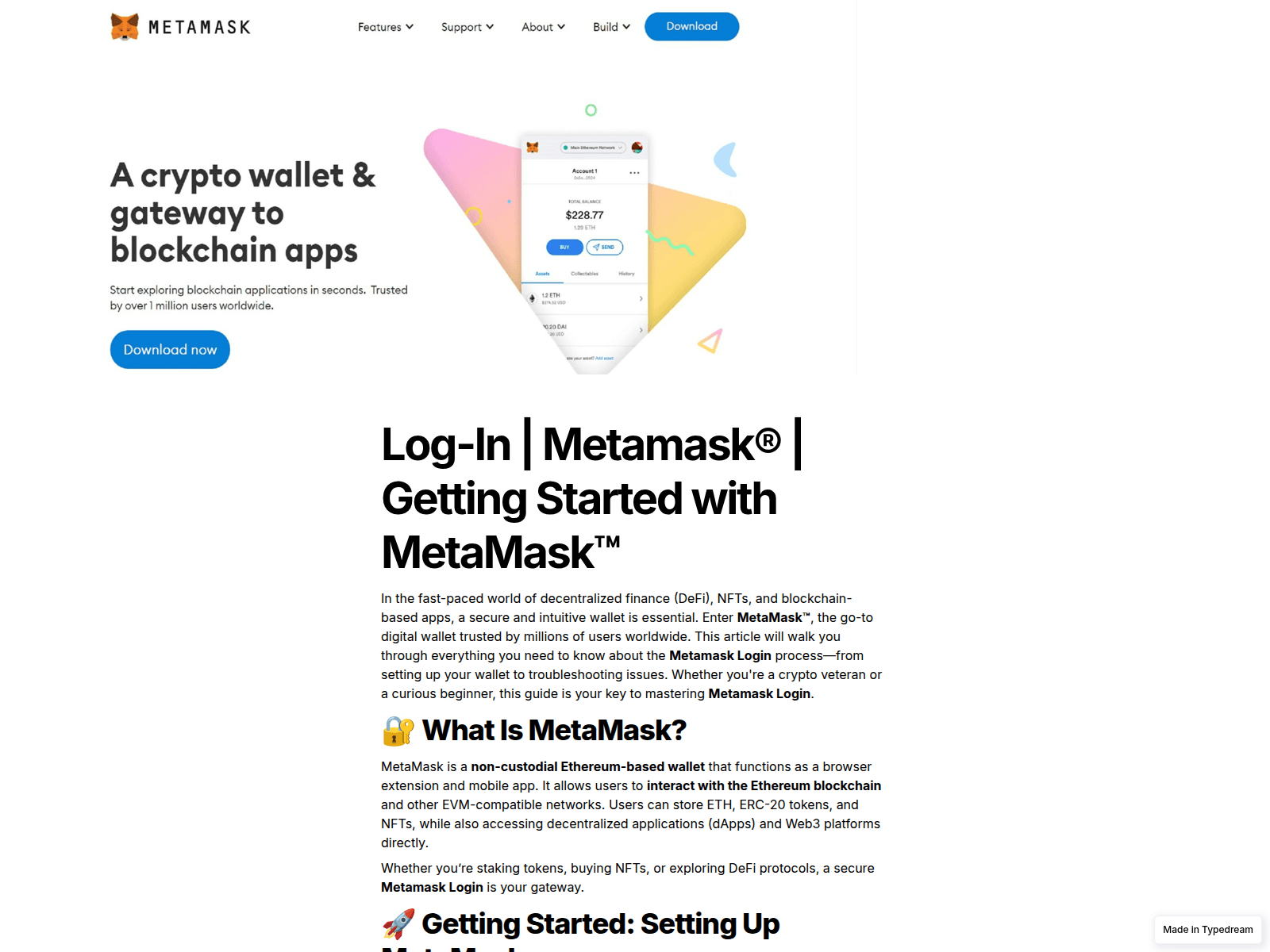
“Log-In | Metamask® | Getting started with MetaMask*”
metamask-login-learn-us-sso.typedream.app — Inhalt nicht verfügbar. Markenidentität: Aave; Betrugstyp: Crypto Drainer. Zusammenfassung der Beweislage: VirusTotal 18/95 (ADMINUSLabs, ChainPatrol, Criminal IP, alphaMountain.ai, BitDefender); URLScan malicious verdict; CF Radar malicious; PhishDestroy score 95/100. Registrar: Squarespace Domains II.
Die ausführliche Analyse von PhishDestroy AI bleibt auf Englisch, damit der ursprüngliche forensische Bericht unverändert bleibt.
This domain is flagged as a high-risk brand impersonation threat specifically targeting Aave, a decentralized finance protocol. The site mimics legitimate authentication portals to harvest credentials, private keys, or seed phrases from unsuspecting users attempting to access cryptocurrency services. Analysis indicates a deliberate effort to exploit trust in the Aave brand, with page elements closely resembling official login interfaces, including the title 'Log-In | Metamask® | Getting started with MetaMask*' despite the domain's primary association with Aave. Infrastructure analysis reveals the domain metamask-login-learn-us-sso.typedream.app was registered through Squarespace Domains II LLC on February 21, 2026, and currently resolves to IP address 188.114.96.3, hosted on AS13335 (Cloudflare, Inc.) in the United States. The domain is detected by 18 out of 95 security vendors on VirusTotal, and appears on three distinct security blocklists. The SSL certificate is issued by Google Trust Services (WE1), a common practice among malicious domains to evade basic HTTPS warnings. Notably, the creation date is anomalous, suggesting either a registration error or intentional obfuscation of the domain's true age. Mitigation requires immediate blocking of the domain and its resolving IP (188.114.96.3) at the network perimeter. Security teams should deploy indicators of compromise (IOCs) including the domain, IP, and SSL certificate fingerprint to endpoint detection systems. Users should be educated to verify domain authenticity before entering credentials, particularly for decentralized finance platforms. Multi-factor authentication (MFA) should be enforced where possible, and wallet software should never be accessed through links in emails or unverified sources. Organizations should monitor for internal traffic to the domain and investigate any connections as potential credential compromise incidents.

 (US)
San Francisco, US
(US)
San Francisco, USNode.js is an open-source, cross-platform, JavaScript runtime environment that executes JavaScript code outside a web browser.
nodejs.org 100 % KonfidenzReact is an open-source JavaScript library for building user interfaces or UI components.
reactjs.org 100 % KonfidenzNext.js is a React framework for developing single page Javascript applications.
nextjs.org 100 % KonfidenzGoogle Cloud Trace is a distributed tracing system that collects latency data from applications and displays it in the Google Cloud Console.
cloud.google.com 100 % KonfidenzCloud CDN uses Google's global edge network to serve content closer to users.
cloud.google.com 100 % KonfidenzCloudflare is a web-infrastructure and website-security company, providing content-delivery-network services, DDoS mitigation, Internet security, and distributed domain-name-server services.
www.cloudflare.com 100 % KonfidenzHTTP/3 is the third major version of the Hypertext Transfer Protocol used to exchange information on the World Wide Web.
httpwg.org 100 % KonfidenzWenn Sie Kontoanmeldeinformationen, persönliche oder Zahlungsinformationen eingegeben oder eine Datei von dieser Domain heruntergeladen haben, ergreifen Sie sofort Maßnahmen. Nachfolgend finden Sie Ressourcen, die Ihnen helfen, den Vorfall zu melden und sich zu schützen.


Wählen Sie Ihr Land aus, um Offizielle Kontakte im Bereich Cyberkriminalität oder einen Beschwerdeentwurf erstellen → zu erhalten.
Diese Berichte werden auf dieselbe gemeinsame Edge-IP aufgelöst. Sie helfen bei der Berichtserkennung, bedeuten jedoch keinen gemeinsamen Besitz oder einen gemeinsamen Ursprungsserver.
These domains also target Aave users. View all Aave threats →
Kürzlich hinzugefügte Berichte aus der PhishDestroy-Datenbank. Diese Discovery-Links implizieren keine gemeinsame Nutzung der Infrastruktur oder des Eigentums.
Bedrohungsanalyse anhand gespeicherter Blocklisten, WHOIS, DNS und öffentlicher Scan-Beweise
Jetzt scannenMelden Sie verdächtige Domains an unsere Bedrohungsdatenbank – schützen Sie die Community
MeldenAktuelle Phishing-Meldungen und beobachtete Verfügbarkeitsänderungen
ÜberwachenBeobachten Sie aktuelle Bedrohungen oder legen Sie Widerspruch gegen diesen Eintrag ein, wenn Sie der Meinung sind, dass es sich um einen Fehlalarm handelt

 payme-paypal.com
  blitz-swap.com
  kenhoward.com
  werdmountbank.com
  federalreservesavings.com
  lux.courexpresst.com