 ChainPatrol
 Web-Check
  SOCRadar
  LeakIX
FBI IC3
Melden Sie internetbasierte Kriminalität in den Vereinigten Staaten
Federal tips line1-800-CALL-FBI
The sent-report ledger records the first outgoing report at .
The recorded recipient is abuse@nicenic.net.
The latest stored availability evidence still shows the domain reachable; 6 months has elapsed since the first outgoing report.
ICANN RAA §3.18 describes registrar abuse-contact and handling obligations. This section records outgoing timestamps, listed recipients, case identifiers, and later availability. It does not by itself prove receipt, acknowledgement, investigation, remediation, or contractual non-compliance.

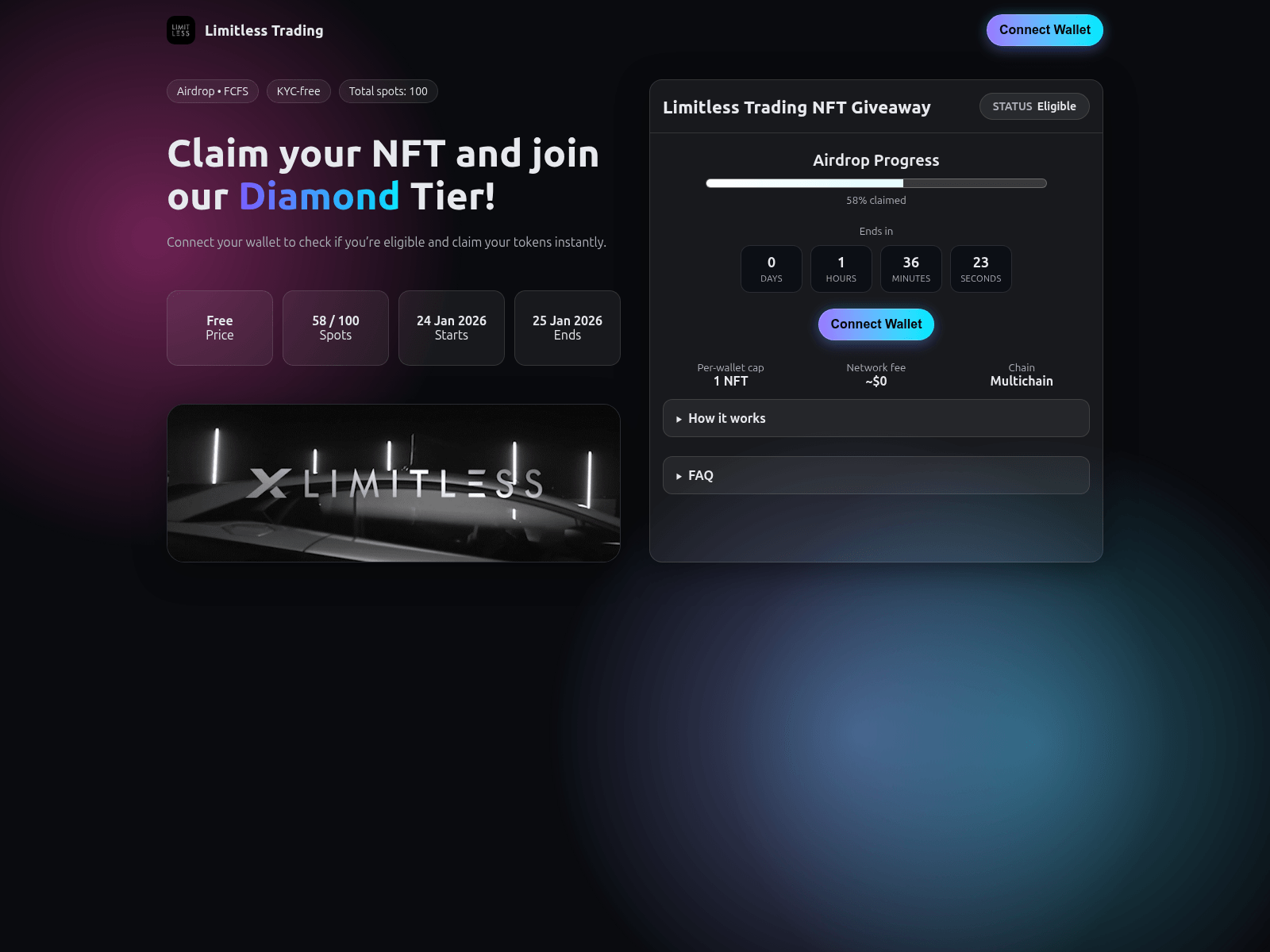
“Limitless Trading NFT Giveaway”
limitlesstradingacademy.top — Nicht bestätigt. Betrugstyp: Fake Exchange. Zusammenfassung der Beweislage: VirusTotal 6/91 (alphaMountain.ai, CRDF, Fortinet, Gridinsoft, LevelBlue); PhishDestroy score 68/100. Registrar: 耐思尼克国际集团有限公司.
Die ausführliche Analyse von PhishDestroy AI bleibt auf Englisch, damit der ursprüngliche forensische Bericht unverändert bleibt.
Analysis of the domain limitlesstradingacademy.top indicates it is an active phishing site targeting users with a fraudulent NFT giveaway scheme. The domain was registered on February 21, 2026, through 耐思尼克国际集团有限公司, a registrar with a history of hosting high-risk domains. Infrastructure analysis reveals the site is proxied behind Cloudflare, resolving to the IP address 104.21.34.54 (AS13335, Cloudflare, Inc., United States). The nameservers, amit.ns.cloudflare.com and michelle.ns.cloudflare.com, further confirm Cloudflare’s role in masking the origin server.
The page title, 'Limitless Trading NFT Giveaway,' explicitly identifies the scam type as a fake giveaway, aligning with the 'Fake Exchange' classification noted in threat intelligence. Detection remains limited but notable: two of 93 security vendors on VirusTotal flag the domain as malicious, and it appears on one security blocklist, with PhishDestroyer already blocking access. The SSL certificate, issued by Google Trust Services (WE1), is valid but provides no inherent trust, as phishing sites routinely abuse free certificates. The HTTP status code 525 (SSL handshake failed) suggests either misconfigured Cloudflare settings or deliberate evasion tactics.
While the exact backend hosting remains obscured, the use of HTTP/3 and Cloudflare’s network is consistent with modern phishing campaigns seeking to bypass traditional IP-based blocking. Defenders should treat this domain as high-risk, particularly given its recent registration and active status. No evidence links it to legitimate trading or NFT platforms, and the absence of broader detection does not imply safety. Network-level blocking of 104.21.34.54 and monitoring for related domains under the same registrar are recommended.

 (US)
San Francisco, US
(US)
San Francisco, USFor this gTLD, the registrar above operates under an ICANN accreditation agreement. The links below provide the official fee schedule and current DNS abuse compliance guidance.
RAA §3.18 establishes abuse-contact and handling requirements. This report can document stored outbound notices and later technical observations; it does not by itself establish receipt, investigation, remediation, or contractual non-compliance.
Web infrastructure and security company providing CDN, DDoS mitigation, and DNS services.
www.cloudflare.comThird major version of HTTP protocol, built on QUIC for faster, more reliable connections.
PD-20260125-3A8B3B Recipient: abuse@nicenic.net Wenn Sie Kontoanmeldeinformationen, persönliche oder Zahlungsinformationen eingegeben oder eine Datei von dieser Domain heruntergeladen haben, ergreifen Sie sofort Maßnahmen. Nachfolgend finden Sie Ressourcen, die Ihnen helfen, den Vorfall zu melden und sich zu schützen.


Wählen Sie Ihr Land aus, um Offizielle Kontakte im Bereich Cyberkriminalität oder einen Beschwerdeentwurf erstellen → zu erhalten.
Kürzlich hinzugefügte Berichte aus der PhishDestroy-Datenbank. Diese Discovery-Links implizieren keine gemeinsame Nutzung der Infrastruktur oder des Eigentums.
Bedrohungsanalyse anhand gespeicherter Blocklisten, WHOIS, DNS und öffentlicher Scan-Beweise
Jetzt scannenMelden Sie verdächtige Domains an unsere Bedrohungsdatenbank – schützen Sie die Community
MeldenAktuelle Phishing-Meldungen und beobachtete Verfügbarkeitsänderungen
ÜberwachenBeobachten Sie aktuelle Bedrohungen oder legen Sie Widerspruch gegen diesen Eintrag ein, wenn Sie der Meinung sind, dass es sich um einen Fehlalarm handelt
 moonshot-trade.top
  kraken3yvbvzmhytnrnuhsy772i6dfobofu652e27f5hx6y5cpj7rgyd.top
  nexusdarknetmarket.top
  flamefortune.cc