ChainPatrol
 Web-Check
  SOCRadar
  LeakIX
FBI IC3
Melden Sie internetbasierte Kriminalität in den Vereinigten Staaten
Federal tips line1-800-CALL-FBI

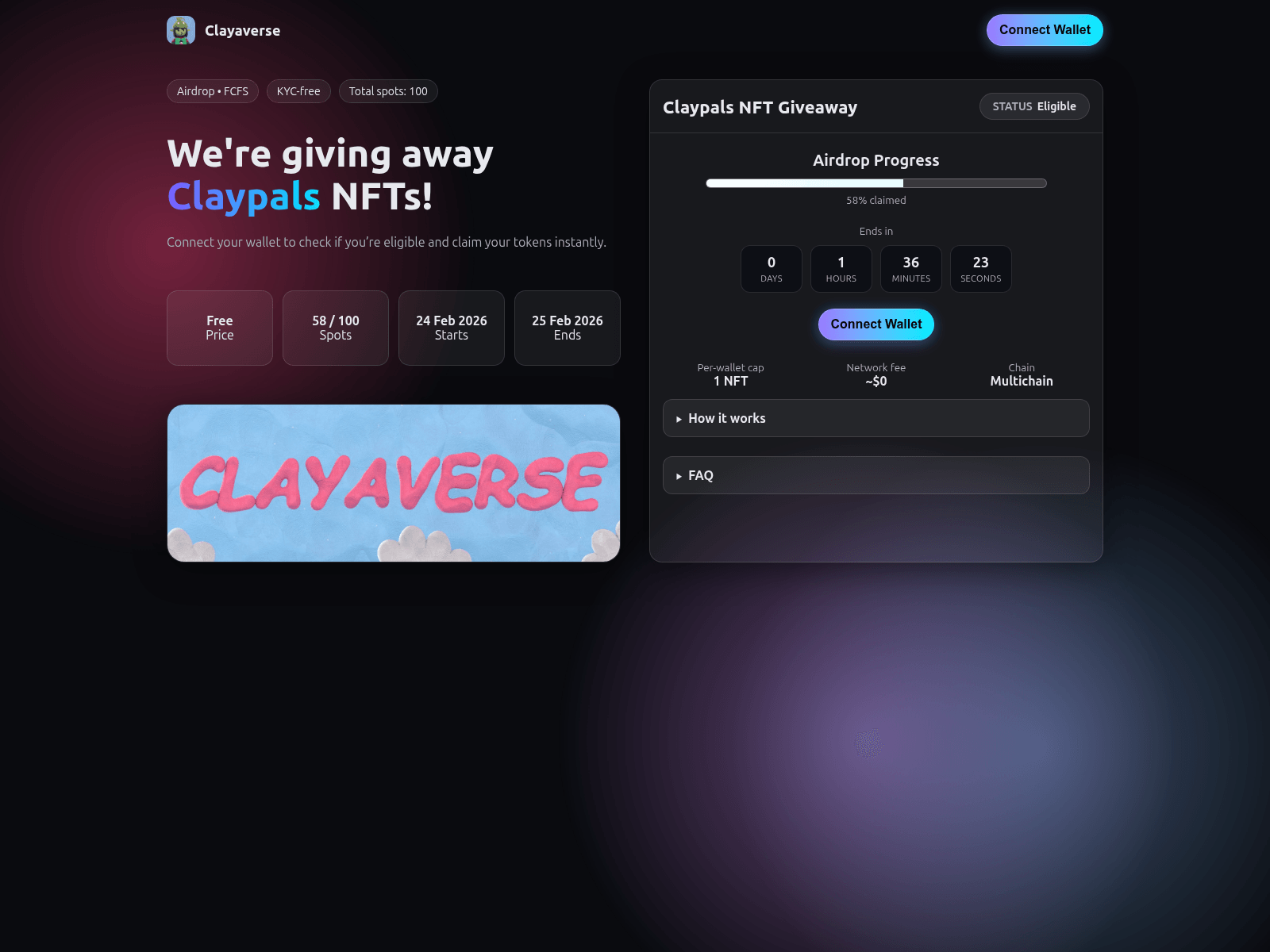
“Claypals NFT Giveaway”
clayaverse.xyz — Serverfehler (HTTP 502). Betrugstyp: Investment Scam. Zusammenfassung der Beweislage: VirusTotal 3/93 (Fortinet, SOCRadar, Trustwave); Spamhaus DBL_PHISH; PhishDestroy score 65/100. Registrar: NiceNIC.
Die ausführliche Analyse von PhishDestroy AI bleibt auf Englisch, damit der ursprüngliche forensische Bericht unverändert bleibt.
The domain clayaverse.xyz was registered on February 24, 2026 through NiceNIC International Group Co., Limited and is currently listed as offline. DNS resolution points to the IP address 172.67.173.84, which belongs to AS13335 Cloudflare, Inc., and is geolocated in the United States. The domain uses Cloudflare’s authoritative name servers earl.ns.cloudflare.com and laura.ns.cloudflare.com. No TLS certificate is observed for the site, indicating that HTTPS was not configured at the time of analysis.
The page title retrieved from the site reads "Claypals NFT Giveaway," and the intelligence categorises the operation as an investment scam employing an Airdrop Scam phishing kit. The domain appears on a single security blocklist and has been actively blocked by the PhishDestroy service. VirusTotal scans reported detections from three of ninety‑three security vendors, providing modest corroboration of malicious intent. Because the site is currently taken offline, content‑level evidence such as form fields or credential‑capture mechanisms is unavailable, leaving the exact phishing workflow uncertain.
Defenders should add clayaverse.xyz to internal blocklists, monitor the associated Cloudflare IP range for any re‑registration attempts, and enforce transport‑layer security policies that reject unencrypted HTTP connections. Continuous observation of the registrar NiceNIC International Group for related registrations is also advisable, as threat actors often recycle registration services. Overall, the available infrastructure signals a purposeful malicious campaign targeting NFT‑related investors, and proactive blocking is recommended to mitigate exposure.

 (RU)
PhishDestroy Investigation
(RU)
PhishDestroy Investigation
 San Francisco, US
For this gTLD, the registrar above operates under an ICANN accreditation agreement. The links below provide the official fee schedule and current DNS abuse compliance guidance.
RAA §3.18 establishes abuse-contact and handling requirements. This report can document stored outbound notices and later technical observations; it does not by itself establish receipt, investigation, remediation, or contractual non-compliance.
PD-20260224-63FE4F Recipient: abuse@nicenic.net, abuse@gen.xyz, compliance@icann.org Wenn Sie Kontoanmeldeinformationen, persönliche oder Zahlungsinformationen eingegeben oder eine Datei von dieser Domain heruntergeladen haben, ergreifen Sie sofort Maßnahmen. Nachfolgend finden Sie Ressourcen, die Ihnen helfen, den Vorfall zu melden und sich zu schützen.


Wählen Sie Ihr Land aus, um Offizielle Kontakte im Bereich Cyberkriminalität oder einen Beschwerdeentwurf erstellen → zu erhalten.
Diese Berichte werden auf dieselbe gemeinsame Edge-IP aufgelöst. Sie helfen bei der Berichtserkennung, bedeuten jedoch keinen gemeinsamen Besitz oder einen gemeinsamen Ursprungsserver.
Part of the Airdrop-Betrug phishing campaign. View all campaign domains →
Kürzlich hinzugefügte Berichte aus der PhishDestroy-Datenbank. Diese Discovery-Links implizieren keine gemeinsame Nutzung der Infrastruktur oder des Eigentums.
Bedrohungsanalyse anhand gespeicherter Blocklisten, WHOIS, DNS und öffentlicher Scan-Beweise
Jetzt scannenMelden Sie verdächtige Domains an unsere Bedrohungsdatenbank – schützen Sie die Community
MeldenAktuelle Phishing-Meldungen und beobachtete Verfügbarkeitsänderungen
ÜberwachenBeobachten Sie aktuelle Bedrohungen oder legen Sie Widerspruch gegen diesen Eintrag ein, wenn Sie der Meinung sind, dass es sich um einen Fehlalarm handelt
 corent.cc
  familletimeless.top
  megastresser.com
  instagram-clone-dusky-tau.vercel.app
  zoom-meetings.live
  epiclocker.top
  cnear.com