VirusTotal
6 / 91 engine detections
打开报告

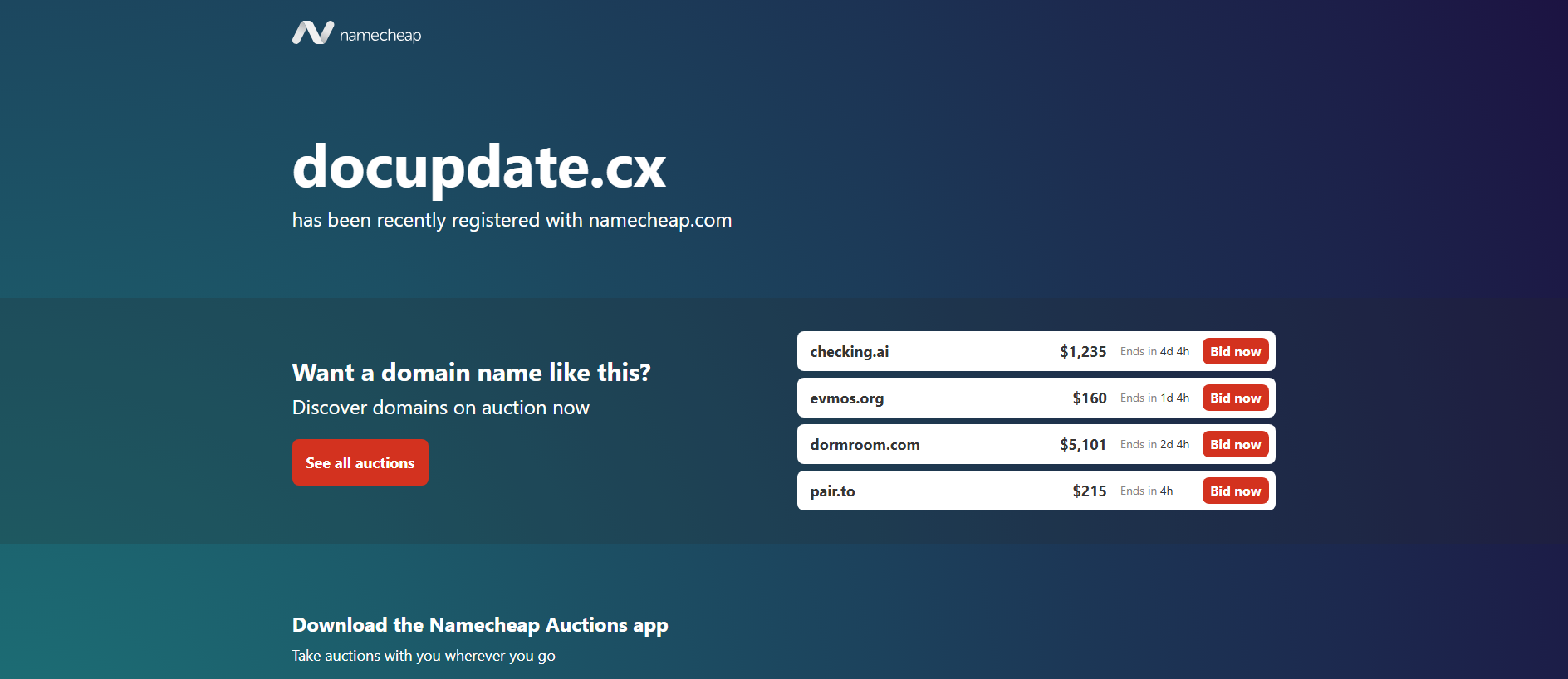
“docupdate.cx is registered at Namecheap”
The sent-report ledger records the first outgoing report at .
The recorded recipient is abuse@key-systems.net.
The latest stored availability evidence still shows the domain reachable; 1 month has elapsed since the first outgoing report.
ICANN RAA §3.18 describes registrar abuse-contact and handling obligations. This section records outgoing timestamps, listed recipients, case identifiers, and later availability. It does not by itself prove receipt, acknowledgement, investigation, remediation, or contractual non-compliance.
冒充 ["namecheap"]: docupdate.cx — 最后已知的活跃状态 (HTTP 302). 证据摘要: VirusTotal 6/91 (alphaMountain.ai, CRDF, Forcepoint ThreatSeeker, Fortinet, Gridinsoft); URLQuery…
为保留原始取证记录,下方的 PhishDestroy AI 详细分析仍使用英文。
6 / 91 engine detections
打开报告1 threat-system alert
打开报告DBL_PHISH
4 community references
打开报告provider verdict: clean
打开报告No threat flag
打开报告No malicious flag
打开报告Results reflect each source’s collection time. Zero detections do not guarantee safety. OTX references are community publications.
| Detection System | Indicator | Verdict | Alert |
|---|---|---|---|
| DNS4EU | docupdate.cx |
malicious | Sinkholed |
PhishDestroy threat report
docupdate.cx is an impersonation phishing domain that trades on the Namecheap brand. Its likely targets are people who manage domains or online accounts and would trust a Namecheap-branded page. PhishDestroy first flagged it on 2026-09-16. When last checked on 2026-10-19, the site was still alive and redirecting visitors elsewhere. The page title reads "docupdate.cx is registered at Namecheap", which is the wording of a registrar parking notice, while we classify the domain as Namecheap impersonation phishing.
Brand-impersonation pages like this borrow the look and wording of a trusted service so a visitor lowers their guard. The name "docupdate" fits the usual pattern of a fake account notice or document update request. In this kind of scheme, the victim is steered to a login or verification form and asked for a password, a one-time code or payment details. Whoever controls the page captures that input. A stolen registrar account lets an attacker hijack domains, repoint DNS or launch further phishing from a domain the victim owns. The live redirect means the final destination can change without the domain itself changing.
On VirusTotal, 6 of 91 engines flag the domain as of 2026-09-29: alphaMountain.ai, CRDF, Forcepoint ThreatSeeker, Fortinet, Gridinsoft and SOCRadar. That count is modest, but these are independent vendors reaching the same verdict. Spamhaus lists the domain in its DBL under the phishing category. MetaMask's and SEAL's blocklists carry it alongside PhishDestroy, and it appears in 4 AlienVault OTX threat pulses.
The domain was registered on 2026-06-30 through CentralNic Ltd, about eleven weeks before PhishDestroy detected it. That gap suggests it was registered in advance and later put into use. It resolves to an address on Namecheap, Inc.'s network in the United States. Hosting a Namecheap lookalike on the same provider's network makes the parking-style title look more believable at a glance.
If you entered a Namecheap or other account password on this site, change it immediately, starting with your registrar and email accounts. Then reset or re-enroll two-factor authentication and review active sessions. Check your domains for unexpected transfers, contact changes or altered DNS records, and enable registrar lock if it is off. If you entered card details, contact your bank. Defenders should block docupdate.cx at DNS and proxy level, follow its redirect target, and search mail logs for messages linking to it.
Last checked
dns1.registrar-servers.comdns2.registrar-servers.comeforward2.registrar-servers.compriority 10eforward1.registrar-servers.compriority 10eforward3.registrar-servers.compriority 10eforward4.registrar-servers.compriority 15eforward5.registrar-servers.compriority 20Location describes the IP network.
Saved certificate metadata. Certificate dates without a timezone are shown as stored. Transport encryption does not establish that the site is trustworthy.
An estimated time describes an observation window. It does not prove a registrar action or the exact moment a site became unavailable.
Compare what a browser and a crawler receive, and check for Keitaro traffic routing.
docupdate.cx
Dated changes retained by the monitor and source collectors. Newest observations appear first; source states are not proof of a takedown.
未知→redirected
http_redirect
不可用→可访问
可访问→不可用
未知→redirected
http_redirect
未知→redirected
http_redirect
不可用→可访问
可访问→不可用
未知→redirected
http_redirect
未知→redirected
http_redirect
未知→redirected
http_redirect
未知→redirected
http_redirect
未知→redirected
http_redirect
未知→redirected
http_redirect
未知→redirected
http_redirect
未知→redirected
http_redirect
未知→redirected
http_redirect
未知→redirected
http_redirect
未知→redirected
http_redirect
未知→redirected
http_redirect
未知→redirected
http_redirect
未知→redirected
http_redirect
可访问
4 community references
View sourceNo threat flag
View source6/91 engine detections
View sourcePD-20260916-CF0D7F
docupdate.cx
View sourcePage captured
View source每条路径都代表一个将域名与该主机关联的原因。实心节点表示已检测到VirusTotal,虚线节点表示已离线。完整列表如下。
Reports with the same collector label. A shared label does not establish impersonation or common ownership. View matching reports →
通过同一家注册商注册。一家注册商通常为数百万互不相关的客户提供服务,因此这仅表明数据归属同一群体,而非证明存在关联。
PD-20260916-CF0D7F Recipient: abuse@key-systems.net 如果您输入了帐户凭据、个人或付款信息,或者从此域下载了文件,请立即采取措施。以下资源可帮助您报告事件并保护自己。
选择您所在的国家/地区以获取 官方网络犯罪联系人 或 创建投诉草稿 →。
Template-based draft · optional AI wording assistance requires separate consent
Choose the steps that match what you shared. Keep a copy of this report alongside your own records.
Stop using the suspicious site. Open the real service through its official app or an address you already trust.
Keep original emails, receipts, messages and screenshots in a secure place. A factual timeline helps the receiving authority understand what happened. IC3 evidence guidance ↗
docupdate.cx)即使你并不了解所有细节—— 不管怎样都要提交报告. 即使信息不完整,对调查仍有帮助。
A report is not a guarantee of recovery or investigation, but prompt, accurate transaction data can help authorities and service providers trace the incident.
Further guidance: NIST · phishing responseFBI IC3 · reports & evidenceFTC · recovery scams
This report combines saved page captures, registration and network records, scanner results and PhishDestroy reporting history. Each source keeps its own observation date. Open a source report to inspect the original result.
The AI-assisted analysis was written on . It describes the evidence available at that time; later source checks can change.
A capture documents what was shown. A scanner result records that provider’s assessment at the time of its check. Neither a valid certificate nor a zero-detection result is a guarantee of safety.