VirusTotal
7 / 89 engine detections
Ouvrir le rapport

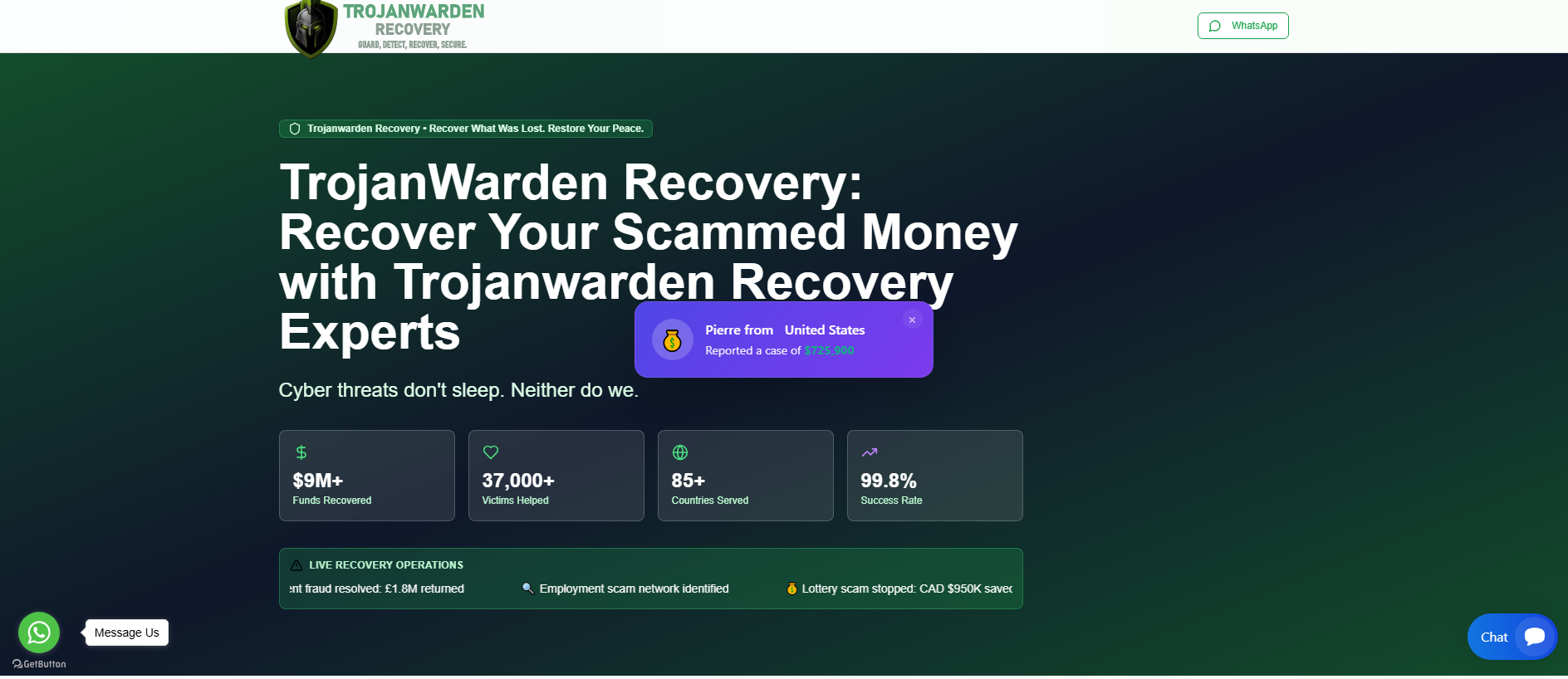
“403 Forbidden”
Usurpation de MetaMask: trojanwardenrecoverys.com — Contenu indisponible. Résumé des preuves: VirusTotal 7/89 (alphaMountain.ai, CRDF, Forcepoint…
L’analyse détaillée de PhishDestroy AI reste en anglais afin de préserver le relevé forensique original.
7 / 89 engine detections
Ouvrir le rapportchecked — no detections recorded
Ouvrir le rapport3 community references
Ouvrir le rapportprovider verdict: clean
Ouvrir le rapportNo threat flag
Ouvrir le rapportNo malicious flag
Ouvrir le rapportResults reflect each source’s collection time. Zero detections do not guarantee safety. OTX references are community publications.
PhishDestroy threat report
trojanwardenrecoverys.com is an impersonation phishing site whose name presents it as a recovery service. That theme typically targets crypto holders who have already lost money and are searching for help. PhishDestroy first flagged it on 2026-09-14, two days after registration. The site has been offline since 2026-09-17 and was still dead at the last check on 2026-10-19.
Fake recovery services borrow the look and language of a trusted name. They then ask victims for one of three things: a seed phrase to "trace" the stolen assets, a wallet connection that grants spending rights, or an upfront fee to start the recovery. Whatever is handed over is lost. A seed phrase gives the operator full control of the wallet, and fees are never refunded. When last captured, the page returned a "403 Forbidden" title rather than visible phishing content. We classified the domain as impersonation phishing based on its name, detections and blocklist listings.
Seven of 89 VirusTotal engines flagged the domain as of 2026-09-16: alphaMountain.ai, CRDF, Forcepoint ThreatSeeker, Fortinet, Gridinsoft, SOCRadar and VIPRE. That is a modest count. Still, it came from vendors working independently of each other within four days of registration. MetaMask and SEAL both blocklist the domain alongside PhishDestroy, which matters most for wallet users because those lists protect people at the point of connecting. Three AlienVault OTX pulses also reference it, so other researchers tracked it as part of wider campaigns.
The domain was registered on 2026-09-12 through OwnRegistrar, Inc. It was detected two days later and went dark three days after that. A lifespan that short is typical of throwaway phishing domains built to be replaced quickly. The site sat behind Cloudflare, Inc., with the address geolocated to Canada, so the real origin server stays hidden. Its Let's Encrypt certificate gave it a padlock, which says nothing about whether the site is legitimate.
If you typed a seed phrase or private key on this site, treat that wallet as compromised. Move any remaining assets to a new wallet created with a fresh phrase. If you connected a wallet, review and revoke token approvals you granted around that time. If you paid a "recovery" or "processing" fee, do not send more money, and report the payment to your bank or the exchange used. Legitimate recovery firms never ask for seed phrases. Defenders should block the domain, check DNS and proxy logs for visits since 2026-09-12, and watch for new lookalike recovery domains from the same operation.
Last checked
La réputation Edge-IP n’est pas attribuée à ce domaine.
adaline.ns.cloudflare.comarmfazh.ns.cloudflare.comLocation describes the IP network.
7be284576111fceadfa1abb886c416b2d11b2b3770e0b21cfda78333395e670fSaved certificate metadata. Certificate dates without a timezone are shown as stored. Transport encryption does not establish that the site is trustworthy.
Google PageSpeed Insights — mobile performance audit of trojanwardenrecoverys.com · checked Sep 14, 2026
An estimated time describes an observation window. It does not prove a registrar action or the exact moment a site became unavailable.
Compare what a browser and a crawler receive, and check for Keitaro traffic routing.
trojanwardenrecoverys.com
Dated changes retained by the monitor and source collectors. Newest observations appear first; source states are not proof of a takedown.
Accessible→Indisponible
Accessible
No threat flag
View source7/89 engine detections
View source3 community references
View sourcePD-20260914-627165
trojanwardenrecoverys.com
View sourcePage captured
View source79 domaines ressemblants enregistrés
Chaque ligne correspond à une raison pour laquelle un domaine est associé à cet hébergeur. La taille des nœuds indique les détections de VirusTotal et les nœuds en pointillés sont déjà hors ligne. Les listes complètes figurent ci-dessous.
Même hachage de favicon ou même titre de page que cet hébergeur.
Reports with the same collector label. A shared label does not establish impersonation or common ownership. View matching reports →
Enregistrés auprès du même bureau d'enregistrement. Un bureau d'enregistrement dessert des millions de clients sans lien entre eux ; ce regroupement constitue donc simplement un constat et ne prouve pas l'existence d'un lien.
PD-20260914-627165 Recipient: abuse@ownregistrar.com Si vous avez saisi des informations d'identification de compte, des informations personnelles ou de paiement, ou téléchargé un fichier à partir de ce domaine, agissez immédiatement. Vous trouverez ci-dessous des ressources pour vous aider à signaler l'incident et à vous protéger.


Sélectionnez votre pays pour obtenir contacts officiels en matière de cybercriminalité ou créer un projet de plainte →.
Template-based draft · optional AI wording assistance requires separate consent
Choose the steps that match what you shared. Keep a copy of this report alongside your own records.
Stop using the suspicious site. Open the real service through its official app or an address you already trust.
Keep original emails, receipts, messages and screenshots in a secure place. A factual timeline helps the receiving authority understand what happened. IC3 evidence guidance ↗
trojanwardenrecoverys.com)Même si vous ne disposez pas de tous les détails — déposer quand même une plainte. Même des informations partielles peuvent aider les enquêtes.
A report is not a guarantee of recovery or investigation, but prompt, accurate transaction data can help authorities and service providers trace the incident.
Further guidance: NIST · phishing responseFBI IC3 · reports & evidenceFTC · recovery scams
Analyse des menaces à l'aide de listes de blocage stockées, de WHOIS, de DNS et de preuves d'analyse publique
Scanner maintenantSignalez les domaines suspects à notre base de données des menaces — protégez la communauté
SignalerRapports de phishing récents et changements de disponibilité observés
SurveillerSurveillez les menaces en temps réel ou signalez cette alerte si vous pensez qu'il s'agit d'un faux positif
This report combines saved page captures, registration and network records, scanner results and PhishDestroy reporting history. Each source keeps its own observation date. Open a source report to inspect the original result.
The AI-assisted analysis was written on . It describes the evidence available at that time; later source checks can change.
A capture documents what was shown. A scanner result records that provider’s assessment at the time of its check. Neither a valid certificate nor a zero-detection result is a guarantee of safety.