 ChainPatrol
 Web-Check
  SOCRadar
  LeakIX
IC3 del FBI
Denunciar delitos cometidos a través de Internet en los Estados Unidos
Federal tips line1-800-CALL-FBI

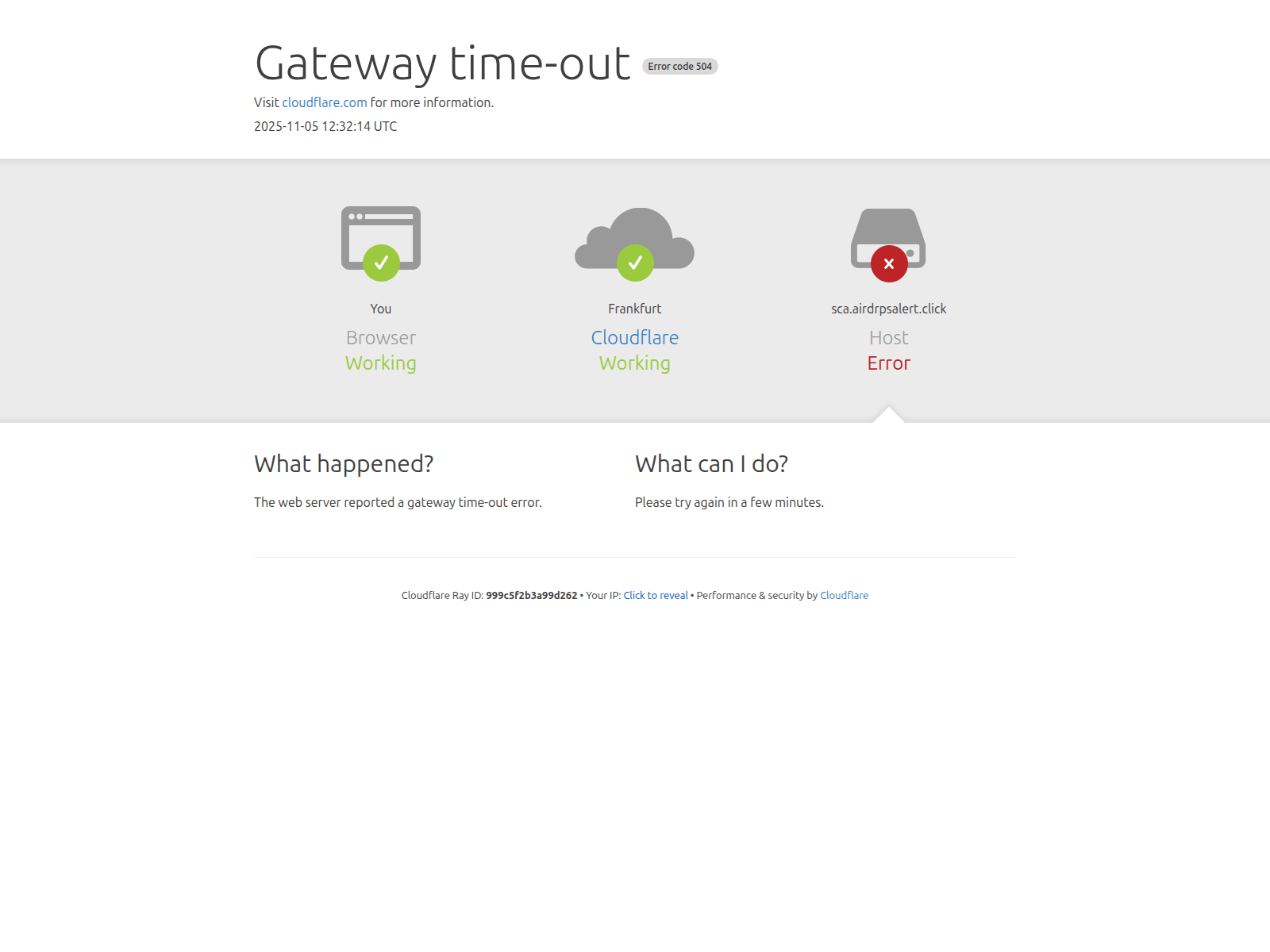
“airdrpsalert.click | 504: Gateway time-out”
sca.airdrpsalert.click — Contenido no disponible (HTTP 502). Tipo de estafa: Credential Phishing. Resumen de las pruebas: VirusTotal 8/95 (ChainPatrol, CRDF, CyRadar, Seclookup, SOCRadar); PhishDestroy score 74/100. Registrador: Dynadot.
El análisis detallado de PhishDestroy AI se mantiene en inglés para conservar el registro forense original.
sca.airdrpsalert.click was registered on 26 October 2025 through Dynadot LLC. The domain resolves to the IP address 188.114.96.3, which belongs to AS13335 (Cloudflare, Inc.) and is geolocated in the United States. DNS resolution is provided by the Cloudflare authoritative nameservers brenna.ns.cloudflare.com and hassan.ns.cloudflare.com. No TLS certificate is presented; HTTP requests return a 504 Gateway‑time‑out page title that simply repeats the domain name and the error code, indicating that the site is currently offline. Threat intelligence correlates the domain with a credential‑phishing campaign that leverages an “Airdrop Scam” kit.
Eight of ninety‑five VirusTotal scanners have flagged the domain as malicious, and it appears on one external blocklist. PhishDestroy has already blocked the host, and Gridinsoft assigns it a trust score of 0 / 100, reinforcing the malicious assessment. The presence of the kit suggests the operator may be attempting to harvest cryptocurrency‑related credentials or private keys, although the exact payload has not been captured because the site is not serving content. The available evidence confirms a malicious infrastructure that uses Cloudflare’s network to hide the origin server, a common tactic for fast‑flux or abuse‑resistant phishing operations.
Because the domain is presently offline, active probing cannot reveal additional indicators such as redirect URLs, form fields, or malicious scripts. Defenders should continue to deny any DNS resolution to 188.114.96.3 for this host, add sca.airdrpsalert.click to internal blocklists, monitor for re‑registration or resurrection of the domain, and watch for similar patterns in newly observed Airdrop‑kit domains. Ongoing vigilance is recommended, especially for users who may receive unsolicited airdrop invitations that request private keys or login credentials.

 (US)
San Francisco, US
(US)
San Francisco, USFor the registrable domain airdrpsalert.click behind this subdomain, the registrar above operates under an ICANN accreditation agreement. The links below provide the official fee schedule and current DNS abuse compliance guidance.
RAA §3.18 establishes abuse-contact and handling requirements. This report can document stored outbound notices and later technical observations; it does not by itself establish receipt, investigation, remediation, or contractual non-compliance.
Si ingresó credenciales de cuenta, información personal o de pago, o descargó un archivo de este dominio, tome medidas inmediatas. A continuación encontrará recursos que le ayudarán a informar el incidente y protegerse.


Seleccione su país para obtener contactos oficiales de cibercrimen o crear un borrador de queja →.
Estos informes se resuelven en la misma IP perimetral compartida. Ayudan a descubrir informes, pero no implican una propiedad común ni un servidor de origen compartido.
Part of the Estafa de airdrop phishing campaign. View all campaign domains →
Informes agregados recientemente de la base de datos PhishDestroy. Estos enlaces de descubrimiento no implican infraestructura ni propiedad compartida.
Análisis de amenazas utilizando listas de bloqueo almacenadas, WHOIS, DNS y evidencia de escaneo público
Escanear ahoraEnvía los dominios sospechosos a nuestra base de datos de amenazas: protege a la comunidad
DenunciarInformes de phishing recientes y cambios de disponibilidad observados
MonitorizarSupervisa las amenazas en tiempo real o impugna esta entrada si crees que se trata de un falso positivo.
 payme-paypal.com
  instagram-clone-dusky-tau.vercel.app