
 ChainPatrol
 Web-Check
  SOCRadar
  LeakIX
IC3 del FBI
Denunciar delitos cometidos a través de Internet en los Estados Unidos
Federal tips line1-800-CALL-FBI

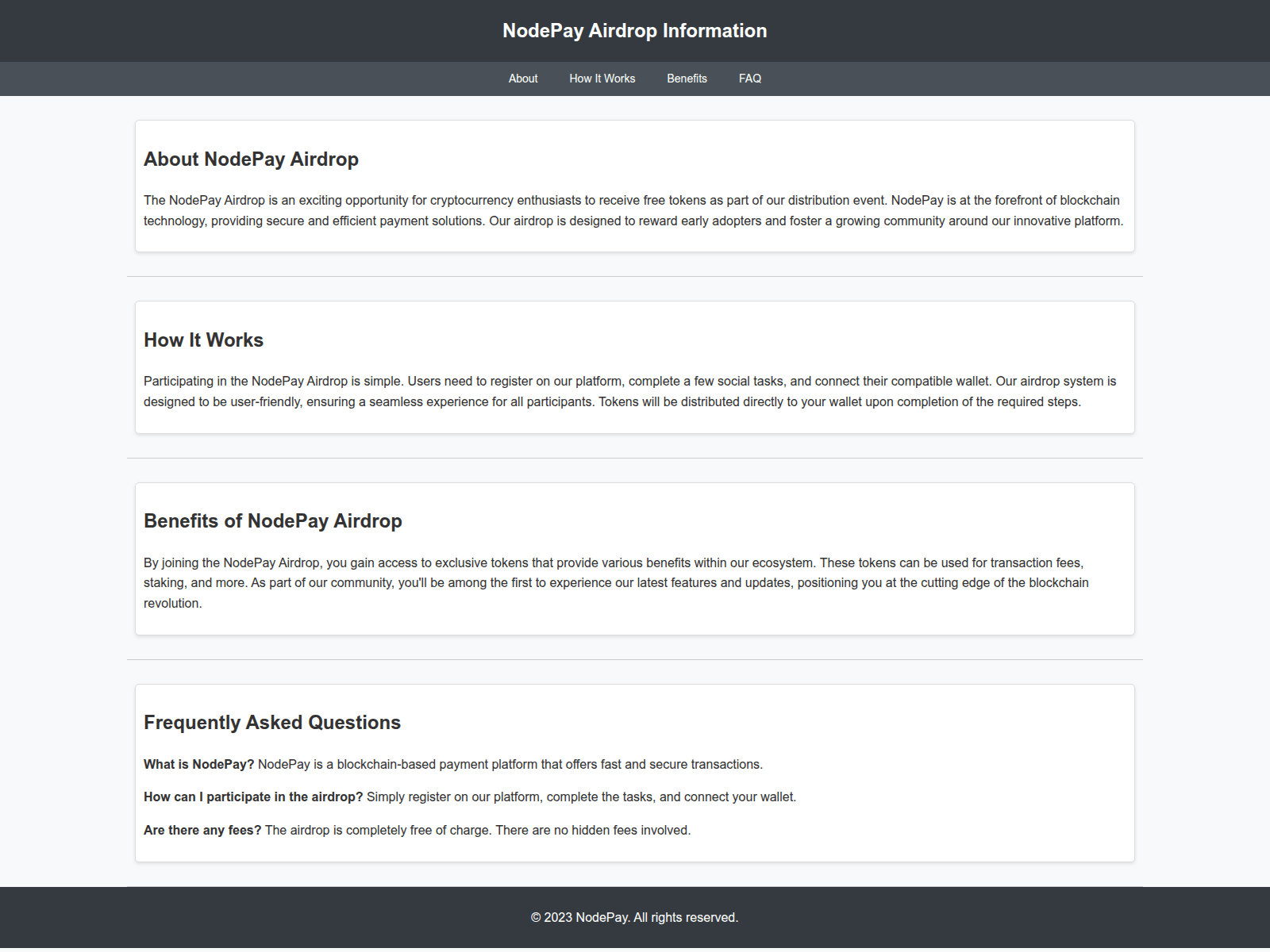
“NodePay Airdrop - Claim Your Tokens”
airdrop-nodepay.live — No verificado. Tipo de estafa: Airdrop Scam. Resumen de las pruebas: VirusTotal 1/95 (Gridinsoft); Spamhaus DBL_PHISH; PhishDestroy score 71/100. Registrador: Web Commerce Communica….
El análisis detallado de PhishDestroy AI se mantiene en inglés para conservar el registro forense original.
The domain airdrop-nodepay.live operated as a crypto drainer phishing site designed to steal cryptocurrency from victims by tricking them into connecting their wallets to a malicious smart contract. Unlike typical airdrop scams, this site did not impersonate a known brand or use a publicly identified drainer kit. As of the latest verification, airdrop-nodepay.live has been taken offline and no longer resolves to an active phishing page.
Technical analysis of airdrop-nodepay.live revealed limited detection, with only 1 of 95 VirusTotal security vendors flagging the domain. The site was registered through Web Commerce Communications Limited and resolved to the IP address 104.21.75.152, hosted on Cloudflare's network (AS13335) in the US. It appeared on a single security blocklist, PhishDestroy, and used an SSL certificate issued by Google Trust Services (WE1). The observed page title was 'NodePay Airdrop - Claim Your Tokens,' and the site employed Cloudflare Browser Insights and HTTP/3 technologies. No creation date was available for the domain, and its nameservers were nelci.ns.cloudflare.com and rudy.ns.cloudflare.com.
Victims who interacted with airdrop-nodepay.live should immediately revoke any token approvals granted to unknown or suspicious contracts using a tool like Etherscan's token approval checker or Revoke.cash. Funds should be transferred to a new, secure wallet to prevent further unauthorized access. Additionally, users are advised to report the domain to their wallet provider, the hosting provider (Cloudflare), and relevant threat intelligence platforms such as PhishTank or URLVoid to aid in tracking and mitigating the scam.

 (MY)
(MY)
 San Francisco, US
For this gTLD, the registrar above operates under an ICANN accreditation agreement. The links below provide the official fee schedule and current DNS abuse compliance guidance.
RAA §3.18 establishes abuse-contact and handling requirements. This report can document stored outbound notices and later technical observations; it does not by itself establish receipt, investigation, remediation, or contractual non-compliance.
Performance monitoring tool that measures website speed from real users.
www.cloudflare.comWeb infrastructure and security company providing CDN, DDoS mitigation, and DNS services.
www.cloudflare.comThird major version of HTTP protocol, built on QUIC for faster, more reliable connections.
Si ingresó credenciales de cuenta, información personal o de pago, o descargó un archivo de este dominio, tome medidas inmediatas. A continuación encontrará recursos que le ayudarán a informar el incidente y protegerse.


Seleccione su país para obtener contactos oficiales de cibercrimen o crear un borrador de queja →.
Part of the Estafa de airdrop phishing campaign. View all campaign domains →
Informes agregados recientemente de la base de datos PhishDestroy. Estos enlaces de descubrimiento no implican infraestructura ni propiedad compartida.
Análisis de amenazas utilizando listas de bloqueo almacenadas, WHOIS, DNS y evidencia de escaneo público
Escanear ahoraEnvía los dominios sospechosos a nuestra base de datos de amenazas: protege a la comunidad
DenunciarInformes de phishing recientes y cambios de disponibilidad observados
MonitorizarSupervisa las amenazas en tiempo real o impugna esta entrada si crees que se trata de un falso positivo.
 coingecko.com.cn
  vole22.cn
  chcn-2026-fifa.com.cn
  kradza.abvdk.cn
  instagram-clone-dusky-tau.vercel.app
  fpx-ge1tgo.blogspot.com
  megaweb20at.xyz