mxhaisyx.us.cc
  rainbowmoon.cc
  instagram-clone-dusky-tau.vercel.app
FBI IC3
Melden Sie internetbasierte Kriminalität in den Vereinigten Staaten
Federal tips line1-800-CALL-FBI
The sent-report ledger records the first outgoing report at . A report was sent to the recorded registrar; contact details remain in Domain Intelligence. The latest stored availability evidence still shows the domain reachable; 6 months has elapsed since the first outgoing report.
ICANN RAA §3.18 describes registrar abuse-contact and handling obligations. This section records outgoing timestamps and later availability. It does not by itself prove receipt, acknowledgement, investigation, remediation, or contractual non-compliance.

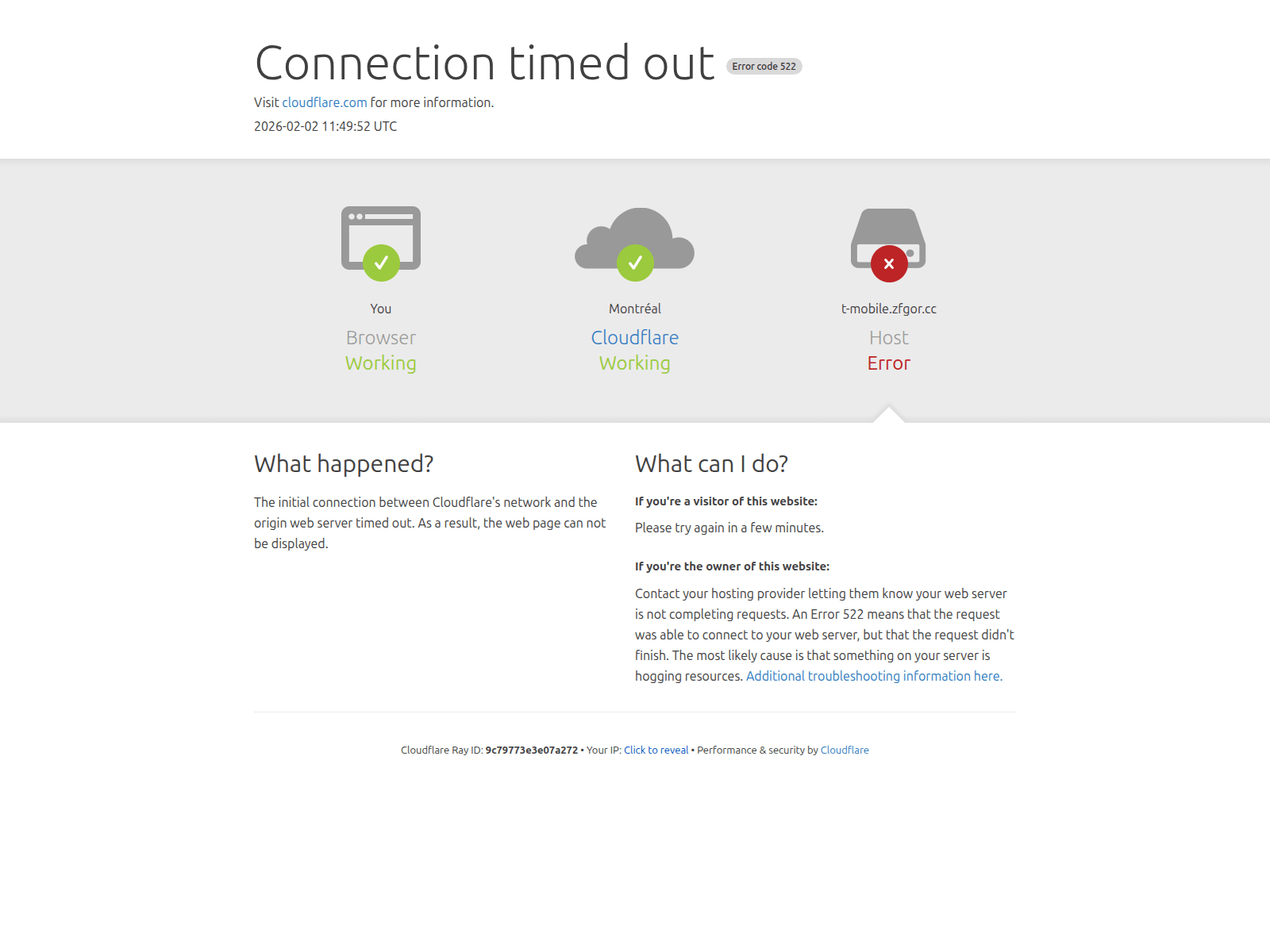
“zfgor.cc | 522: Connection timed out”
Gespeicherte Beobachtung
Analysis of t-mobile.zfgor.cc, registered on 21 February 2026 through Gname.com Pte. Ltd., shows an active high‑risk brand‑impersonation infrastructure targeting the T‑Mobile brand. The domain resolves to 104.21.39.121, an address owned by AS13335 Cloudflare, Inc., and is served behind Cloudflare’s edge network with HTTP/3 enabled. The TLS certificate is issued by Google Trust Services under the WE1 intermediate, confirming that encryption is in place but does not vouch for legitimacy. The site returns HTTP 200 and the page title displayed by the server is “zfgor.cc | 522: Connection timed out”, indicating that the underlying payload may be a placeholder or a timed‑out response rather than the phishing content itself. The infrastructure uses the nameservers matias.ns.cloudflare.com and paige.ns.cloudflare.com, both Cloudflare‑managed. Security telemetry flags the domain as malicious.
Sixteen of ninety‑three VirusTotal scanners have identified it as malicious, and it appears on at least one public blocklist. PhishDestroy has explicitly blocked the domain, and Gridinsoft assigns a trust score of 0 / 100, reinforcing the malicious assessment. The observed scam kit is labeled “Airdrop Scam”, which aligns with recent social‑engineering campaigns that lure victims with fraudulent airdrop offers. The brand target is listed as T‑Mobile, confirming that the operator is being impersonated. While the page title does not reveal the exact phishing landing page, the combination of Cloudflare hosting, a recent registration date, low trust score, and multiple vendor detections strongly suggests that the domain is being used to host a credential‑stealing or fraud page.
The exact content of the page has not been publicly captured, leaving the specific tactics (e.g., credential capture form, malicious download) uncertain. Defenders should add the domain to internal blocklists, monitor DNS queries for the 104.21.39.
PD-20260202-5A489A
10 überwachte externe Feeds · gespeicherter Stand 12.08.2026
Cloudflare-Radar-Scan gespeichert · Scan öffnen
Erreichbar → Nicht erreichbar
Cloudflare-Radar-Scan gespeichert · Scan öffnen
Erreichbar → Nicht erreichbar
Nicht erreichbar → Erreichbar
Erreichbar → Nicht erreichbar
Nicht erreichbar → Erreichbar
 (SG)
(SG)
 San Francisco, US
Google PageSpeed Insights — mobile performance audit of t-mobile.zfgor.cc · checked Apr 23, 2026
Diese Berichte werden auf dieselbe gemeinsame Edge-IP aufgelöst. Sie helfen bei der Berichtserkennung, bedeuten jedoch keinen gemeinsamen Besitz oder einen gemeinsamen Ursprungsserver.
These domains also target T-mobile users. View all T-mobile threats →
Part of the Airdrop-Betrug phishing campaign. View all campaign domains →
Kürzlich hinzugefügte Berichte aus der PhishDestroy-Datenbank. Diese Discovery-Links implizieren keine gemeinsame Nutzung der Infrastruktur oder des Eigentums.
Wenn Sie Kontoanmeldeinformationen, persönliche oder Zahlungsinformationen eingegeben oder eine Datei von dieser Domain heruntergeladen haben, ergreifen Sie sofort Maßnahmen. Nachfolgend finden Sie Ressourcen, die Ihnen helfen, den Vorfall zu melden und sich zu schützen.


Wählen Sie Ihr Land aus, um Offizielle Kontakte im Bereich Cyberkriminalität oder einen Beschwerdeentwurf erstellen → zu erhalten.
Bedrohungsanalyse anhand gespeicherter Blocklisten, WHOIS, DNS und öffentlicher Scan-Beweise
Jetzt scannenMelden Sie verdächtige Domains an unsere Bedrohungsdatenbank – schützen Sie die Community
MeldenAktuelle Phishing-Meldungen und beobachtete Verfügbarkeitsänderungen
ÜberwachenBeobachten Sie aktuelle Bedrohungen oder legen Sie Widerspruch gegen diesen Eintrag ein, wenn Sie der Meinung sind, dass es sich um einen Fehlalarm handelt