mxhaisyx.us.cc
  rainbowmoon.cc
  instagram-clone-dusky-tau.vercel.app
ABUSE NOTICE · 7D+ OPEN
Outgoing abuse reports are recorded; the latest stored availability evidence still shows the domain reachable.
Notification and current-status evidence
The sent-report ledger records the first outgoing report at . A report was sent to the recorded registrar; contact details remain in Domain Intelligence. The latest stored availability evidence still shows the domain reachable; 6 months has elapsed since the first outgoing report.
ICANN RAA §3.18 describes registrar abuse-contact and handling obligations. This section records outgoing timestamps and later availability. It does not by itself prove receipt, acknowledgement, investigation, remediation, or contractual non-compliance.
Elapsed since first report
6 months
Reports sent
1
Current status
HTTP 200 at latest stored check
Sicurezza del dominio e intelligence sulle minacce

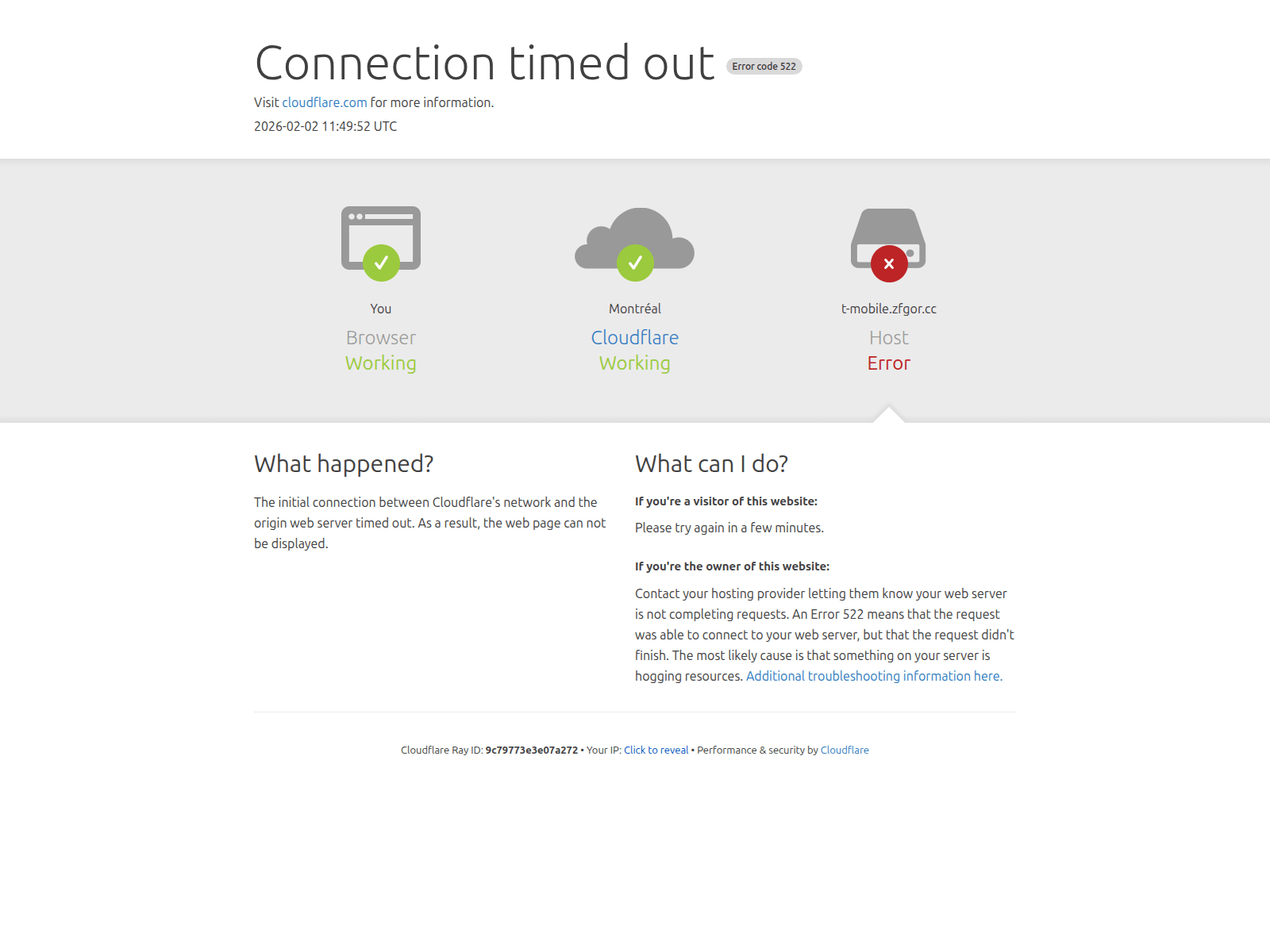
t-mobile[.]zfgor[.]cc
“zfgor.cc | 522: Connection timed out”
Verdetto di minaccia
Critico
Punteggio delle prove 100/100
Disponibilità
Ultimo attivo conosciuto
Ultima osservazione di raggiungibilità memorizzata
Segnali di rischio
Rilevamenti VirusTotal: 16/91
Spamhaus DBL: DBL_PHISH
URLQuery threat systems: 2 alerts
Simulazione del marchio: T-mobile
Ultimo attivo conosciuto
Osservazione memorizzata
Contrasto dei titoli osservato
Titolo mostrato allo scannerSeized by the Federal Bureau of Investigation
Titolo mostrato al visitatorezfgor.cc | 522: Connection timed out
Riepilogo delle prove
CRITICO
Analysis of t-mobile.zfgor.cc, registered on 21 February 2026 through Gname.com Pte. Ltd., shows an active high‑risk brand‑impersonation infrastructure targeting the T‑Mobile brand. The domain resolves to 104.21.39.121, an address owned by AS13335 Cloudflare, Inc., and is served behind Cloudflare’s edge network with HTTP/3 enabled. The TLS certificate is issued by Google Trust Services under the WE1 intermediate, confirming that encryption is in place but does not vouch for legitimacy. The site returns HTTP 200 and the page title displayed by the server is “zfgor.cc | 522: Connection timed out”, indicating that the underlying payload may be a placeholder or a timed‑out response rather than the phishing content itself. The infrastructure uses the nameservers matias.ns.cloudflare.com and paige.ns.cloudflare.com, both Cloudflare‑managed. Security telemetry flags the domain as malicious.
Sixteen of ninety‑three VirusTotal scanners have identified it as malicious, and it appears on at least one public blocklist. PhishDestroy has explicitly blocked the domain, and Gridinsoft assigns a trust score of 0 / 100, reinforcing the malicious assessment. The observed scam kit is labeled “Airdrop Scam”, which aligns with recent social‑engineering campaigns that lure victims with fraudulent airdrop offers. The brand target is listed as T‑Mobile, confirming that the operator is being impersonated. While the page title does not reveal the exact phishing landing page, the combination of Cloudflare hosting, a recent registration date, low trust score, and multiple vendor detections strongly suggests that the domain is being used to host a credential‑stealing or fraud page.
The exact content of the page has not been publicly captured, leaving the specific tactics (e.g., credential capture form, malicious download) uncertain. Defenders should add the domain to internal blocklists, monitor DNS queries for the 104.21.39.
Istantanea delle prove inviate
- Inviato
- Voci del registro
- 1
- ID del caso
PD-20260202-5A489A- Titolo della pagina acquisita
- about:privatebrowsing
- Artefatto PDF
- Prova in PDF
Testo completo delle prove
Registrar: Gname.com Pte. Ltd. (Singapore)
Policy Violations: Illegal Activities section forbids phishing, fraud, fake sites, malware distribution; registrar investigates and may suspend or delete domain
Applicable Laws: Computer Misuse Act 1993 §§3+, Penal Code §§415–420 (cheating), Online Criminal Harms Act (OCHA)
Policy Violations: Illegal Activities section forbids phishing, fraud, fake sites, malware distribution; registrar investigates and may suspend or delete domain
Applicable Laws: Computer Misuse Act 1993 §§3+, Penal Code §§415–420 (cheating), Online Criminal Harms Act (OCHA)
VirusTotal
16 det.
URLQuery
2 threat alerts
CF Radar
Malevolo
Certificato TLS
WE1
Stato osservato
Ultimo attivo conosciuto HTTP 200

Elenco da eliminare
Presente
Reports Sent
1
Data Coverage
VirusTotal
16 / 91
URLQuery
2 threat-system alerts
PhishStats
checked — no match recorded
OTX
no community references
CF Radar
provider verdict: malicious
URLScan capture
rapporto memorizzato
URLScan verdict
Analisi completata
Blocchi DNS
non controllato
TLS
valid certificate, 59d
WHOIS
not parsed
Screenshot
3 captures · 3 sources
Catena di reindirizzamenti
non sondato
Informazioni sulla sicurezza di rete
Pipeline di risposta alle minacce
Scoperta
Checks
Reports
Disponibilità
12/13
Copertura delle blocklist
10 fonti esterne monitorate · snapshot del 12/08/2026
10 fonti esterne monitorate Nessuna corrispondenza
MetaMask
Nessuna corrispondenza
ScamSniffer
Nessuna corrispondenza
Polkadot
Nessuna corrispondenza
CryptoFirewall
Nessuna corrispondenza
OpenPhish
Nessuna corrispondenza
SEAL
Nessuna corrispondenza
Enkrypt
Nessuna corrispondenza
Phishunt
Nessuna corrispondenza
Codeesura
Nessuna corrispondenza
DiscordPhishing
Nessuna corrispondenza
Cronologia del rilevamento
-
Cloudflare Radar
Scansione Cloudflare Radar archiviata · Apri scansione
-
Stato del dominio
Raggiungibile → Non raggiungibile
-
Cloudflare Radar
Scansione Cloudflare Radar archiviata · Apri scansione
-
Stato del dominio
Raggiungibile → Non raggiungibile
-
Stato del dominio
Non raggiungibile → Raggiungibile
-
Stato del dominio
Raggiungibile → Non raggiungibile
-
Stato del dominio
Non raggiungibile → Raggiungibile
Acquisizione salvata
Analisi dei domini
Dominio
URLScan Verdict
Analisi completata
score 0 report ↗
Server / ASN
cloudflare · AS13335 CLOUDFLARENET - Cloudflare, Inc., US
IP Context
Cloudflare shared edge
origin IP hidden
La reputazione Edge-IP non è attribuita a questo dominio.
Registrar (base domain)
Gname
 (SG)
(SG)
(SG)
Indirizzo IP
104.21.39.121
CDN
Posizione San Francisco, US
San Francisco, USReteAS13335 · Cloudflare, Inc.
L'IP di origine è nascosto dietro un proxy CDN. I risultati dell'IP inverso per l'indirizzo edge contengono tenant non correlati; la ricerca dell'origine richiede DNS passivo o dati di trasparenza del certificato.
Registration (base domain)zfgor.cc · Expires 28/01/2027
Stato HTTP200
Dettagli tecniciDNS, nomi TLS e date
Rilevato per la prima volta02/02/2026
DOM Analysisanalyzed 23/04/2026DOM analysis score 10/1001 brand signal
Submitted URLhttp://t-mobile.zfgor.cc/
Nameserverpaige.ns.cloudflare.com
Impronta TLS
Osservazione TLSvalido dal 28/01/2026analizzato il 15/03/2026
Nomi alternativi del soggetto TLSzfgor.cc
Segnala questo dominio
Invia le prove e contribuisci a proteggere gli altri
Analisi di VirusTotal
16 / I fornitori di sicurezza 91 hanno contrassegnato questo dominio
View on VT
Last analyzed Previous stored snapshot: 16 detections
ADMINUSLabs
Criminal IP
BitDefender
Chong Lua Dao
CyRadar
ESET
Forcepoint ThreatSeeker
Fortinet
G-Data
Google Safe Browsing
Gridinsoft
Lionic
SOCRadar
Sophos
VIPRE
Webroot
Analisi delle prestazioni del sito
Google PageSpeed Insights — mobile performance audit of t-mobile.zfgor.cc · checked Apr 23, 2026
96
Good
Performance
FCP
1.53s
First Contentful Paint
LCP
2.52s
Largest Contentful Paint
CLS
0
Cumulative Layout Shift
TBT
10ms
Total Blocking Time
SI
2.71s
Speed Index
Powered by Google PageSpeed Insights · Mobile strategy · Scores: 90-100 Good 50-89 Needs Work 0-49 Poor
Infrastruttura e rapporti correlati
Altri rapporti sul bordo Cloudflare condiviso 1
Questi report si risolvono nello stesso IP edge condiviso. Aiutano con l'individuazione dei report ma non implicano la proprietà comune o un server di origine condiviso.
Stesso registrar: Gname 6
T-mobile impersonation 8
These domains also target T-mobile users. View all T-mobile threats →
Airdrop Scam kit 8
Part of the Truffa tramite airdrop phishing campaign. View all campaign domains →
Rapporti recenti sulle minacce 6
Rapporti aggiunti di recente dal database PhishDestroy. Questi collegamenti di scoperta non implicano infrastrutture o proprietà condivise.
Questo sito ti ha influenzato in qualche modo?
If credentials were compromised, report immediately. Do not engage with recovery scammers.
Se hai inserito credenziali dell'account, informazioni personali o di pagamento oppure hai scaricato un file da questo dominio, agisci immediatamente. Di seguito sono riportate le risorse per aiutarti a segnalare l'incidente e proteggerti.

Europol
Trova il canale di segnalazione ufficiale per il tuo paese dell'UE
National police directory

Action Fraud
Segnala frodi e crimini informatici in Inghilterra, Galles e Irlanda del Nord
Contact centre0300 123 2040
PhishDestroy listing review Non un rapporto delle forze dell'ordine
Ricorso in materia di domini
Richiedi una revisione se possiedi questo dominio e ritieni che l'elenco non sia corretto
Attenzione ai truffatori che promettono il recupero dei fondi! I criminali possono contattare nuovamente le vittime fingendo di essere investigatori, avvocati o agenti di recupero. Non pagare commissioni anticipate né condividere credenziali. Scopri di più sulle frodi relative ai sussidi di recupero →
Segnalalo alle autorità locali
Seleziona il tuo Paese per ottenere contatti ufficiali del crimine informatico o creare una bozza di reclamo →.
Elenco di 97 paesi
Bozza assistita dall'intelligenza artificiale: i dettagli dell'incidente vengono elaborati dal fornitore di intelligenza artificiale
Controllalo e invialo tu stesso
Verifica qualsiasi dominio
Analisi delle minacce utilizzando blocklist archiviate, WHOIS, DNS e prove di scansione pubblica
Scansiona oraSegnala un tentativo di phishing
Segnala i domini sospetti al nostro database delle minacce — proteggi la comunità
SegnalaFeed in tempo reale sulle minacce
Segnalazioni recenti di phishing e modifiche osservate della disponibilità
MonitoraRimani informato, rimani al sicuro
Controlla le minacce in tempo reale oppure contesta questa segnalazione se ritieni che si tratti di un falso positivo