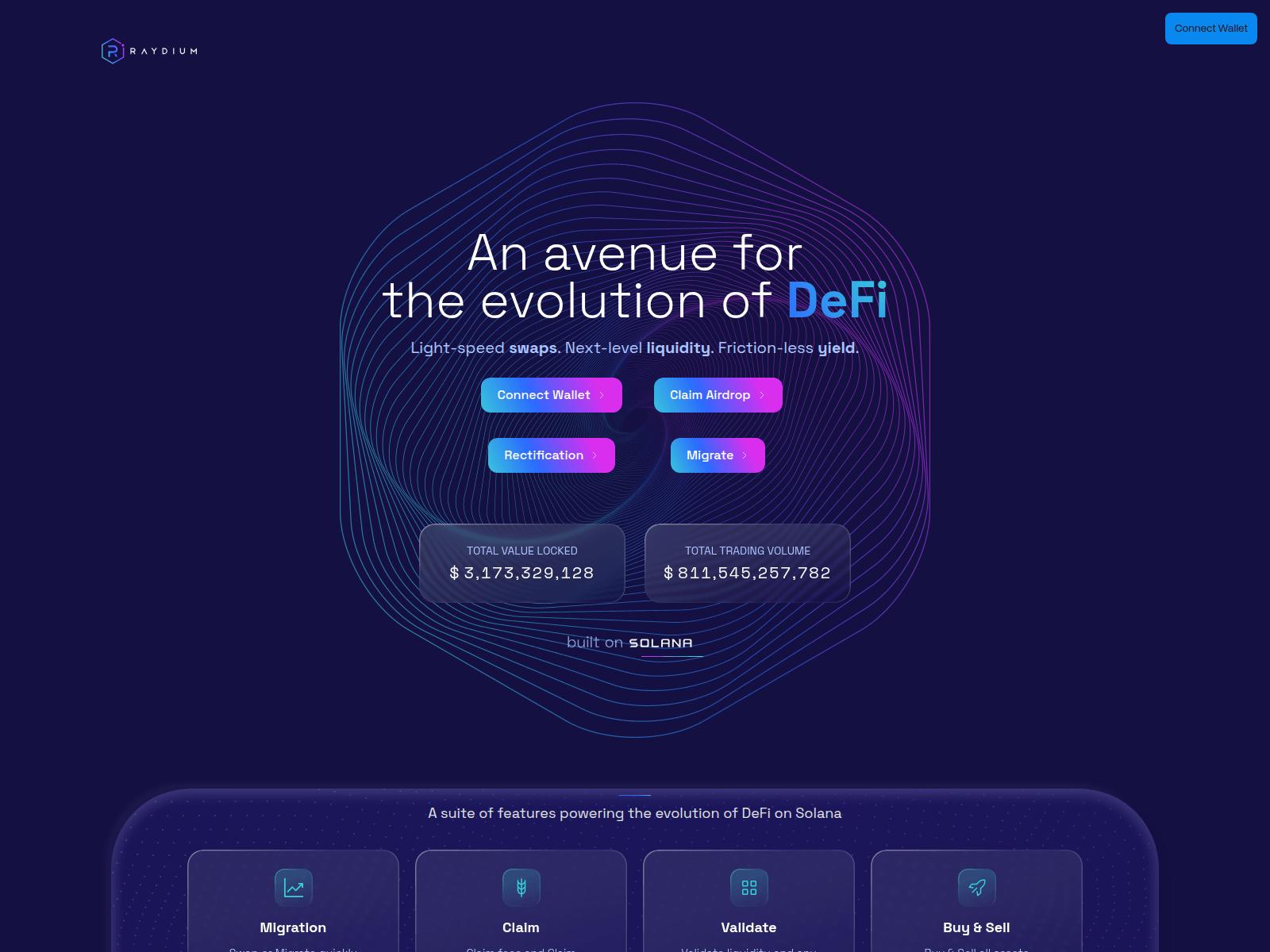
raydiumdexnetlify.world
  dfximpact.live
  ethguanfangweiyilianjie.com
  irsgovtreasury.dev
Sécurité des domaines et renseignements sur les menaces

multidapssfix[.]xyz
“Raydium”
Verdict de menace
Critique
86/100 score de preuve
Disponibilité
Contenu indisponible
Le contenu n'était pas disponible dans la dernière observation
Signaux de risque
Détections VirusTotal : 12/93
Correspondances de la liste de blocage stockée : 3
Usurpation de l'identité de la marque : Raydium
Résumé des preuves
CRITIQUE
This domain is flagged as a high-risk brand impersonation threat designed to deceive users by mimicking the legitimate Raydium decentralized finance platform. Analysis indicates the domain is specifically engineered for fraudulent activities, likely involving cryptocurrency theft or credential harvesting under the guise of a trusted service. The impersonation tactic leverages visual and contextual similarities to exploit user trust, a common vector for financial fraud in decentralized ecosystems. Infrastructure analysis reveals multiple technical indicators corroborating the malicious classification. The domain multidapssfix.xyz was registered on March 01, 2026, an unusually forward-dated creation that may indicate an attempt to evade immediate detection. It resolves to the IP address 159.198.44.198, which has been associated with prior fraudulent activity. VirusTotal reports 12 out of 95 security vendors flagging the domain as malicious, while Google Safe Browsing classifies it under SOCIAL_ENGINEERING. The domain appears on four independent security blocklists, including MetaMask, PhishDestroy, SEAL, and ScamSniffer. The page title, Raydium, further confirms the intent to impersonate the legitimate platform, and the domain is currently offline, potentially due to enforcement actions or takedown efforts. Mitigation against this type of brand impersonation threat requires a multi-layered approach. Users should verify domain authenticity by cross-referencing official communications from the legitimate service, particularly for decentralized finance platforms where phishing risks are elevated. Security teams are advised to block the domain and its resolving IP (159.198.44.198) at the network level to prevent access. Monitoring for newly registered domains with similar naming patterns or resolving to the same infrastructure can help preempt future attacks. Additionally, deploying real-time domain reputation checks and educating users on identifying impersonation tactics—such as scrutinizing URLs, page titles, and registration dates—can reduce exposure to such threats.
VirusTotal
12 det.
Âge
5 mo
Statut observé
Contenu indisponible

DestroyList
Répertorié
Data Coverage
VirusTotal
12 / 93
URLQuery
pas vérifié
PhishStats
checked — no match recorded
OTX
no community references
CF Radar
scan completed
URLScan capture
rapport stocké
URLScan verdict
Analyse terminée
Blocs DNS
pas vérifié
TLS
aucune donnée de certificat
WHOIS
5 mo old
Capture d'écran
2 captures · 2 sources
Chaîne de redirection
non sondé
Renseignements sur la sécurité réseau
SSL Certificate
Invalid
SSL certificate is invalid or expired. Issuer:
Processus de réponse aux menaces Pipeline
Découverte
Checks
Reports
Disponibilité
13/14
Couverture des listes de blocage
10 sources externes surveillées · instantané du 13/08/2026
7 sources externes surveillées Aucune correspondance
Chronologie de détection
-
Cloudflare Radar
Analyse Cloudflare Radar enregistrée · Ouvrir l’analyse
-
VirusTotal
7 → 12
Capture enregistrée
Informations sur les domaines
Domaine
URLScan Verdict
Analyse terminée
score 0 report ↗
Google Safe Browsing
Marqué
Social engineering checked 26/06/2026
Serveur / ASN
nginx/1.24.0 (Ubuntu) · AS22612 Namecheap, Inc.
Réputation de l’IP
IP abuse confidence 0/100 0 reports checked 14/06/2026
EnregistrementCréé 01/03/2026 (164d)
Détails techniquesDNS, noms TLS et horodatages
Première détection01/03/2026
DOM Analysisanalyzed 29/07/2026DOM analysis score 80/1001 brand signal
Submitted URLhttps://multidapssfix.xyz/
Serveurs de nomsdns1.registrar-servers.comdns2.registrar-servers.com
Observation TLSanalysé le 15/03/2026
Signaler ce domaine
Envoyez des éléments de preuve et contribuez à protéger les autres
Analyse VirusTotal
12 / Les fournisseurs de sécurité 93 ont signalé ce domaine
View on VT
Last analyzed Previous stored snapshot: 9 detections
alphaMountain.ai
BitDefender
CRDF
CyRadar
Forcepoint ThreatSeeker
Fortinet
G-Data
Google Safebrowsing
Gridinsoft
Lionic
Sophos
Webroot
Infrastructure et rapports associés
Shared IP 159.198.44.198 1
Un autre domaine de phishing partage cette adresse IP d’origine – une éventuelle infrastructure colocalisée.
Raydium impersonation 8
These domains also target Raydium users. View all Raydium threats →
Rapports récents sur les menaces 6
Rapports récemment ajoutés à partir de la base de données PhishDestroy. Ces liens de découverte n’impliquent pas d’infrastructure ou de propriété partagée.
Ce site vous a-t-il affecté ?
If credentials were compromised, report immediately. Do not engage with recovery scammers.
Si vous avez saisi des informations d'identification de compte, des informations personnelles ou de paiement, ou téléchargé un fichier à partir de ce domaine, agissez immédiatement. Vous trouverez ci-dessous des ressources pour vous aider à signaler l'incident et à vous protéger.


Action Fraud
Signaler la fraude et la cybercriminalité en Angleterre, au Pays de Galles et en Irlande du Nord
Contact centre0300 123 2040
PhishDestroy listing review Pas un rapport des forces de l'ordre
Recours en matière de nom de domaine
Demandez un examen si vous possédez ce domaine et pensez que la liste est incorrecte
Méfiez-vous des escrocs qui prétendent vous aider à récupérer vos biens ! Les criminels peuvent recontacter leurs victimes tout en se faisant passer pour des enquêteurs, des avocats ou des agents de recouvrement. Ne payez pas de frais initiaux et ne partagez pas vos informations d'identification. En savoir plus sur la fraude liée aux aides à la reprise →
Signalez-le à vos autorités locales
Sélectionnez votre pays pour obtenir contacts officiels en matière de cybercriminalité ou créer un projet de plainte →.
Annuaire de 97 pays
Brouillon assisté par l'IA : les détails de l'incident sont traités par le fournisseur d'IA
Examinez-le et soumettez-le vous-même
Vérifier n'importe quel domaine
Analyse des menaces à l'aide de listes de blocage stockées, de WHOIS, de DNS et de preuves d'analyse publique
Scanner maintenantSignaler une tentative d'hameçonnage
Signalez les domaines suspects à notre base de données des menaces — protégez la communauté
SignalerFlux d'alertes en temps réel
Rapports de phishing récents et changements de disponibilité observés
SurveillerRestez informés, restez en sécurité
Surveillez les menaces en temps réel ou signalez cette alerte si vous pensez qu'il s'agit d'un faux positif