


 ChainPatrol
 Web-Check
  SOCRadar
  LeakIX
Sécurité des domaines et renseignements sur les menaces

en-uphold-login-app[.]blogspot[.]ca
“Uphold Login | Secure Access to Your Crypto & Digital Assets”
Verdict de menace
Critique
88/100 score de preuve
Disponibilité
Non vérifié
L'accessibilité actuelle n'est pas vérifiée
Signaux de risque
Détections VirusTotal : 9/91
Usurpation de l'identité de la marque : Uphold
Résumé du rapport
en-uphold-login-app.blogspot.ca — Non vérifié. Usurpation de l'identité de la marque : Uphold; Type d'arnaque : Credential Phishing. Résumé des preuves: VirusTotal 9/91 (ADMINUSLabs, alphaMountain.ai, BitDefender, Fortinet, Google Safe Browsing); URLScan malicious verdict; Google Safe Browsing flagged; PhishDestroy score 88/100. Bureau d’enregistrement: MarkMonitor.
L’analyse détaillée de PhishDestroy AI reste en anglais afin de préserver le relevé forensique original.
Résumé des preuves
CRITIQUE
This domain poses a high-risk credential phishing threat targeting users of a cryptocurrency platform. The site mimics the legitimate login interface of a well-known digital asset service, presenting a page titled 'Uphold Login | Secure Access to Your Crypto & Digital Assets.' Visitors are prompted to enter sensitive credentials, which are then harvested by threat actors for unauthorized account access, financial theft, or further exploitation. The fraudulent nature of the page is designed to exploit trust in the brand, leveraging familiar branding elements to deceive users into disclosing login details. Analysis indicates the domain is part of a subdomain structure hosted on a widely used blogging platform, registered through MarkMonitor, Inc., with a creation date of October 18, 2006. While the parent domain has a long-standing registration, the subdomain in question is flagged by 10 out of 95 security vendors on VirusTotal, including detection by PhishDestroy, MetaMask, and SEAL. The domain resolves to the IP address 142.250.81.225, associated with AS15169 (Google LLC), and appears on three security blocklists. The SSL certificate, issued by Google Trust Services, does not mitigate the phishing risk, as encryption is commonly exploited to lend false legitimacy to malicious sites. Users who visited en-uphold-login-app.blogspot.ca and entered credentials should immediately revoke access to any linked accounts, enable multi-factor authentication, and monitor for unauthorized transactions. Passwords for the compromised account and any reused credentials should be changed across all platforms. Network-level protections, such as DNS filtering or endpoint detection, can block future access to known phishing infrastructure. If financial data or recovery codes were submitted, affected parties should contact their financial institution and the legitimate service provider to report the incident and request account lockdown procedures.
VirusTotal
9 det.
URLScan
Certificat TLS
Expiré ou non vérifié -114d
Âge
19.8 yr
Statut observé
Non vérifié

DestroyList
Répertorié
Couverture des données
VirusTotal
9 / 91
URLQuery
pas vérifié
PhishStats
pas vérifié
OTX
no community references
CF Radar
scan completed
URLScan capture
rapport stocké
URLScan verdict
malicious
Blocs DNS
pas vérifié
TLS
Expiré ou non vérifié
WHOIS
241 mo old
Capture d'écran
2 captures · 2 sources
Chaîne de redirection
non sondé
Processus de réponse aux menaces Pipeline
Découverte
Checks
Reports
Disponibilité
13/15
Statut de la liste de blocage publique
Capture enregistrée
Informations sur les domaines
Domaine
URLScan Verdict
Malveillant
score 100 Phishing brand: Uphold report ↗
Google Safe Browsing
Marqué
Social engineering checked 25/02/2026
Serveur / ASN
GSE · AS15169 GOOGLE, US
Réputation de l’IP
abuse score 0/100 0 reports checked 16/08/2026
Fournisseur de plateforme
MarkMonitor
 (US)
(US)
(US)
Adresse IP
142.250.81.225
Détails techniquesDNS, SAN SSL, horodatages
Première détection02/01/2026
DOM Analysisanalyzed 10/07/2026score 88/100
IoC Extractionscanned 29/07/20260 wallet · 0 Telegram IoCs
Submitted URLhttp://en-uphold-login-app.blogspot.ca/
Serveurs de nomsns1.google.comns2.google.comns3.google.comns4.google.com
TLS Fingerprint
TLS Observationvalid from 02/02/2026scanned 12/03/2026
TLS SAN Domainsblogspot.aeblogspot.alblogspot.amblogspot.bablogspot.beblogspot.bgblogspot.cablogspot.chblogspot.clblogspot.co.atblogspot.co.idblogspot.co.ilblogspot.co.keblogspot.co.nzblogspot.co.uk+55
Technologies · 5 identified
B
Blogger
J
Java
P
Python
OpenGSE
H
HTTP/3
Miscellaneous
Third major version of HTTP protocol, built on QUIC for faster, more reliable connections.
Detected via Cloudflare Radar · Wappalyzer engine
Signaler ce domaine
Envoyez des éléments de preuve et contribuez à protéger les autres
Analyse VirusTotal
9 / Les fournisseurs de sécurité 91 ont signalé ce domaine
View on VT
Last analyzed Previous stored snapshot: 10 detections
ADMINUSLabs
alphaMountain.ai
BitDefender
Fortinet
Google Safe Browsing
Kaspersky
Lionic
Sophos
Webroot
Preuves archivées
Wayback Machine Snapshot
Un instantané historique est disponible pour l’examen des preuves
Données factuelles et rapports externes
Analyse de sécurité
OSINT et renseignement
DNS et réseau
Référencement naturel et nom de domaine
Ce site vous a-t-il affecté ?
If credentials were compromised, report immediately. Do not engage with recovery scammers.
Si vous avez saisi des informations d'identification de compte, des informations personnelles ou de paiement, ou téléchargé un fichier à partir de ce domaine, agissez immédiatement. Vous trouverez ci-dessous des ressources pour vous aider à signaler l'incident et à vous protéger.


Action Fraud
Signaler la fraude et la cybercriminalité en Angleterre, au Pays de Galles et en Irlande du Nord
Contact centre0300 123 2040
PhishDestroy listing review Pas un rapport des forces de l'ordre
Recours en matière de nom de domaine
Demandez un examen si vous possédez ce domaine et pensez que la liste est incorrecte
Méfiez-vous des escrocs qui prétendent vous aider à récupérer vos biens ! Les criminels peuvent recontacter leurs victimes tout en se faisant passer pour des enquêteurs, des avocats ou des agents de recouvrement. Ne payez pas de frais initiaux et ne partagez pas vos informations d'identification. En savoir plus sur la fraude liée aux aides à la reprise →
Signalez-le à vos autorités locales
Sélectionnez votre pays pour obtenir contacts officiels en matière de cybercriminalité ou créer un projet de plainte →.
Annuaire de 97 pays
Brouillon assisté par l'IA : les détails de l'incident sont traités par le fournisseur d'IA
Examinez-le et soumettez-le vous-même
Infrastructure et rapports associés
Content matches 4


Shared IP 142.250.81.225 1
Un autre domaine de phishing partage cette adresse IP d’origine – une éventuelle infrastructure colocalisée.
 uphold-login-en.blogspot.ba
 Même bureau d’enregistrement: MarkMonitor 6
 list-serve.com
  urlwatch.com
  contact-metamask-support.blogspot.com.co
 Uphold impersonation 8
These domains also target Uphold users. View all Uphold threats →
 en-uphold-login-auth.tem3.io
  uphldd.zapier.app
  sso-auth-uphold-eng.square.site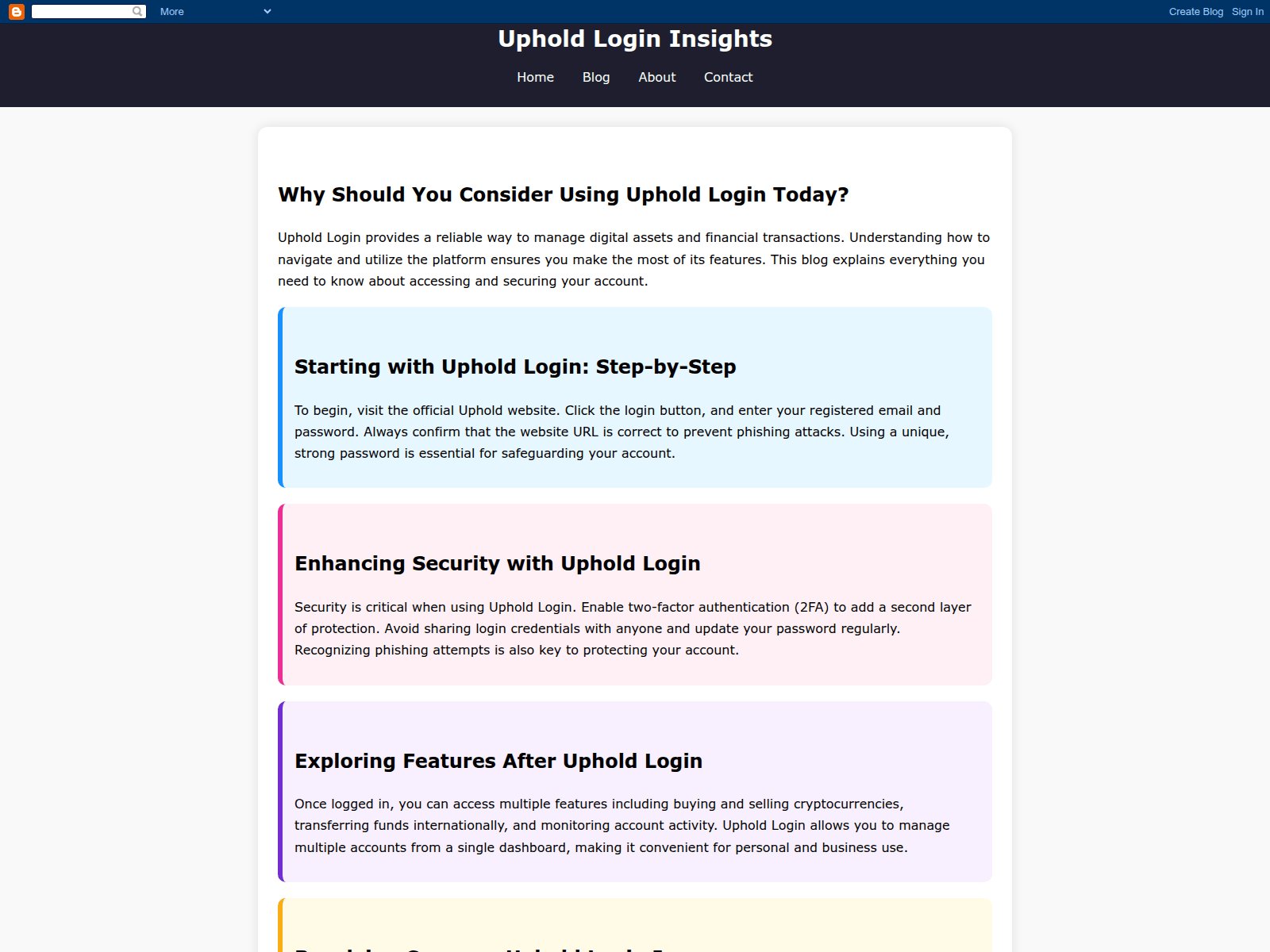
Rapports récents sur les menaces 4
Rapports récemment ajoutés à partir de la base de données PhishDestroy. Ces liens de découverte n’impliquent pas d’infrastructure ou de propriété partagée.
Vérifier n'importe quel domaine
Analyse des menaces à l'aide de listes de blocage stockées, de WHOIS, de DNS et de preuves d'analyse publique
Scanner maintenantSignaler une tentative d'hameçonnage
Signalez les domaines suspects à notre base de données des menaces — protégez la communauté
SignalerFlux d'alertes en temps réel
Rapports de phishing récents et changements de disponibilité observés
SurveillerRestez informés, restez en sécurité
Surveillez les menaces en temps réel ou signalez cette alerte si vous pensez qu'il s'agit d'un faux positif