letsvpn-ai.com
  tronoscan.org
  instagram-clone-dusky-tau.vercel.app
  dfximpact.live
  ethguanfangweiyilianjie.com
  irsgovtreasury.dev
IC3 del FBI
Denunciar delitos cometidos a través de Internet en los Estados Unidos
Federal tips line1-800-CALL-FBI
The sent-report ledger records the first outgoing report at . A report was sent to the recorded registrar; contact details remain in Domain Intelligence. The latest stored availability evidence still shows the domain reachable; 6 months has elapsed since the first outgoing report.
ICANN RAA §3.18 describes registrar abuse-contact and handling obligations. This section records outgoing timestamps and later availability. It does not by itself prove receipt, acknowledgement, investigation, remediation, or contractual non-compliance.

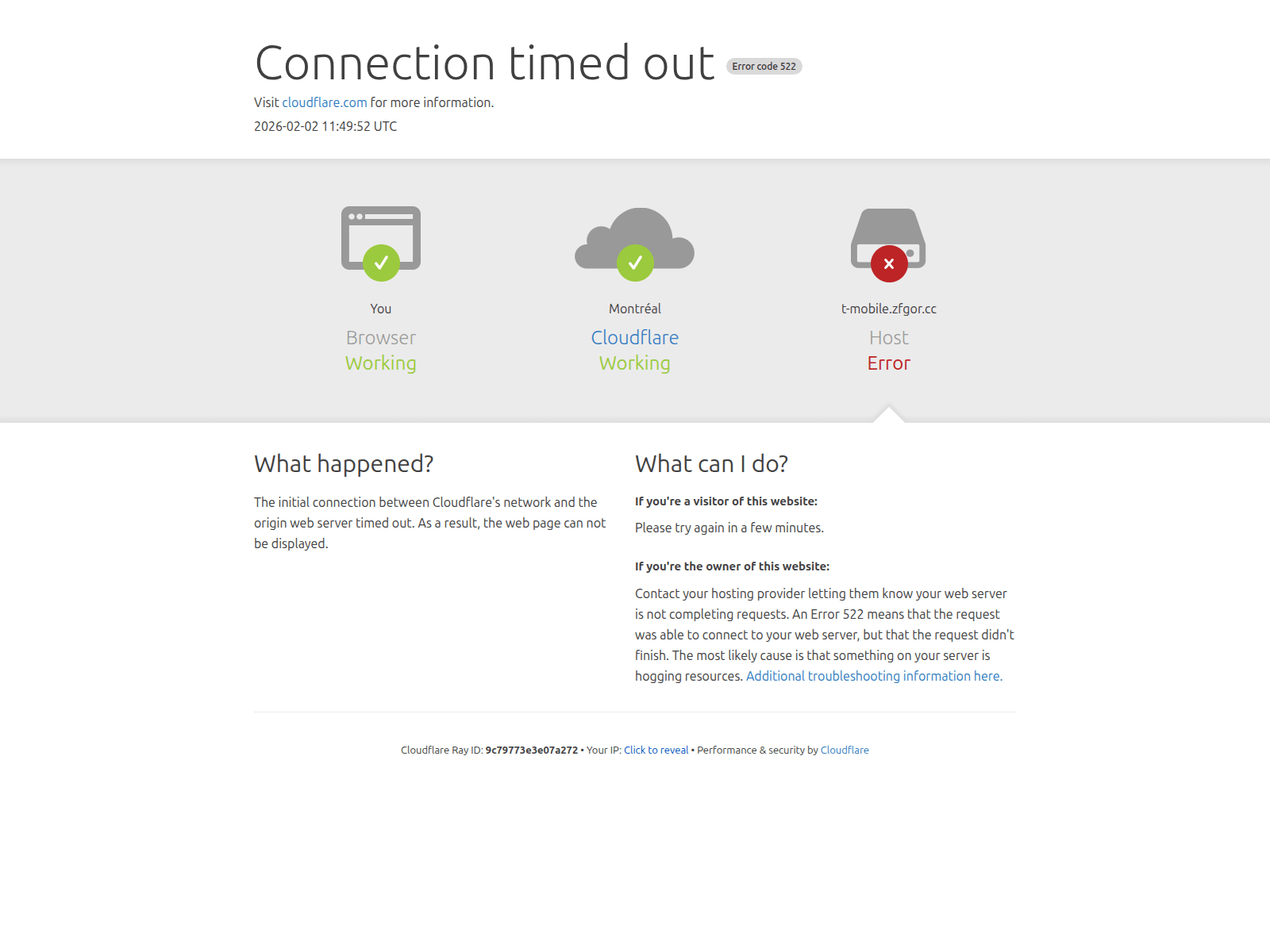
“zfgor.cc | 522: Connection timed out”
Analysis of t-mobile.zfgor.cc, registered on 21 February 2026 through Gname.com Pte. Ltd., shows an active high‑risk brand‑impersonation infrastructure targeting the T‑Mobile brand. The domain resolves to 104.21.39.121, an address owned by AS13335 Cloudflare, Inc., and is served behind Cloudflare’s edge network with HTTP/3 enabled. The TLS certificate is issued by Google Trust Services under the WE1 intermediate, confirming that encryption is in place but does not vouch for legitimacy. The site returns HTTP 200 and the page title displayed by the server is “zfgor.cc | 522: Connection timed out”, indicating that the underlying payload may be a placeholder or a timed‑out response rather than the phishing content itself. The infrastructure uses the nameservers matias.ns.cloudflare.com and paige.ns.cloudflare.com, both Cloudflare‑managed. Security telemetry flags the domain as malicious.
Sixteen of ninety‑three VirusTotal scanners have identified it as malicious, and it appears on at least one public blocklist. PhishDestroy has explicitly blocked the domain, and Gridinsoft assigns a trust score of 0 / 100, reinforcing the malicious assessment. The observed scam kit is labeled “Airdrop Scam”, which aligns with recent social‑engineering campaigns that lure victims with fraudulent airdrop offers. The brand target is listed as T‑Mobile, confirming that the operator is being impersonated. While the page title does not reveal the exact phishing landing page, the combination of Cloudflare hosting, a recent registration date, low trust score, and multiple vendor detections strongly suggests that the domain is being used to host a credential‑stealing or fraud page.
The exact content of the page has not been publicly captured, leaving the specific tactics (e.g., credential capture form, malicious download) uncertain. Defenders should add the domain to internal blocklists, monitor DNS queries for the 104.21.39.
PD-20260202-5A489A
10 fuentes externas supervisadas · instantánea del 13/08/2026
Análisis de Cloudflare Radar almacenado · Abrir análisis
Accesible → Inaccesible
Análisis de Cloudflare Radar almacenado · Abrir análisis
Accesible → Inaccesible
Inaccesible → Accesible
Accesible → Inaccesible
Inaccesible → Accesible
 (SG)
(SG)
 San Francisco, US
Google PageSpeed Insights — mobile performance audit of t-mobile.zfgor.cc · checked Apr 23, 2026
Estos informes se resuelven en la misma IP perimetral compartida. Ayudan a descubrir informes, pero no implican una propiedad común ni un servidor de origen compartido.
These domains also target T-mobile users. View all T-mobile threats →
Part of the Estafa de airdrop phishing campaign. View all campaign domains →
Informes agregados recientemente de la base de datos PhishDestroy. Estos enlaces de descubrimiento no implican infraestructura ni propiedad compartida.
Si ingresó credenciales de cuenta, información personal o de pago, o descargó un archivo de este dominio, tome medidas inmediatas. A continuación encontrará recursos que le ayudarán a informar el incidente y protegerse.


Seleccione su país para obtener contactos oficiales de cibercrimen o crear un borrador de queja →.
Análisis de amenazas utilizando listas de bloqueo almacenadas, WHOIS, DNS y evidencia de escaneo público
Escanear ahoraEnvía los dominios sospechosos a nuestra base de datos de amenazas: protege a la comunidad
DenunciarInformes de phishing recientes y cambios de disponibilidad observados
MonitorizarSupervisa las amenazas en tiempo real o impugna esta entrada si crees que se trata de un falso positivo.