
 ChainPatrol
 Web-Check
  SOCRadar
  LeakIX
IC3 del FBI
Denunciar delitos cometidos a través de Internet en los Estados Unidos
Federal tips line1-800-CALL-FBI

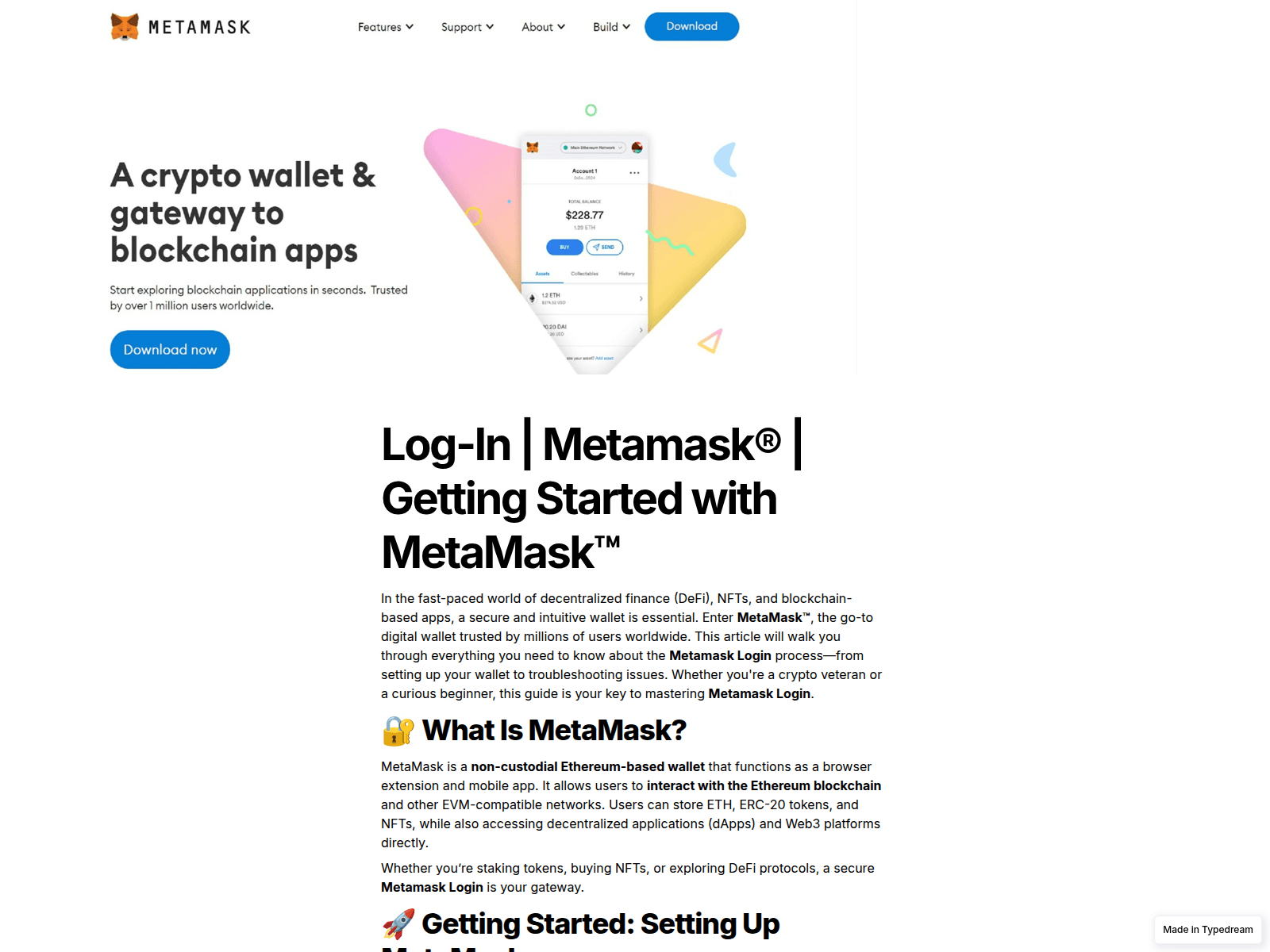
“Log-In | Metamask® | Getting started with MetaMask*”
metamask-login-learn-us-sso.typedream.app — Contenido no disponible. Suplantación de marca: Aave; Tipo de estafa: Crypto Drainer. Resumen de las pruebas: VirusTotal 18/95 (ADMINUSLabs, ChainPatrol, Criminal IP, alphaMountain.ai, BitDefender); URLScan malicious verdict; CF Radar malicious; PhishDestroy score 95/100. Registrador: Squarespace Domains II.
El análisis detallado de PhishDestroy AI se mantiene en inglés para conservar el registro forense original.
This domain is flagged as a high-risk brand impersonation threat specifically targeting Aave, a decentralized finance protocol. The site mimics legitimate authentication portals to harvest credentials, private keys, or seed phrases from unsuspecting users attempting to access cryptocurrency services. Analysis indicates a deliberate effort to exploit trust in the Aave brand, with page elements closely resembling official login interfaces, including the title 'Log-In | Metamask® | Getting started with MetaMask*' despite the domain's primary association with Aave. Infrastructure analysis reveals the domain metamask-login-learn-us-sso.typedream.app was registered through Squarespace Domains II LLC on February 21, 2026, and currently resolves to IP address 188.114.96.3, hosted on AS13335 (Cloudflare, Inc.) in the United States. The domain is detected by 18 out of 95 security vendors on VirusTotal, and appears on three distinct security blocklists. The SSL certificate is issued by Google Trust Services (WE1), a common practice among malicious domains to evade basic HTTPS warnings. Notably, the creation date is anomalous, suggesting either a registration error or intentional obfuscation of the domain's true age. Mitigation requires immediate blocking of the domain and its resolving IP (188.114.96.3) at the network perimeter. Security teams should deploy indicators of compromise (IOCs) including the domain, IP, and SSL certificate fingerprint to endpoint detection systems. Users should be educated to verify domain authenticity before entering credentials, particularly for decentralized finance platforms. Multi-factor authentication (MFA) should be enforced where possible, and wallet software should never be accessed through links in emails or unverified sources. Organizations should monitor for internal traffic to the domain and investigate any connections as potential credential compromise incidents.

 (US)
San Francisco, US
(US)
San Francisco, USNode.js is an open-source, cross-platform, JavaScript runtime environment that executes JavaScript code outside a web browser.
nodejs.org 100 % de confianzaReact is an open-source JavaScript library for building user interfaces or UI components.
reactjs.org 100 % de confianzaNext.js is a React framework for developing single page Javascript applications.
nextjs.org 100 % de confianzaGoogle Cloud Trace is a distributed tracing system that collects latency data from applications and displays it in the Google Cloud Console.
cloud.google.com 100 % de confianzaCloud CDN uses Google's global edge network to serve content closer to users.
cloud.google.com 100 % de confianzaCloudflare is a web-infrastructure and website-security company, providing content-delivery-network services, DDoS mitigation, Internet security, and distributed domain-name-server services.
www.cloudflare.com 100 % de confianzaHTTP/3 is the third major version of the Hypertext Transfer Protocol used to exchange information on the World Wide Web.
httpwg.org 100 % de confianzaSi ingresó credenciales de cuenta, información personal o de pago, o descargó un archivo de este dominio, tome medidas inmediatas. A continuación encontrará recursos que le ayudarán a informar el incidente y protegerse.


Seleccione su país para obtener contactos oficiales de cibercrimen o crear un borrador de queja →.
Estos informes se resuelven en la misma IP perimetral compartida. Ayudan a descubrir informes, pero no implican una propiedad común ni un servidor de origen compartido.
These domains also target Aave users. View all Aave threats →
Informes agregados recientemente de la base de datos PhishDestroy. Estos enlaces de descubrimiento no implican infraestructura ni propiedad compartida.
Análisis de amenazas utilizando listas de bloqueo almacenadas, WHOIS, DNS y evidencia de escaneo público
Escanear ahoraEnvía los dominios sospechosos a nuestra base de datos de amenazas: protege a la comunidad
DenunciarInformes de phishing recientes y cambios de disponibilidad observados
MonitorizarSupervisa las amenazas en tiempo real o impugna esta entrada si crees que se trata de un falso positivo.

 blitz-swap.com
  kenhoward.com
  reward-plus.net
  finglobalheritage.online
  metamask-k.blogspot.com.ng