
The exception is
playing without one.
557 of 559 player–Major records include an inspection of at least one weapon with a skin. That is 99.6%. The same pattern runs through all seven events.
At least one skinned weapon in the inspect record.
| Major | With a skin | Share of records | Skinned inspects | Skinned hours |
|---|---|---|---|---|
| Stockholm 2021 ↗CS:GO · 70 maps | 78 / 78 | 100.0% | 101,221 | 43.19player-hours |
| Antwerp 2022 ↗CS:GO · 71 maps | 78 / 79 | 98.7% | 105,494 | 41.27player-hours |
| Rio 2022 ↗CS:GO · 68 maps | 79 / 79 | 100.0% | 134,474 | 53.94player-hours |
| Paris 2023 ↗CS:GO · 67 maps | 77 / 78 | 98.7% | 104,496 | 44.77player-hours |
| Copenhagen 2024 ↗CS2 · 73 maps | 79 / 79 | 100.0% | 154,139 | 7.01player-hours |
| Shanghai 2024 ↗CS2 · 72 maps | 84 / 84 | 100.0% | 155,810 | 6.15player-hours |
| Austin 2025 ↗CS2 · 70 maps | 82 / 82 | 100.0% | 192,598 | 7.34player-hours |
Source: all-weapon player and event reports; hours summed from mapped inspect intervals. Download the calculation ↗
“Cosmetic” describes what an item does to a weapon’s stats.
It does not describe what it does to demand.
A professional player is more than another account in the player base. On the Major stage, the player is a reference point: a favourite team, a recognisable loadout, an object an audience can identify and want. The ordinary-player average does not answer what this stage puts on display.
An animation
for the object itself.
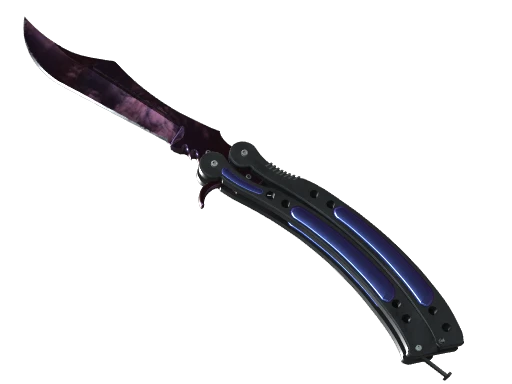
Inspect rotates the held weapon or knife so the player can look at it. It is not firing, reloading or an upgrade to the weapon’s performance. It is a built-in way to examine the finish.
Example by Code Diavolo ↗, 28 March 2023. Mechanic illustration; separate from the Major dataset.
of recorded inspect-button intervals on items with a non-default finish.
Where those hours accumulate
Bars share a zero baseline. CS:GO and CS2 use different input implementations; their recorded button durations are not equivalent animation lengths. Counts and hours are summed across simultaneous players, not a broadcast timeline.
From a demo interval to the number on this page
For each mapped skinnable-weapon record: max(0, end_s − start_s). For the skinned total, retain paint_kit ≠ 0. Sum across players and maps, then divide by 3,600.
The parser observes the inspect input state. It does not record the broadcast director’s camera, animation completion or the number of viewers. An item can remain visible outside Inspect; these hours are not the full time a skin appears in play.
The knife goes away.
The gloves remain.
A player switches from a knife to a rifle. The gloves stay on the hands holding it. Their visual presence does not depend on pressing Inspect.
Weapon finishes occupy the held object. Gloves occupy the hands around it: shooting, reloading and inspecting all take place in the same first-person view. They recur throughout active play, rather than in one isolated showcase animation.
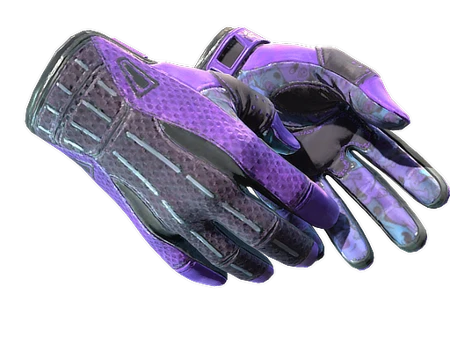
have skinned gloves
associated with skinned gloves²
² From the supplied glove report’s time field: first-to-last tracked player spans, summed across players. These spans include time when a player is not the observed camera or their hands are not visible; they are not measured screen exposure. Glove and inspect hours overlap and must not be added. Glove records ↗
Different winners.
The same showcase.
Select a Major. Follow the teams, the recorded matches and the skins behind the event-level totals.
The emblem on each selector identifies that Major’s champion. Team artwork is taken from in-game tournament stickers.
The showcase is
part of the system.
This is not an unrelated fashion show. It is Counter-Strike’s most prestigious competition, supported by the company that creates the items and controls their Steam inventory and transfer infrastructure.
Professional competition and the players fans follow.
The finish, knife and gloves become part of a player’s on-screen identity.
Our argument: admired players turn visible items into desirable objects.
Steam supplies the item infrastructure. Price discovery and cash trading extend onto external venues.
Follow the market mechanics →The dataset measures professional use and inspect activity. The demand pathway above is the investigation’s interpretation of that exposure; it is not a measured sales-conversion rate.
Valve is inside the picture.
Valve’s first Major announcement explicitly linked its tournament prize fund to revenue from in-game items. Its Major rulebook sets requirements for organisers and includes the use of players’ likenesses in Counter-Strike-related media. The platform, competition and item economy are connected by design.
Valve’s prize-fund announcement ↗Valve’s Major rulebook ↗“You can play without skins” misses the issue.
The issue is the model of Counter-Strike presented at its highest level. Almost every recorded player–event group in this sample inspected a skinned item. The fact that a purchase is optional does not remove the economic pull of a stage filled with desirable, tradable objects.
That is why this chapter belongs beside the dossier’s price atlas, external-market evidence and authentication record: it shows the aspirational end of the same item economy.
The stage builds the aspiration.
The markets put a price on it.
Steam remains the infrastructure.
More than a
colour on a weapon.
The supplied valuation report attaches market asks to the observed loadouts. The average across its 395 priced player–Major records is $11,824.
The loadout layer records carried weapons beyond the Inspect button. All 396 player–Major records in this subset have at least one skinned weapon. The value panel uses the archive’s BUFF / CSFloat lowest-ask snapshot.
| Major | Series covered | Priced records | Average ask | Summed asks |
|---|---|---|---|---|
| Stockholm 2021 | 1 / 40 | 10 | $16,104 | $161,041 |
| Antwerp 2022 | 3 / 40 | 25 | $12,251 | $306,282 |
| Rio 2022 | 4 / 40 | 39 | $8,227 | $320,859 |
| Paris 2023 | 28 / 40 | 80 | $10,258 | $820,637 |
| Copenhagen 2024 | 37 / 40 | 80 | $11,863 | $949,008 |
| Shanghai 2024 | 22 / 40 | 78 | $14,115 | $1,101,000 |
| Austin 2025 | 27 / 40 | 83 | $12,190 | $1,011,806 |
Supplied valuation, not current prices or completed sales. Repeated players, item changes and borrowed items may be represented; this is not a census of uniquely owned inventories. Premiums for stickers, StatTrak, Souvenir status or provenance are not included. Full valuation CSV ↗
From the headline
to the individual row.
One row per nickname–Major group; inspect time includes default and skinned weapons.
No records match this search.
The evidence behind
the display.
The archive brings the observations together: match links, per-map inspect records, glove and loadout layers, market listings and the parser source.
What is in the sample?
Seven Majors, Stockholm 2021 to Austin 2025. The manifest contains 40 match series per event: the final 16-team Swiss stage (Legends / Elimination / Stage 3) and the playoffs, including the grand final. There are 491 mapped inspect CSVs. Earlier stages and qualifiers are outside this manifest.
What do the percentages count?
“With a skin” means a nickname–event group has at least one inspect record on a skinnable weapon with a nonzero paint kit. The dataset has 559 such groups, not 559 unique people. “Default-only” refers to those inspect records, not an assertion about every item a player owns. The full carried-loadout layer is a separate 122-series subset.
Inspect time, glove time and screen time
Inspect hours are sums of button-state intervals for all players. Multiple players can inspect at once. CS:GO and CS2 record the action differently; do not interpret the drop in CS2 duration as a corresponding reduction in visible skins. Glove hours come from first-to-last tracked spans and are not clipped to active play or the broadcast camera. These two time measures overlap.
Broadcast exposure would require the selected spectator camera and frame-by-frame visibility. Pixel coverage would additionally require masks for the item and hands. Neither measurement is present in this archive. The figures here are player-time measures, not audience-hours or a percentage of screen pixels.
Sources, artwork and video
Match and demo links: HLTV, from the supplied manifest. Skin records and reports: PhishDestroy’s supplied Major archive. Item names and catalogue artwork: the included skins_db.json; team emblems: tournament-sticker artwork from Steam, resolved through ByMykel’s item catalogue. Team and item names belong to their respective owners; their inclusion identifies the evidence.
Inspect example: Code Diavolo, Butterfly Knife Fade, 28 March 2023. The player loads only after a click. It illustrates the mechanic and is not presented as footage from a sampled match.
Data pack SHA-256 0d92ad7c8e95a66f071f49b3c75a8706a5ff0b8e92572fc2ec5c494b38624051
Data pack excludes credentials and compiled executables. Original game demos are linked through the match manifest, not included. Publication: 5 October 2026.