Conditional permission.
Betting sponsorship messages are acceptable with a licence valid for the targeted territories, or a foreign licence explicitly permitted there. Official-language feeds without geoblocking also determine targeting.
FOLLOW THE BOUNDARY VALVE ENFORCES.
Which businesses were permitted, which were prohibited, and from what date?
This chapter follows the sponsor agreements, Valve’s published licence and its protection of cosmetic exclusivity. Seven Majors supply the measured record: 948,232 of 960,770 weapon-inspect records (98.70%) show a non-default skin, and 557 of 559 player–Major records include at least one skinned inspect — two default-only records across seven events. The complete dataset, player files and the data explorer remain in PhishDestroy’s original investigation.
VALVE’S OWN FUNDING ANNOUNCEMENT
In September 2013, Valve announced a $250,000 DreamHack prize pool supported by a portion of in-game item sales. Its own announcement links appearance purchases to the competition, and the seven-Major record shows the professionals on that stage inspecting non-default skins in 98.70% of 960,770 recorded inspect inputs. The relevant economic question is what users pay to obtain that appearance, including paid random outcomes and resale; the New York complaint expressly addresses items with no gameplay effect. Cosmetic describes the function of the reward; it does not settle the commercial or legal question raised by the transaction. Read the original research ↗
The event record keeps both denominators: skinned inspect records over all recorded inspect inputs, per Major. An inspect input — commonly the F key — turns the weapon into an object to look at; the totals below measure that act across 491 maps and 280 series, with a total recorded inspect duration of 733,185.415 seconds ≈ 203.66 player-hours.
| Major | Skinned / total inspect records | Share |
|---|---|---|
| Stockholm | 101,221 / 102,683 | 98.58% |
| Antwerp | 105,494 / 106,006 | 99.52% |
| Rio | 134,474 / 136,221 | 98.72% |
| Paris | 104,496 / 106,224 | 98.37% |
| Copenhagen | 154,139 / 155,740 | 98.97% |
| Shanghai | 155,810 / 160,544 | 97.05% |
| Austin | 192,598 / 193,352 | 99.61% |
| Seven-Major total | 948,232 / 960,770 | 98.70% |
| Player–Major records | 557 / 559 | two default-only (0.36%) |
557 of 559 player–Major records include at least one skinned inspect. Event totals independently summed from the author’s published CSVs; CS:GO and CS2 duration encodings differ.
The complete dataset, player files and the data explorer remain in PhishDestroy’s original investigation. Open the original Major investigation ↗
THE PUBLIC CLAIM AGAINST THE LICENSE
Valve’s March 2026 response presents a broad prohibition on gambling-related tournament participation and sponsorship. The publicly available licence contains a more specific boundary. Before the 08 DEC 2025 §2.4(e) obligation, the same licence permitted betting operators conditionally under §2.4(d) — the question “what was before the ban” has a documented answer in Valve’s own licence history.
Betting sponsorship messages are acceptable with a licence valid for the targeted territories, or a foreign licence explicitly permitted there. Official-language feeds without geoblocking also determine targeting.
The licence excludes sponsorship dependent on Valve’s game economies or violating its agreements, including case-opening, skin-trading and inventory-related businesses.
These clauses cannot be described as a single ban on all betting businesses.
Valve’s Git commit 8594dc0 records the addition of an express §2.4(e) obligation for ranked and unranked tournament operators. This is a dated change to the Tournament Operation Requirements. The underlying licence version and each event’s application deadline belong beside it.
The applicable TOR version is tied to each event’s Additional Information deadline. Valve and each organiser hold the dated licence, the event deadline and any exception granted; Valve should publish them so its March 2026 broad-prohibition claim can be tested against the contracts it actually approved.
ANNOUNCED COMMERCIAL RELATIONSHIPS
DOCUMENTED POLICY RECORDS
TOR adds the §2.4(e) obligation.
Valve states a broad gambling-sponsorship prohibition.
The announced betting partnership spans the rule-change period. The legal question is which sponsor category each rule covers and when that rule applies—not whether every betting business was prohibited.
The table records the announced sponsor relationship and its surface. A team booth, an event contract and a series partnership are separate arrangements.
Exclusive betting partnership, confirmed retrospectively in PGL’s 4 April 2022 announcement.
PGL announces broadcast support, live odds and bookmaker offers; also covers the Bucharest RMR.
BLAST announces a global partnership including the Major, with broadcast integration and event branding.
Operator announces jersey branding and a slot-machine-themed activation at G2’s Major booth.
Broadcast betting odds, predictions and physical/digital branding. This series deal is distinct from a Major contract.
PGL names its betting partner for the first CS2 Major and describes media and financial support.
PGL announces a two-year global betting partnership, advertising placements and broadcast rights.
For Stockholm, Antwerp, Paris and Copenhagen, Valve, PGL and BLAST hold the sponsor’s contracting entity, the dated event licence, each broadcast language and target territory, and the applicable national advertising permissions. They should publish those records together with the licence versions Valve enforced. The dated announcements are themselves the primary record of each sponsorship; the licence conditions behind them are held by Valve and the organisers, not by this page. Whether related brands share contracting entities or beneficial owners is a record PGL, BLAST and the bookmakers hold; they should disclose it with each announced partnership.
The announcements establish commercial integration around the tournaments. They do not disclose Valve’s approval of each agreement. That approval and supervision trail is exactly the record this investigation calls for.
PGL’s historical press URLs currently redirect to its news index. The cited releases and dates were retrieved from indexed copies of PGL’s own announcements on 10 October 2026. BLAST’s 2024 page separately corroborates GG.BET’s Stockholm and Antwerp partnerships.
Publish the boundary you actually enforced. Which sponsorships were permitted, refused or ended; who reviewed them; under which dated clause; in which territories? The account-ban total answers none of these questions.
THE ENFORCEMENT OF APPEARANCE
Its server guidelines prohibit simulated unowned items, expressly including appearances visible only to the player. Valve records permanent GSLT restrictions in January 2016 for noncompliant server operators.
“Yes. Regardless of who can see the items, mods should not generate/simulate items that are not owned by a player.”
Valve’s answer to question 2 about visibility in server mods.
The published, redacted letter bears Melling, Voitishkin & Partners’ name and says it represents Valve. It asserts rights in software, trademarks and the appearance of weapons, knives and gloves, demanding cessation and warning of compensation claims and referral to law enforcement.
Touch Skins’ own website states that it received a demand from Valve’s representatives in Russia and decided to close its site and software. The redacted letter hides the addressee; the project’s statement separately establishes the closure.
The record consists of the published pre-litigation demand and the recipient project’s account of closing its site and software. Together, they document the legal pressure used to protect control over cosmetic appearance.
Valve treats access to appearance as something worth enforcing. That choice belongs beside its claim that cosmetic items impose no gameplay disadvantage. A person unable to afford a coveted look can still face the boundary protecting its exclusivity.
Touch Skins is one documented case, not the whole record. A server-side cosmetic substitution (a mod showing an unowned skin to one player) and a client intervention changing what the game itself renders are different acts with different legal weight — Valve answers the first with a GSLT ban and the second with a lawyer’s letter. Publish every demand letter sent to skinchanger services, every closure, and the distinction Valve itself applies between the two.
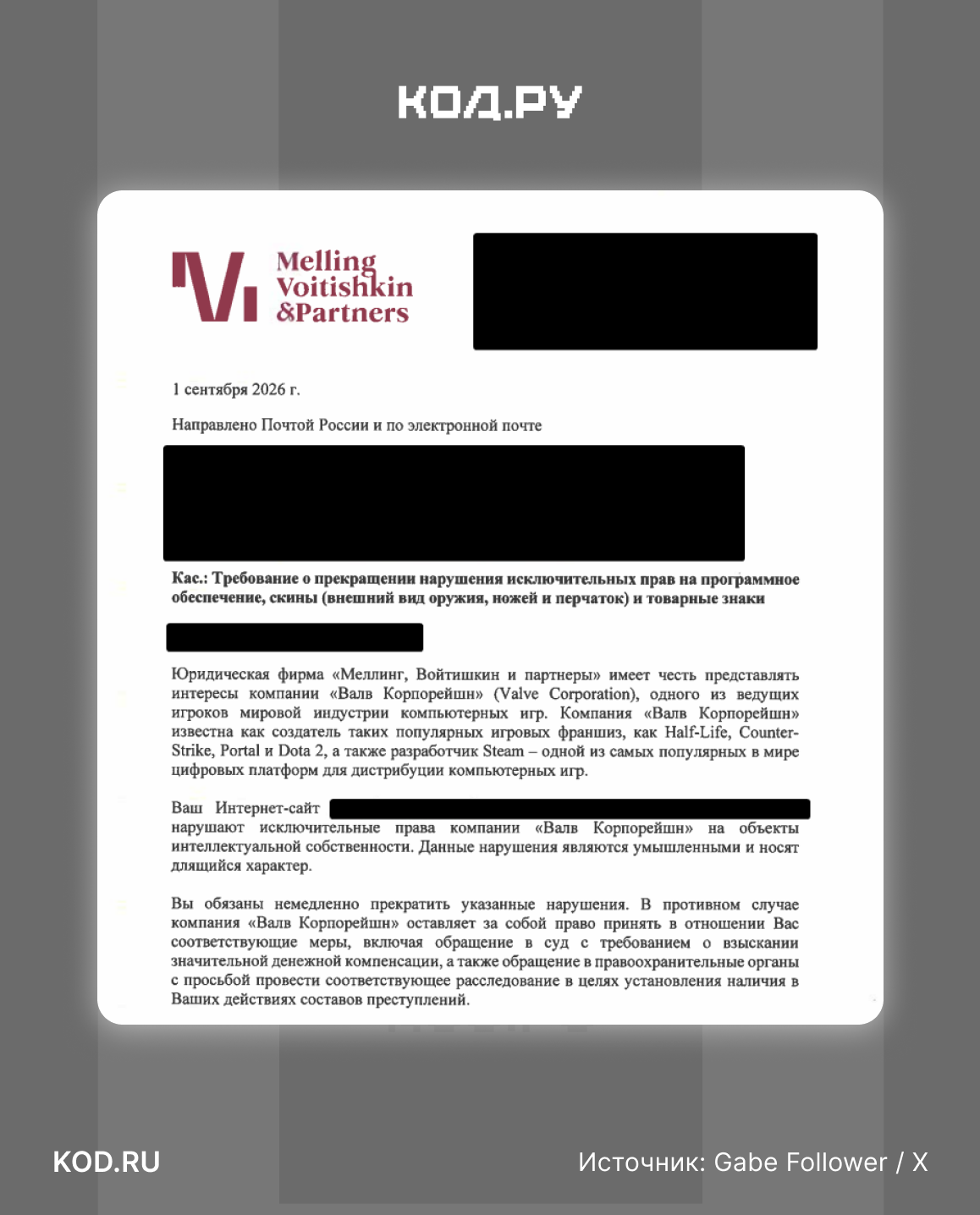
The archived image names weapons, knives and gloves in the demand. It threatens compensation proceedings and referral to law enforcement. Valve’s representatives assert commercial control over the appearance that its public defence calls cosmetic.
Published redacted image credited by KOD.RU to Gabe Follower / X. Original image restored from the supplied archive, unchanged.
Open the original letter at full size ↗THE PUBLIC RECORD
Sources cited in this article appear first. Select “All records” to inspect the complete 107-record register shared by the investigation; the dedicated evidence files retain their own detailed registers.
No matching records. Try a different term or select “All records”.
Reviewed 10 October 2026. Major percentages are recalculated from the author’s published CSVs, with both event and player denominators retained. Sponsor entries identify the announcing organisation and date. Legal correspondence is attributed to the published copy and the project’s separate statement.
Measured inspect use, commercial interpretation, announced sponsorship and enforcement outcomes are distinguished at the point of each finding. The complete twelve-case series and the original seven-Major investigation remain available through the navigation.
The data Valve already holds, regional controls and payment decisions.
