INVESTIGATION BY AGENT VICTORCASE FILE 04 / 11 OCTOBER 2026
EVIDENCE FILE 02 / THE ECONOMICS OF DEPENDENCE OWNERSHIP, GAMBLING & PLATFORM CONTROL10 OCT 2026 • WORKING PAPER
THE GAMBLING SYSTEM
The skin moves. The platform decides.
A direct transfer still runs through someone else’s rules.
Follow the complete exchange: the customer supplies the skin, Steam records the transfer and an outside service assigns value and releases its own balance. This file traces those dependencies and the economic effect of account restrictions. The case against Valve’s public defence and enforcement record is developed in the main investigation.
The participant’s Steam inventory holds the delivery asset.
VALVEPermits the transfer.
Steam records item transfers and applies account restrictions.
THE OUTSIDE SERVICERecognises the return.
Its ledger sets valuation, balance availability and settlement.
01
THE MECHANISM
Follow the whole transaction.
INTERACTIVE EXPLAINER
CSGORoll ↗ illustrates how another operator adds its own rules to Valve’s item system. It offers Roll, Case Opening, Case Battles, Dice and Plinko, and announced a G2 esports partnership in May 2023 that included jersey branding and a branded slot machine at the team’s Major booth. The skin exchange supports this commercial service: Steam delivers the item while Roll records the return in its own balance.
A skin-for-coins exchange spans two records: the item movement on Steam and the balance recorded by the operator. Walk through the points where the platform’s decisions matter.
FIG. 02 / TWO RECORDS, ONE EXCHANGE
Skin deliveryPlatform decisions & recordsConceptual reconstruction · no live account data
01 / VALUATION
The operator supplies the accounting value.
CSGORoll’s FAQ attributes its Coin Calculation to an automated system and manual review. The platform’s unit of account frames the exchange.
THE DISTINCTION
The Steam transfer does not carry the coin credit. The return is recorded in the platform’s ledger.
From listing to usable coins: the complete commercial sequence+
List the skin. The platform records an available item and a coin valuation while delivery remains a later Steam action.
Match the request. Another platform user requests the skin against their internal balance. The operator coordinates the pending transaction.
Send the Steam offer. The sender follows the platform’s instructions and Steam’s confirmation process.
Recognise delivery. The documented token or manual-verification route supplies the completion decision.
Apply the balance rules. The operator credits or releases coins under its protection and eligibility conditions.
Enforce failures and reversals. Disputes, cancellations and penalties are handled through the platform’s rules and support process.
The receiver’s coin debit and the sender’s coin credit are recorded by the operator; Steam records the skin transfer.
02
THE VALUE PARADOX
Internal currency still has an acquisition cost
The balance is called virtual. The exchange is priced.
A user gives up something to acquire a balance, then uses that balance to obtain an item. The investigation follows that exchange of value and asks who defines each conversion.
The user sends a skin through Steam. The return is recorded separately as conditional credit in the platform’s ledger. The platform determines when that balance becomes usable and the rules for using it.
ANALYSIS Economic dependence does not require physical custody of the skin.
THE OPERATOR’S OWN DOCUMENTS03 RECORDS
A
MONEY ENTERS
Money → Roll Coins
The terms describe purchases using money or cryptocurrency at operator-displayed rates.
B
VALUE IS ASSIGNED
A platform calculation
The FAQ describes automated coin valuation with staff verification.
C
DELIVERY HAS CONDITIONS
Cost-based substitution
The trading policy permits equivalent-cost substitutions after exceptional price movements.
THE PLATFORM’S UNITS OF ACCOUNT
Roll Coins, CSGR Skins and promotional Roll Chips have different terms. In particular, the terms describe conditional cryptocurrency redemption for eligible Roll Chips. The ordinary coin balance remains usable on the operator’s terms.
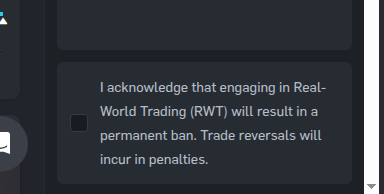
EXHIBIT A / SUBMITTED IMAGE
Original crop · date and origin unverified
THE EXIT RULE
The asset can move. The rules follow the user.
The supplied warning asks the user to acknowledge a permanent ban for real-world trading and penalties for reversals.
Separately, CSGORoll’s published trading policy restricts off-site cash exchanges and permits account sanctions. The practical power is over participation in its economy.
JULY 2025 / CONTROL OVER REVERSALS
The same transfer can remain subject to a reversal window.
Steam’s Trade Protection feature allows eligible recent CS2 trades to be reversed within seven days and imposes a 30-day trading and Market cooldown on the account initiating the reversal. CSGORoll’s corresponding update ties coin availability, instant-credit tiers and penalties to that protection window. The item transfer and the platform’s spendable balance run on different rules and clocks.
THE VALUE OUTSIDE THE WALLET
The expensive end of the economy moves outside Steam’s market.
≈ $1,800Steam Market listing ceiling
248CS2 categories above it in the dossier’s snapshot
$10,941Lowest Factory New Dragon Lore listing in that snapshot
The dossier’s 23 September 2026 comparison across five outside markets records prices above Steam’s own venue limit. Those prices are offered outside Steam; the items still move through Steam accounts. The transfer infrastructure connects a restricted Wallet economy to a wider cash-priced market. A Steam Community Market transaction carries a combined fee of roughly 15% — the game fee plus the Steam fee.
The outside price does not free the item from Steam. It brings another service into a transfer that still needs Valve’s permission. CSGORoll provides a concrete example: the transaction above follows the skin through Steam and the corresponding return through a separate platform ledger.
The useful test is a decision-by-decision audit. A user’s involvement in sending an item tells us little about who governs the surrounding service.
Allocation of control in the documented CSGORoll exchange
Decision
User’s role
Controlling layer
Record
01Coin valuation
Choose whether to participate
Platform calculation
02Item delivery
Send or accept a Steam offer
Users, within Steam’s rules
03Verification & disputes
Provide a response or evidence
Operator workflow & support
04Credit availability
Rely on the settlement outcome
Platform release rules
05Trade cancellation
Request an explanation
Operator discretion
06Steam access
Maintain an eligible account
Valve’s infrastructure & terms
A COMPLETION RULE WRITTEN BY THE OPERATOR
Ten minutes of silence can become a completed trade.
In its October 2024 manual workflow, CSGORoll watches for the item to leave the sender’s inventory. The receiver then confirms receipt or disputes it. After ten minutes without a response, the system assumes delivery and completes the trade. A dispute can be routed through the user’s token or the operator’s support team. The same policy sets escalating cooldowns and, for some receiver offences, deductions based on the trade’s value.
The seller-side rule is written in the same workflow. If the seller cancels the trade or lets it expire, the workflow records the Canceled or Declined status: the buyer’s coins are unfrozen and returned, and the seller’s account collects penalty points or a temporary P2P ban. The platform publishes the punishment schedule for a failed delivery — while asking Valve to believe the same delivery cannot be policed.
This is the platform’s authority in concrete form: its timer, its accepted evidence and its penalty schedule decide the accounting result. The two users do not negotiate those rules with each other.
Control map reconstructed from the policies and dated technical records linked above.
Removing the inventory bot does not remove the intermediary.
After the 29 March 2018 seven-day trade cooldown, operators moved from inventory bots to P2P; the intermediary stayed and changed shape.
04
THE ECONOMIC EFFECT OF ACCOUNT RESTRICTIONS
Who bears the loss. Who keeps the business.
The enforcement claim is examined in the main Valve investigation. This record follows the economic result: inventory permissions, outside balances and the service that coordinates the exchange.
FOLLOW THE LOSS / FOLLOW THE BUSINESS
The casino’s balance sheet is bigger than a Steam inventory.
CSGORoll’s terms provide for purchases with money or cryptocurrency. Its game rules explicitly describe house edges and probability-based payout multipliers. The operator’s economic mechanism combines funding, priced play and an internal ledger; skin delivery connects that mechanism to Steam.
What an account-level inventory restriction acts on
Layer
What the restriction can immobilise
What remains outside that account
The participant
The skins in the restricted inventory and the ability to move their value through a trade.
The participant has to seek a remedy from the platform controlling access.
The outside operator
A delivery route or the items on a particular account.
Its money or cryptocurrency holdings, internal balance records, game rules, pricing system and website.
Valve
The user’s permission to participate in Steam transfers.
Control of the item records, account restrictions and the wider Steam economy.
That is the asymmetry this investigation identifies: a user can lose the economic use of the skin while the operator retains the machinery that earns from play and Valve retains the machinery that controls the item. A ban count measures the account action. To measure its effect on gambling, follow the operator’s continued access, settlement and business.
PAYMENTS & ENFORCEMENT / NEW EVIDENCE FILE
10,712,351 “Users”. Over one million accounts locked.
Inspect the CSGOFast counter alongside Valve’s account total, the missing classification, real payment routes and the difference between locking an inventory and disabling an operator.
Valve combines these categories in one account total. The published number does not show the value of stranded inventories, which account holders lost access, or the outcome of their challenges. These are the human and economic consequences hidden behind the total.
THE COMMERCIAL RESULT
Crypto. Ledger. House edge.
An inventory restriction does not itself seize the outside operator’s cryptocurrency or switch off its game mathematics. The relevant test is whether the commercial service still accepts value and settles balances after the user-facing action.
SCARCITY / A PUBLISHED ECONOMIC JUSTIFICATION
Valve invokes value when refusing restoration.
Its restoration policy says duplication can reduce other items’ value. The later Trade Protection system returns originals in eligible CS2 trades. Together they put the choice of remedy under scrutiny: economic value is recognised when restricting restoration, and technical reversal exists within a scope Valve defines.
An inventory restriction reduces the affected holder’s ability to supply items through the blocked route. Valve holds the inventory, price and sales records for the market it operates: it should publish what the million-plus account locks did to item prices, case purchases and the inventories frozen in place. The structural finding is concrete: the issuer controls scarcity rules, monetisation and remedies within the same economy.
Valve’s physical-collectible analogy omits the issuer’s continuing authority over the item. The commercial workflows in this investigation show the consequences of that omission.
THE CONTROL THAT THE LABEL HIDES
A physical collector can retain the object independently of the original seller. A Steam user relies on Valve’s records and transfer permissions. When an outside casino is involved, the user also relies on that operator to recognise delivery and release its own credit. Each layer retains a power the customer needs in order to realise the item’s value.
“P2P” describes the direct delivery of the skin; C2C describes the trade between customers. Neither label removes the central ledger, account restrictions or credential requirements documented here. Presenting the system through the independence of physical ownership conceals precisely the dependency that becomes decisive in a dispute.
RECORDS CSGOROLL MUST DISCLOSE
01Pricing inputs and manual valuation overrides.
02The event log linking a Steam trade to a coin credit.
03Token scopes, retention and server-side access records.
04Criteria for cancellations, sanctions and appeals.
06
THE PUBLIC RECORD
Inspect the evidence.
15 RECORDS
Sources cited in this article appear first. Select “All records” to inspect the complete 107-record register shared by the investigation; the dedicated evidence files retain their own detailed registers.
No matching records. Try a different term or select “All records”.
Methodology & source notes+
Research date: 10 October 2026. This chapter reconstructs skin delivery, valuation, verification, coin release and account restrictions from the operator’s dated trading policies and Steam’s published rules. The supplied RWT warning remains available as original exhibit E12 in the shared source register.
The control tables distinguish the Steam item record from the operator’s ledger. The legal-response analysis is retained in Valve and enforcement; the dated credential and Link Filter records are retained in Steam access.