VirusTotal
13 / 93 engine detections
Retrieved / checked:
Open report 
PhishDestroy first recorded darkluck.one on 2026-02-27. Stored VirusTotal result: 13/93 engines flagged.
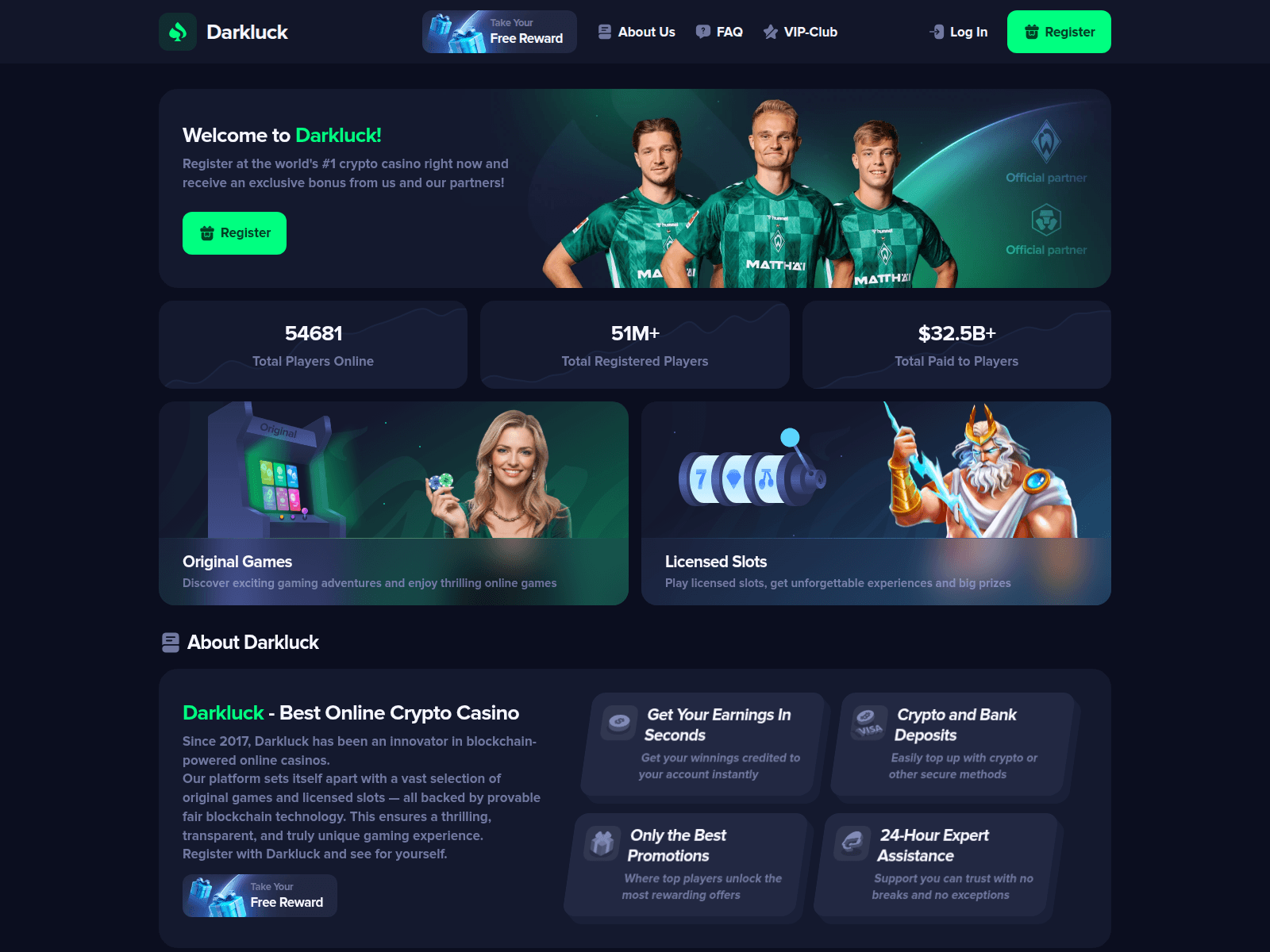
Page title: “Darkluck: Most Popular Online Crypto Casino Based on Blockchain”
Stored VirusTotal result: 13/93 engines flagged. Use caution — do not enter credentials or personal information.
 NameSilo172.67.195.103Cloudflare, Inc. · CDN
Risk score, higher = worse · How this score works
Pick what happened and tick the steps as you go. The ticks are kept only in this browser.
Expert view has every section: DNS, TLS, network requests, hashes and the raw JSON.
PhishDestroy first recorded darkluck.one on 2026-02-27. Stored VirusTotal result: 13/93 engines flagged. Risk: critical (evidence score 89/100). Registrar: NameSilo. Status: Content unavailable. Hosting: Cloudflare, Inc. PhishDestroy sent 1 abuse report. Do not enter credentials or connect a wallet.
172.67.195.103Cloudflare, Inc. · CDNNameSiloPhishDestroy analysis, earlier unreviewed version
The domain darkluck.one poses a significant threat as a brand impersonation of a crypto casino. It is designed to mislead users into believing they are engaging with a legitimate platform in the online gambling sector. Such domains are often utilized to harvest sensitive personal and financial information from unsuspecting users, thereby increasing the risk of identity theft and financial fraud.
Evidence of the domain's malicious intent is shown by its presence on one security blocklist and the high detection rate on VirusTotal, where it was flagged by 13 out of 95 security vendors. The domain was registered through NameSilo, LLC on February 26, 2026, positioning it as a relatively new entity within the online landscape, and demonstrating the persistence of brand impersonation tactics. The domain currently resolves to the IP address 172.67.195.103 and has been blocked by PhishDestroy, indicating that security measures are being taken against this fraudulent site.
Users who may have visited darkluck.one should take immediate action to secure their information. It is recommended that they monitor their financial accounts for any unauthorized activity and change passwords for platforms they suspect may have been compromised. Additionally, users should consider enabling two-factor authentication wherever possible and remain vigilant about potential phishing attempts in the future.
13 / 93 engine detections
Malicious
Open reportSeparate stored monitor snapshot; does not replace the primary report record or establish current availability.
Scan report
Open reportObserved: · Retrieved:
| UUID | 1ef2e398-bca3-4edc-8036-c62aad2ea724 |
|---|
63 / 100 · heuristic score · 1 brand reference · 1 classification
Content heuristic only; not the final score
Open reportThis dated monitor analysis is separate from the primary PhishDestroy analysis above. A heuristic score is not a measured probability.
Narrative generation metadata
Open reportThe narrative generation date is separate from observation dates. These are the retained publication fields, not an additional independent detection.
Results reflect each source’s collection time. Zero detections do not guarantee safety. OTX references are community publications.
Stored page, network and scanner observations, grouped by source and observation time.
PhishDestroy rates darkluck.one as critical risk (evidence score 89/100) from the recorded evidence; it was first recorded on 2026-02-27. Stored VirusTotal result: 13/93 engines flagged. The local score and a listing do not prove fraud. Check each source’s date and the exact URL.
Because of the risk signals above, do not connect a wallet, sign messages or approve token permissions on darkluck.one. A confirmed blockchain transaction cannot be reversed.
Keep the address, dates, payment or transaction details and messages for a report to the police or another competent authority. A report does not guarantee that money is returned. Step-by-step help: emergency guide.
9a4559b6c926122c283dfe14bfd026e1b83b40d4b671bb5a927e0c524978738e · 499688 bytes 34ae20309d166e457ca4808a31365158995da61f4e4415a945ca9e5fb28c0ced · 96222 bytes 53525d5024a348daa99e0fa21abfd0fa237d15085f9b7708cc8ca30ee204e390 · 94970 bytes c232755d723087d77e3cab7501a360a92a650b0d89b48d410dfd2f98e4d9a68f · 114483 bytes ddc5ddc3a7ed13739a13d50eb39507fd87ad4eba58ed4f7f3f78f048b4ef4f58 · 115184 bytes 52df300b319378a1cce0836a21adf20a5a935b23fd451c81c48fca4d29e665fc · 114465 bytes bc0ab205f5f7b4b53ce7a366eeb16a795aee54c6def3c0c5c8c82cb4e28410a8 · 119278 bytes  172.67.195.103 Cloudflare shared edge origin IP hidden Edge-IP reputation is not attributed to this domain. (US) PhishDestroy Investigation
For this gTLD, the registrar above operates under an ICANN accreditation agreement. The links below provide the official fee schedule and current DNS abuse compliance guidance.
RAA §3.18 establishes abuse-contact and handling requirements. This report can document stored outbound notices and later technical observations; it does not by itself establish receipt, investigation, remediation, or contractual non-compliance.
172.67.195.103San Francisco, USEdge-IP reputation is not attributed to this domain.
mona.ns.cloudflare.comwesley.ns.cloudflare.comLocation describes the IP network.
darkluck.one*.darkluck.oneSaved certificate metadata. Certificate dates without a timezone are shown as stored. Transport encryption does not establish that the site is trustworthy.
The domain no longer resolves in DNS.
An estimated time describes an observation window. It does not prove a registrar action or the exact moment a site became unavailable.
Network requests: 72 SHA-256 hashes: 72 URLScan scan:
Network requests that the URLScan browser recorded while loading the page. URLScan does not provide a hash for every request. PhishDestroy retrieved this list on 2026-10-29 05:34 UTC.
Open this scan on URLScan 019c9bf9-e410-70d2-a9ee-b73fb877388f ↗
Loads saved data; the suspicious site is not opened.
| # | Network request | HTTP method · status | Type | Uncompressed size | Response body SHA-256 |
|---|
Compare what a browser and a crawler receive, and check for Keitaro traffic routing.
The site did not answer our scanner (host unreachable).
darkluck.one Source: domain_monitor. This stored snapshot does not establish current availability.
Recorded events: 15. These records describe collected evidence, outgoing notifications and publication; they do not confirm a complete investigation or a takedown.
Lifecycle
Reported 11 d 15 h after registration
We scan suspicious URLs, inspect public results and send evidence through the appropriate abuse-reporting channels. The dated events above show what is recorded for this domain. The directory below explains the wider workflow.
Capture the rendered page, requests and visible infrastructure.
Compare the available engine results and retain the analysis timestamp.
Check whether Google currently lists the URL as unsafe.
Inspect a public scan and its recorded network and classification data.
Look for indicator references and related community intelligence.
Compare archived captures and preserve historical context.
Look for matching indicators and associated threat records.
Inspect certificate records and related hostnames.
Compare security resolver responses and record observed blocking.
Inspect the public DNS, TLS, HTTP and technology surface.
Security services used for scanning, reputation checks and reporting are listed below. A service being listed is not evidence that it received, accepted or acted on this particular domain. Recorded submissions appear in the notification history above.
 GoogleSafe Browsing↗ GoogleWeb Risk↗
 MicrosoftSmartScreen↗
 VirusTotalURL analysis↗
 CloudflareRadar / abuse reporting↗
 YandexSafe Browsing↗
 URLScan.ioPublic scan↗
 ESETSample / URL submission↗
 BitdefenderURL submission↗
 NortonSafe Web↗
 SymantecSiteReview↗
 AviraURL reporting↗
 Avast / AVGURL reporting↗
 KasperskyOpenTIP↗
 Dr.WebOnline scanner↗
 NetcraftAbuse reporting↗
 PhishTankCommunity reporting↗
 APWG eCXPhishing intelligence↗
 PhishStatsPublic feed↗
 Phish.ReportHosting abuse↗
 SpamhausDomain reputation↗
 PolySwarmMulti-engine analysis↗
 CheckPhishURL scan↗
 QutteraMalware scan↗
 URLqueryBrowser analysis↗
 Criminal IPAsset intelligence↗
 CRDFThreat Center↗
 ScamadviserReputation check↗
 MyWOTCommunity reputation↗
Browse this domain’s complete history by source. The download includes every record of the selected source. Dates retain their original field labels.
Download all records as JSON| ID | Stored data |
|---|
Same favicon Supporting signal 4
Similar title Supporting signal 1
Kit: Gambler Scam Direct link 8
Registrar: NameSilo Discovery only 6
Each spoke is one reason a domain is linked to this report. Node size marks VirusTotal detections, dashed nodes are already offline, and the full lists follow below. Full list of related reports
Same favicon file hash, or a recorded page title that starts with the same 20 characters. A content match does not establish a shared phishing kit or owner.
Shared with 4 other domains
These reports carry the same identified kit name (Gambler Scam). A shared kit is not proof of a common operator or campaign. View all campaign domains →
Registered through the same registrar. A registrar serves millions of unrelated customers, so this groups reports rather than proving a link.
Recently added threat reports.
Reported by 1 community member, first seen 2026-02-26
PD-20260227-95FAB9 Recipient: admin-ari@namesilo.com Policy Violations: Illegal Activities: Active phishing operation targeting victims Fraud & Deception: Impersonation of legitimate services Identity Theft: Collection of credentials under false pretenses Applicable Laws (US): 18 U.S.C. § 1343 - Wire Fraud 18 U.S.C. § 1030 - Computer Fraud and Abuse Act (CFAA) 15 U.S.C. § 45 - FTC Act (Deceptive Practices) Federal laws prohibit wire fraud, computer fraud, and deceptive business practices. Action Required: This evidence-backed report demonstrates clear violations requiring suspension per your policies. Continued hosting exposes your organization to regulatory scrutiny and potential legal liability.
Act on what you actually did. Entered a password: change it, and wherever you reused it. Paid or gave card details: contact your bank or payment service. Downloaded a file: scan the device. Then report the incident.
The draft stays only with you.
First secure your money: call your bank or revoke wallet approvals. Immediate steps →



Emergency help from security researchers when a crypto wallet is being drained right now.

Report scams and fraud to the US Federal Trade Commission. Reports go into a database used by law enforcement.


Report cyber incidents and phishing to the US Cybersecurity and Infrastructure Security Agency.

Forward scam emails and text messages to the National Cyber Security Centre, which takes down the malicious sites it finds.
Emailreport@phishing.gov.uk Text messages7726
Directory of national incident response teams (CSIRTs) in the EU. Find the team for your country.

Forward phishing emails to the Anti-Phishing Working Group.
Emailreportphishing@apwg.org
National Cyber Crime Reporting Portal. For financial fraud, also call the 1930 helpline straight away.
Helpline1930


Choose the steps that match what you shared. Keep a copy of this report alongside your own records.
Stop using the suspicious site. Open the real service through its official app or an address you already trust.
Keep original emails, receipts, messages and screenshots in a secure place. A factual timeline helps the receiving authority understand what happened. IC3 evidence guidance ↗
darkluck.one)Even if you don't have all details — file a report anyway. Partial information still helps investigations.
A report is not a guarantee of recovery or investigation, but prompt, accurate transaction data can help authorities and service providers trace the incident.
Further guidance: NIST · phishing responseFBI IC3 · reports & evidenceFTC · recovery scams
Threat analysis using stored blocklist, WHOIS, DNS, and public scan evidence
Scan NowSubmit suspicious domains to our threat database — protect the community
ReportRecent phishing reports and observed availability changes
MonitorMonitor live threats or contest this listing if you believe it's a false positive
This report combines saved page captures, registration and network records, scanner results and PhishDestroy reporting history. Each source keeps its own observation date. Open a source report to inspect the original result.
The AI-assisted analysis was written on . It describes the evidence available at that time; later source checks can change.
A capture documents what was shown. A scanner result records that provider’s assessment at the time of its check. Neither a valid certificate nor a zero-detection result is a guarantee of safety.